Na₄O₁₈Si₆Sn₂
alkali silicate glass · structural translucent glassNa4O18Si6Sn2 is a alkali silicate glass suitable as structural translucent glass. Color: clear. Fired at 1150°C from 4 precursors (SiO2, SnO2, Na2CO3). Workshop batch: 400g at €5.43. Compressive strength ~500 MPa; estimated 0.84 kg CO₂/kg (-2% vs float glass). Notable: no special functions flagged. Confidence: high.
- forms at
- 1150 °C · high-fire
- replaces
- float glass
- CO₂
- 1.9% lower than float glass (0.84 vs 0.86 kg CO₂/kg)
- energy
- 62.5% lower than float glass (5.62 vs 15.00 MJ/kg)
- compressive
- 500 MPa
- density
- 3.06 g/cm³
- crystal
- trigonal
- band gap
- 3.66 eV
- cost
- €13.57/kg · €5.43 / 400 g batch
- confidence
- high (synthesis route)
- potential
- 0.64 · env 0.78 · novel 0.00 · struct 1.00 · lineage 0.70 · supply 1.00
Architectural potential
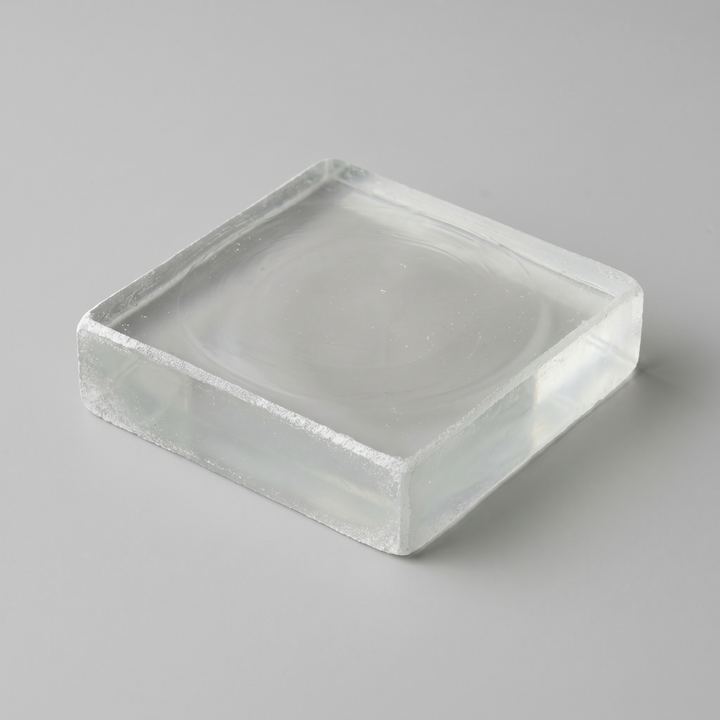
This is the atlas's cleanest structural-transparent glass: a soda-silicate body with tin-driven clarity, 500 MPa of compression and no colour filter to negotiate around. Natural placements are pressed-glass floor panels walked on from above in domestic and commercial staircase architecture, load-bearing stair treads in gallery and retail interiors where absolute transparency is the design brief, column-like light-admitting piers in atria and entrance lobbies, transparent partitions in laboratories and operating-theatre anterooms where colour neutrality is clinically required, and pressed-glass beams in pavilion and greenhouse architecture where the tectonic wants to read as disappeared mass. Against float glass the embodied CO₂ is level at minus two per cent, so the argument is not environmental; the real gain is the sixty-three-per-cent reduction in forming energy during the melt-and-press cycle, plus the tin-refined clarity that keeps the body free of the iron tint common to standard soda-lime panes. High confidence and perfect supply-chain and safety scores, making this the most specifiable glass in the batch. The caveat is edge work: at 85×85×45 mm the slab carries the usual annealing discipline of thick pressed glass, and corner chipping under load is the failure mode to design against.
Material character
The slab reads fully clear — no colour body, no tint — with the faint tin-driven brightness that distinguishes a soda-stannate glass from the iron-tinged standard float variant. At 3.06 g/cm³ and 85×85×45 mm the piece is the densest in the structural-translucent series, a step up in hand-feel from the Mn and Fe siblings for the same face area. Surface finishes pressed-glass with thin anneal striae visible at the mould seam; cold-cut edges carry the lapidary bloom. Light passes through the 45 mm depth with only the slightest brightening along the long edge where the tin-refined body catches the raking daylight. Against plain float this reads genuinely colourless.
Recipe
400 g batch · peak 1150 °C| element | precursor | formula | mass | safety |
|---|---|---|---|---|
| Na | sodium carbonate / soda ash | Na2CO3 | 24.26 g | safe |
| Si | quartz flour / silica | SiO2 | 41.25 g | safe |
| Sn | tin(IV) oxide | SnO2 | 34.49 g | safe |
- 1Ramp
- 2Hold
- 3Ramp
- 4Hold
- 5Ramp
- 6Hold