Al₁₂B₄Mn₄O₃₆Si₄
borosilicate glass · structural translucent advancedAl12B4Mn4O36Si4 is a borosilicate glass suitable as structural translucent advanced. Color: purple-brown. Fired at 1300°C from 4 precursors (Al2O3, MnO2, SiO2). Workshop batch: 200g at €3.08. Compressive strength ~500 MPa; estimated 1.01 kg CO₂/kg (+18% vs float glass). Notable: no special functions flagged. Confidence: medium.
- forms at
- 1300 °C · extreme-fire
- replaces
- float glass
- CO₂
- 18% higher than float glass (1.01 vs 0.86 kg CO₂/kg; 1.2× higher)
- energy
- 55.0% lower than float glass (6.75 vs 15.00 MJ/kg)
- compressive
- 500 MPa
- density
- 3.05 g/cm³
- crystal
- orthorhombic
- band gap
- —
- cost
- €15.40/kg · €3.08 / 200 g batch
- confidence
- medium (synthesis route)
- potential
- 0.57 · env 0.69 · novel 0.00 · struct 1.00 · lineage 0.80 · supply 0.60
Architectural potential
A manganese-aluminium borosilicate fired at an extreme 1300 °C that reaches 500 megapascals of compression and carries a distinct purple-brown body colour rather than tinted clarity. This is translucent-mass territory rather than sheet-glass territory: monolithic light-admitting columns in public interiors, dense translucent piers in crematoria and bath-house thresholds, structural skylight plinths in exhibition architecture where the design calls for coloured translucent mass instead of clear window. The aluminium-boron matrix raises thermal stability above conventional float glass, so this body tolerates heat cycling at skylight and thermally-loaded-pier conditions where ordinary window glass would creep or haze. Against float glass the embodied CO₂ is eighteen per cent higher but the firing energy drops fifty-five per cent, so the trade is weighted toward energy rather than carbon — the signature-element register applies, not bulk glazing. Natural placements are gallery piers, light-wells in heavy masonry atria, and monolithic translucent beams where coloured light is the architectural argument. The caveat is dual: the 1300 °C firing peak is genuinely extreme and limits production to specialist kilns, and workshop batches cap at 500 g, so specification sits firmly in the one-off translucent element — signature piers and thresholds, never continuous envelope.
Material character
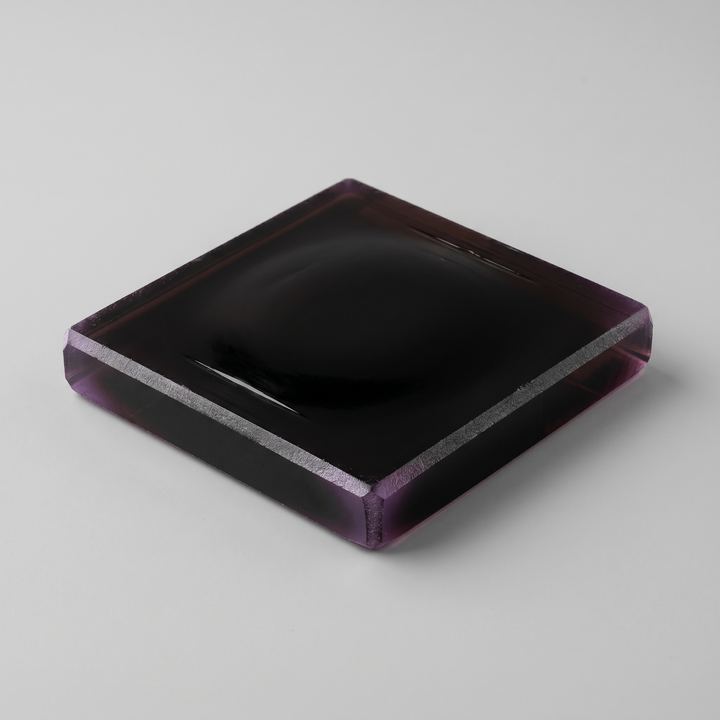
A saturated purple-brown body that reads warm and slightly clouded through the 45 mm depth of the 85×85×45 mm slab — less clear than a standard borosilicate and more coloured than the gadolinium-praseodymium variant in the same family. At 3.05 g/cm³ the weight is moderate: firms single-handed, sits stably on the bench. Surface carries pressed-glass register with a low convex crown and a fine trace of anneal striae; edges come cold-cut with lapidary kerf bloom. Manganese drives the colour deepest at the long-edge sighting, where the body reads almost mahogany under room light. Against a simple borosilicate window-glass sibling the body weight is comparable but the colour saturation and reduced clarity separate it decisively.
Recipe
200 g batch · peak 1300 °C| element | precursor | formula | mass | safety |
|---|---|---|---|---|
| Al | calcined alumina | Al2O3 | 45.69 g | safe |
| B | boron oxide (or borax Na2B4O7) | B2O3 | 10.4 g | safe |
| Mn | manganese dioxide | MnO2 | 25.97 g | moderate |
| Si | quartz flour / silica | SiO2 | 17.95 g | safe |
- 1Ramp
- 2Hold
- 3Ramp
- 4Hold
- 5Ramp
- 6Hold