Fe₂O₁₂Sr₄WZr
heavy oxide ceramic · thermal mass ceramicFe2O12Sr4W1Zr1 is a heavy oxide ceramic suitable as thermal mass ceramic. Color: amber-brown. Fired at 1250°C from 4 precursors (SrCO3, WO3, Fe2O3). Workshop batch: 200g at €23.86. Compressive strength ~300 MPa; estimated 0.94 kg CO₂/kg (+326% vs clay brick). Notable: electrochromic tungstate, magnetic ferrite, visible absorber. Confidence: medium.
- forms at
- 1250 °C · high-fire
- replaces
- clay brick
- CO₂
- 326% higher than clay brick (0.94 vs 0.22 kg CO₂/kg; 4.3× higher)
- energy
- 108% higher than clay brick (6.25 vs 3.00 MJ/kg; 2.1× higher)
- compressive
- 300 MPa
- density
- 5.85 g/cm³
- crystal
- triclinic
- band gap
- 2.07 eV
- cost
- €119.30/kg · €23.86 / 200 g batch
- confidence
- medium (synthesis route)
- potential
- 0.41 · env 0.00 · novel 1.00 · struct 0.60 · lineage 0.50 · supply 0.00
- flags
- electrochromic tungstate: A voltage-switchable optical chemistry. In thin-film form a small DC signal shifts transmission from clear to tinted blue, opening the door to dimmable glazing and responsive partitions that do not need mechanical shading. magnetic ferrite: Permanent-magnetic behaviour embedded in the material itself. Hardware-free fastening, mountable tile surfaces, reconfigurable partitions that hold by magnetism — a niche but specific tectonic opening. visible absorber: A real-colour solar-gain control layer. Where the body takes visible light into itself rather than reflecting it, the material becomes a selective heat collector — useful on thermal-mass walls, absorber panels, and warm-toned cladding.
Architectural potential
A heavy iron-tungstate-zirconate ceramic whose 300 MPa compression and three stacked innovation behaviours carry a complex specification argument. As a passive thermal battery it belongs in south-facing thermal walls, hypocaust floor slabs, and trombe-wall infills — slow release of daytime solar gain after dark. The visible-absorber chemistry of the iron content means the amber-brown face takes solar radiation into itself rather than reflecting it, so the thermal performance and the colour are the same phenomenon. The tungsten content adds voltage-switchable tinting for chosen inserts, and the ferrite behaviour opens hardware-free tile mounting — reconfigurable wall surfaces held by embedded magnetism. Against fired clay brick the embodied-CO₂ balance is severe — 326 per cent higher — which forbids bulk use and places specification in the signature-insert register: a thermal-mass accent panel in an atrium, a switchable reveal at a south-facing window, a reconfigurable wall of magnetic tiles in a gallery. Cold-climate retrofit, solar-gain offices, and exhibition architecture are its natural territories. The caveat is scale and cost: €23.86 per 200 g batch with supply-chain score zero on tungsten-zirconium, a 1250 °C peak fire, and a 500 g workshop ceiling. This is a one-of-a-kind insert, not a wall system.
Material character
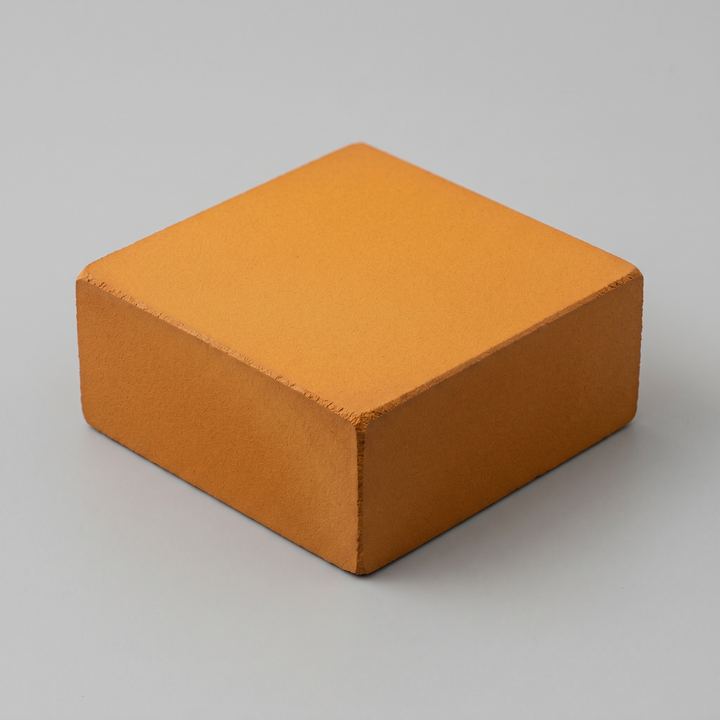
The slab carries a saturated amber-brown from the iron-tungstate matrix — warmer than the neutral tungstate-zincate sibling, the iron pulling the body toward the colour of weathered terracotta with a darker core reading. At 5.85 g/cm³ in a 70×70×35 mm piece, the body is dense and two-handed, noticeably heavier than an equivalent fired brick and closer in hand-feel to a cast iron-glaze tile. Skin matte from the sinter with a faint warm sheen; edges cold-cut, the diamond-kerf powder catching reddish in the cut. Fully opaque. A faint magnetism is legible at the corner if a small steel pin is brought close.
Recipe
200 g batch · peak 1250 °C| element | precursor | formula | mass | safety |
|---|---|---|---|---|
| Fe | iron(III) oxide (red) | Fe2O3 | 14.45 g | safe |
| Sr | strontium carbonate | SrCO3 | 53.43 g | safe |
| W | tungsten trioxide (yellow) | WO3 | 20.98 g | moderate |
| Zr | zirconium dioxide | ZrO2 | 11.15 g | safe |
- 1Ramp
- 2Hold
- 3Ramp
- 4Ramp
- 5Hold
- 6Ramp
- 7Ramp
Electrochromic — color switches under applied voltage (thin-film chemistry)
Magnetic — room-temperature magnetism from ferrite phase
Visible absorber — saturated color from bandgap in the visible range