Cr₂K₄O₂₀Si₈
alkali silicate glass · structural translucent glassCr2K4O20Si8 is a alkali silicate glass suitable as structural translucent glass. Color: green. Fired at 1150°C from 4 precursors (SiO2, K2CO3, Cr2O3). Workshop batch: 400g at €4.18. Compressive strength ~500 MPa; estimated 0.84 kg CO₂/kg (-2% vs float glass). Notable: no special functions flagged. Confidence: high.
- forms at
- 1150 °C · high-fire
- replaces
- float glass
- CO₂
- 1.9% lower than float glass (0.84 vs 0.86 kg CO₂/kg)
- energy
- 62.5% lower than float glass (5.62 vs 15.00 MJ/kg)
- compressive
- 500 MPa
- density
- 2.61 g/cm³
- crystal
- triclinic
- band gap
- 2.80 eV
- cost
- €10.45/kg · €4.18 / 400 g batch
- confidence
- high (synthesis route)
- potential
- 0.68 · env 0.78 · novel 0.00 · struct 1.00 · lineage 1.00 · supply 1.00
Architectural potential
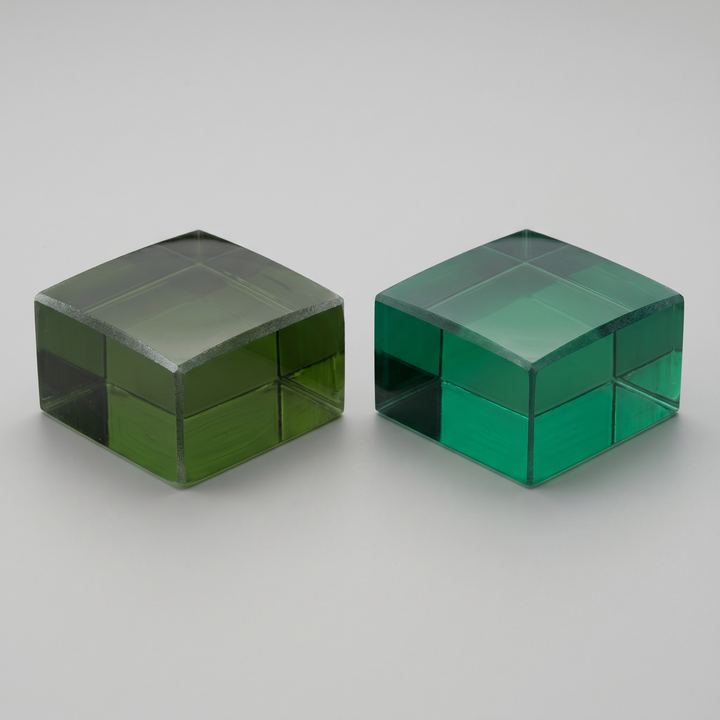
This is a load-bearing transparent glass with a clear chromium-driven green body, delivering 500 MPa of compression at 53 mm slab thickness. Natural placements are structural stair treads in exhibition and retail architecture where a saturated bottle-green tread is the design brief, pressed-glass floor panels above daylit basements and undercrofts where the colour reads strongly under natural light, transparent partitions in greenhouses and conservatories where the green glass registers against the botanical palette, and light-admitting piers in hospitality interiors where a cooled-green volume is wanted against warm timber surrounds. The 85×85×53 mm slab is the thickest in the atlas's transparent-structural series, pushing light depth and colour saturation together. Against float glass the embodied CO₂ is level at minus two per cent; the argument is the combination of structural presence, daylight admission and unambiguous colour in a single element. The sixty-three-per-cent energy reduction during forming against conventional float is a modest operational gain. High confidence across the data and perfect supply-chain and safety scores make specification straightforward. The caveat is edge conditioning: at 53 mm the slab wants careful annealing discipline and patient cold-cutting, or the compressive performance is compromised along the corner.
Material character
The slab reads a clear, saturated bottle-green body, the chromium register that sits firmly apart from the cooler V-grey and the warmer Fe-amber variants. At 2.61 g/cm³ and 85×85×53 mm the piece asks for a two-hand lift, lighter in the hand than the denser V-tinted sibling despite the thicker section. Light through 53 mm reads deep green from above, shifting to a darker forest-emerald along the long edge as path length extends. Surface finishes pressed-glass with fine anneal striae close to the mould seam; cold-cut edges carry the lapidary bloom. Against plain float glass the body is frankly green, not faintly tinted.
Recipe
400 g batch · peak 1150 °C| element | precursor | formula | mass | safety |
|---|---|---|---|---|
| Cr | chromium(III) oxide | Cr2O3 | 16.72 g | safe |
| K | potassium carbonate / potash | K2CO3 | 30.41 g | safe |
| Si | quartz flour / silica | SiO2 | 52.87 g | safe |
- 1Ramp
- 2Hold
- 3Ramp
- 4Hold
- 5Ramp
- 6Hold