Al₁₂FeMn₂RuSi₈
metal pm only · sintered metalAl12Fe1Mn2Ru1Si8 is a metal pm only suitable as sintered-metal. Color: neutral. Fired at 1100°C from 4 precursors (Al, Si, Mn). Workshop batch: 200g at €2.42. Compressive strength ~50 MPa; estimated 0.84 kg CO₂/kg (-53% vs structural steel). Notable: shape memory FeMnSi. Confidence: medium.
- forms at
- 1100 °C · high-fire
- replaces
- structural steel
- CO₂
- 53.1% lower than structural steel (0.84 vs 1.80 kg CO₂/kg)
- energy
- 74.4% lower than structural steel (5.62 vs 26.00 MJ/kg)
- compressive
- 50 MPa
- density
- 3.78 g/cm³
- crystal
- monoclinic
- band gap
- —
- cost
- €12.10/kg · €2.42 / 200 g batch
- confidence
- medium (synthesis route)
- potential
- 0.54 · env 0.74 · novel 0.80 · struct 0.12 · lineage 0.20 · supply 0.46
- flags
- shape memory FeMnSi: Deforms on cue and snaps back to a remembered shape when warmed. Deployable canopies, self-tensioning fasteners, seismic-damping brackets, and geometry-changing envelopes all become mechanically possible.
Architectural potential
A sintered aluminium-silicide compact with iron, manganese and a small ruthenium fraction — powder-pressed at 1100 °C rather than cast from a melt. Fifty megapascals of compression is low for a metal part, so this does not sit in the column-base register; it lives in the brackets, hinges, façade clips, furniture knuckles and seismic-damping hardware where the Fe-Mn-Si shape-memory response earns its keep. A bracket that deforms on load and snaps back to a remembered geometry when warmed becomes a self-tensioning fastener in timber-frame work, a re-settable joint in a modular partition system, or a passive damping element at the base of a light-frame canopy. Against welded structural steel the embodied CO₂ is fifty-three per cent lower and the energy budget seventy-four per cent lower, so for bracket-scale production the environmental argument is real. The supplement-or-replacement framing is surgical: this is not a truss-member candidate, it is a connector-node candidate. The caveat is geometry ceiling — 500 g workshop batches cap any single piece at hardware size, and the shape-memory response has to be characterised per-batch, so specification cannot be copy-pasted between projects.
Material character
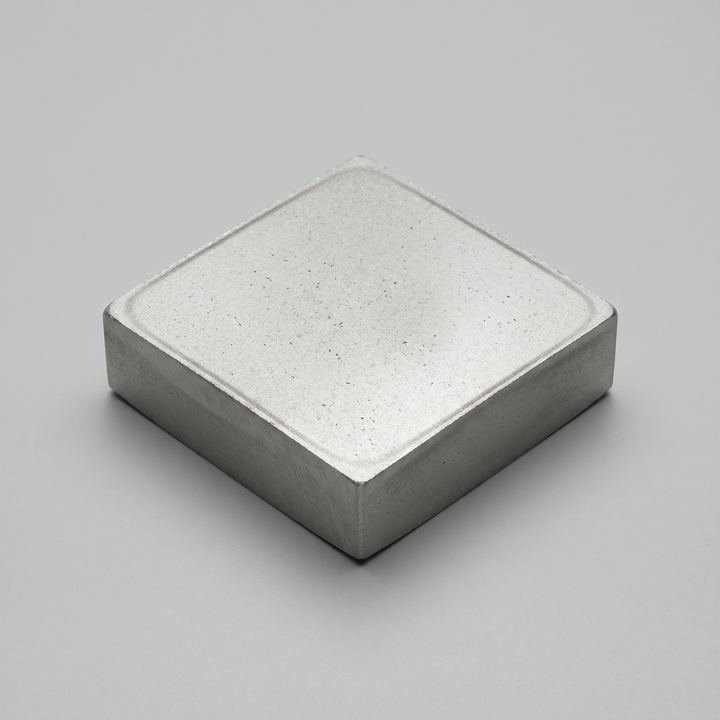
Neutral silver-grey matrix with a fine aluminium-silicide powder signature, slightly duller than a machined cast-aluminium sibling. At 3.78 g/cm³ and 85×85×37 mm the slab sits firm two-handed — lighter than its visual weight suggests, close in hand-feel to an anodised-aluminium plate rather than a steel block. Surface carries the sintered matte grain of a powder-pressed part: a faint orange-peel under raking light, with the mould parting line legible as a soft ridge. Edges cold-cut, the diamond-saw kerf bright. Against a fully cast A356 sibling the skin is drier and holds tool-marks more cleanly, and the ring under tap is softer, thanks to residual micro-porosity.
Recipe
200 g batch · peak 1100 °C| element | precursor | formula | mass | safety |
|---|---|---|---|---|
| Al | aluminum powder | Al | 45.34 g | moderate |
| Fe | iron powder -325 mesh | Fe | 7.82 g | moderate |
| Mn | manganese flakes | Mn | 15.38 g | moderate |
| Si | silicon granules | Si | 31.46 g | safe |
- 1Ramp
- 2Hold
- 3Ramp
- 4Hold
- 5Ramp
- 6Ramp
- 7END
Shape-memory — deformed body recovers on heating (Fe-Mn-Si)