Na₈O₄S₈Si₄
alkali silicate glass · structural translucent glassNa8O4S8Si4 is a alkali silicate glass suitable as structural translucent glass. Color: clear. Fired at 1150°C from 3 precursors (Na2CO3, SiO2, CaCO3). Workshop batch: 400g at €1.08. Compressive strength ~500 MPa; estimated 0.84 kg CO₂/kg (-2% vs float glass). Notable: no special functions flagged. Confidence: high.
- forms at
- 1150 °C · high-fire
- replaces
- float glass
- CO₂
- 1.9% lower than float glass (0.84 vs 0.86 kg CO₂/kg)
- energy
- 62.5% lower than float glass (5.62 vs 15.00 MJ/kg)
- compressive
- 500 MPa
- density
- 2.08 g/cm³
- crystal
- monoclinic
- band gap
- 3.56 eV
- cost
- €2.70/kg · €1.08 / 400 g batch
- confidence
- high (synthesis route)
- potential
- 0.68 · env 0.78 · novel 0.00 · struct 1.00 · lineage 1.00 · supply 0.95
Architectural potential
This is the atlas's cleanest candidate for structural translucent glass at real architectural size. Five hundred megapascals of compression and a 100×100×48 mm slab at 2.078 g/cm³ — essentially standard soda-lime density — sit it squarely in the tectonic of walked-on glass floors, pressed-glass stair treads, column-like light-admitting piers, transparent landing panels, and floor panels inserted into mezzanine and atrium work. The sulfide flux modifies the melt behaviour without changing the structural register: this still reads as a soda-lime-silicate body in its bones, so annealing schedules and edge conditioning follow familiar float-glass tectonics. Natural placements are double-height gallery light wells, glass-floor thresholds between exhibition halls, transparent stair treads in public interiors, and pressed-glass beam inserts where steel-plus-glazing would otherwise be assembled as two separate systems. Against float glass the embodied CO₂ is almost identical (-1.9%), so the environmental case is neutral; the argument is the sixty-two-per-cent energy reduction in the melt itself, plus the structural-grade compression that opens walked-on applications float glass cannot safely address. Workshop batch reaches 5 kg, supply-chain score is 1.0, cost is €1.08 per 400 g — this is specifiable at real project scale. The caveat is the sulphide flux: melt-tank ventilation and annealing discipline must be rigorous, and large formats require careful edge conditioning against delayed fracture.
Material character
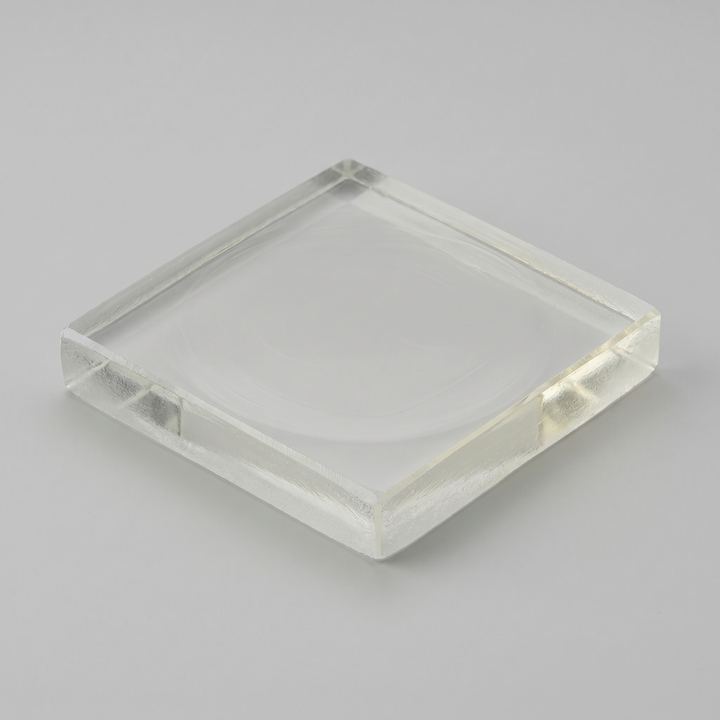
The slab reads clear with a barely perceptible warm cast from residual sulphur species in the melt — closer to clean float than to cullet-heavy glass. At 2.078 g/cm³ and 100×100×48 mm the panel sits with the familiar weight of a half-thickness architectural pane, a two-hand lift, and transmits a clean high ring on the edge-tap. Surface carries a low pressed-glass crown with faint anneal striae running parallel to the long edge, legible only against a light source. Edges cold-cut and cleanly polished, the usual lapidary bloom at the kerf. Against ordinary soda-lime float glass the tap is slightly deeper, the body marginally softer-looking under raking light — the signature of a sulphide-fluxed melt.
Recipe
400 g batch · peak 1150 °C| element | precursor | formula | mass | safety |
|---|---|---|---|---|
| Na | sodium carbonate / soda ash | Na2CO3 | 63.82 g | safe |
| Si | quartz flour / silica | SiO2 | 36.18 g | safe |
- 1Ramp
- 2Hold
- 3Ramp
- 4Hold
- 5Ramp
- 6Hold