Al₁₅B₆FeO₃₇Si₂
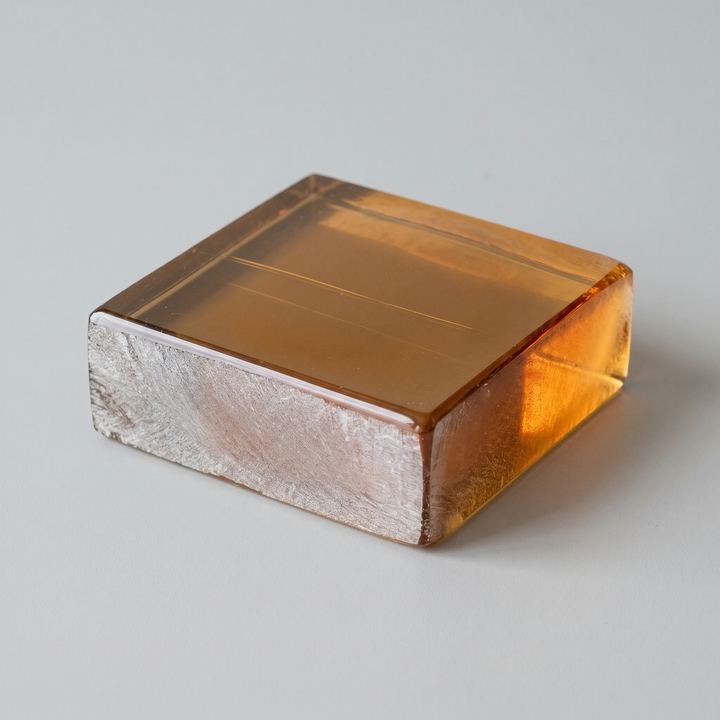
borosilicate glass · structural translucent advancedAl15B6Fe1O37Si2 is a borosilicate glass suitable as structural translucent advanced. Color: amber-brown. Fired at 1300°C from 4 precursors (Al2O3, B2O3, SiO2). Workshop batch: 200g at €2.84. Compressive strength ~500 MPa; estimated 1.01 kg CO₂/kg (+18% vs float glass). Notable: no special functions flagged. Confidence: medium.
- forms at
- 1300 °C · extreme-fire
- replaces
- float glass
- CO₂
- 18% higher than float glass (1.01 vs 0.86 kg CO₂/kg; 1.2× higher)
- energy
- 55.0% lower than float glass (6.75 vs 15.00 MJ/kg)
- compressive
- 500 MPa
- density
- 3.03 g/cm³
- crystal
- monoclinic
- band gap
- —
- cost
- €14.20/kg · €2.84 / 200 g batch
- confidence
- medium (synthesis route)
- potential
- 0.57 · env 0.69 · novel 0.00 · struct 1.00 · lineage 0.80 · supply 0.60
Architectural potential
An iron-doped aluminoborosilicate pushed to 1300 °C, this is a translucent mass body rather than a sheet glass — denser, harder and thermally steadier than float, and capable of five hundred megapascals of compression. Its architectural place is inhabitable translucent solid: monolithic light-admitting columns in public halls, pressed-glass treads in open stairs, structural skylight blocks that carry their own envelope load, and pier-like light wells in bath-houses or crematoria where the iron-amber body throws a warm cast across the floor. Against float glass the energy overhead drops by fifty-five per cent because the melt is held at lower viscosity with the boron flux, but embodied CO₂ runs eighteen per cent higher — so this is not a window replacement. Specify it where conventional glazing would crack, creep or lose clarity under sustained load, and where the warm iron colour is part of the design argument rather than a defect. Workshop batches cap at 500 g and the slab size is small (85×85×46 mm), so the element is a signature pier, a floor-inlay block, a light-well step — not a glazing panel. The caveat is firing: 1300 °C with a boron-rich melt demands careful crucible management and a slow anneal schedule, and medium-confidence properties mean first use should be prototyped at scale before committing to site.
Material character
The body reads a deep amber-brown with iron sitting as a dissolved colourant rather than a particulate — light passes through 46 mm as a tea-coloured translucency, clearer along the short edge, warmer and denser through the 85 mm long axis. At 3.03 g/cm³ the slab is substantially heavier than ordinary float and sits into the bench with a two-hand lift. Surface pressed-glass, with fine anneal striae legible close to the top crown; cold-cut edges show the lapidary bloom of a slow saw. A distinct step up in hardness and thermal steadiness from a soda-lime sibling — the slab rings lower and slower under a tap.
Recipe
200 g batch · peak 1300 °C| element | precursor | formula | mass | safety |
|---|---|---|---|---|
| Al | calcined alumina | Al2O3 | 65.16 g | safe |
| B | boron oxide (or borax Na2B4O7) | B2O3 | 17.8 g | safe |
| Fe | iron(III) oxide (red) | Fe2O3 | 6.8 g | safe |
| Si | quartz flour / silica | SiO2 | 10.24 g | safe |
- 1Ramp
- 2Hold
- 3Ramp
- 4Hold
- 5Ramp
- 6Hold