Er₄FeMnSi₄
metal pm only · sintered metalEr4Fe1Mn1Si4 is a metal pm only suitable as sintered-metal. Color: neutral. Fired at 1100°C from 4 precursors (Er, Si, Fe). Workshop batch: 200g at €8.38. Compressive strength ~250 MPa; estimated 0.84 kg CO₂/kg (-53% vs structural steel). Notable: shape memory FeMnSi. Confidence: medium.
- forms at
- 1100 °C · high-fire
- replaces
- structural steel
- CO₂
- 53.1% lower than structural steel (0.84 vs 1.80 kg CO₂/kg)
- energy
- 74.4% lower than structural steel (5.62 vs 26.00 MJ/kg)
- compressive
- 250 MPa
- density
- 7.83 g/cm³
- crystal
- monoclinic
- band gap
- 0.00 eV
- cost
- €41.90/kg · €8.38 / 200 g batch
- confidence
- medium (synthesis route)
- potential
- 0.62 · env 0.74 · novel 0.80 · struct 0.60 · lineage 0.20 · supply 0.50
- flags
- shape memory FeMnSi: Deforms on cue and snaps back to a remembered shape when warmed. Deployable canopies, self-tensioning fasteners, seismic-damping brackets, and geometry-changing envelopes all become mechanically possible.
Architectural potential
A shape-memory sintered alloy in the FeMnSi family carrying erbium as a rare-earth modifier, pressed and fired at 1100 °C to 250 MPa. At building scale this sits squarely in the hardware register: seismic-damping brackets, self-tensioning fasteners for deployable canopies, connector nodes for timber-to-steel joints, and façade clips whose geometry resets after thermal cycling. Against structural steel the embodied CO₂ is down fifty-three per cent and the energy budget down seventy-four per cent, which begins to make the argument for specification in moderate-repetition hardware runs — retrofit seismic upgrades in masonry buildings, temporary pavilion nodes that re-tension after shipment, bridge-bearing keeper brackets that re-set after an event. The shape-memory capability itself is what earns the alloy its place: warmed above its transformation temperature, the part snaps back to a remembered geometry, so a bracket installed in its deformed state can be activated on site with a heat gun to pre-load a connection. The caveat is workshop scale: 200 g batches to a 500 g ceiling means the piece is specified as a cast node, not as a repeated fastener, and every node carries a verification requirement on its transformation temperature before it goes into load.
Material character
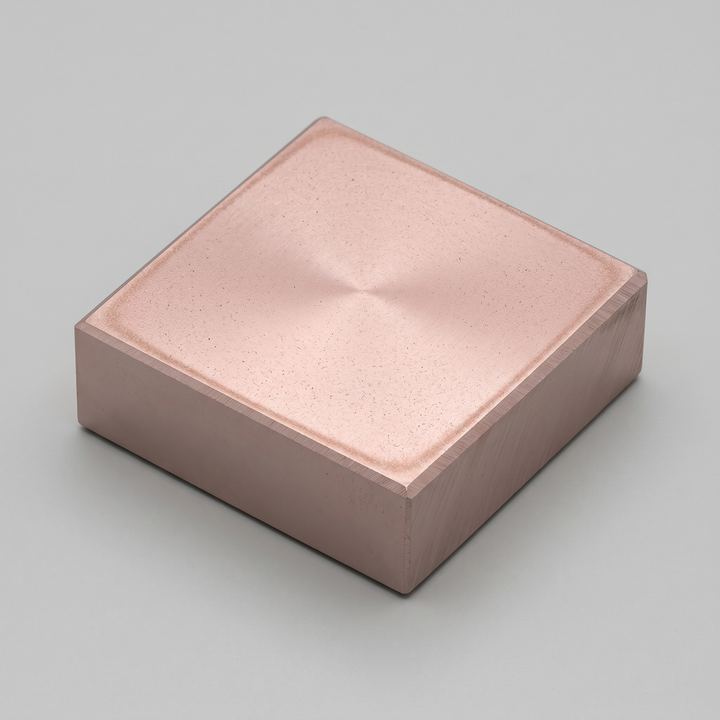
Neutral in colour — a cool pewter-grey with the faint yellow undertone that erbium gives to silicate-modified iron matrices, darker than chromium stainless but warmer than raw ferritic steel. At 7.83 g/cm³ and 70×70×26 mm the slab demands a two-hand grip off the bench, firmly in the heavy-metal register and denser in hand than a comparable mild-steel plate of the same footprint. Skin is the sintered matte grain typical of pressed powder metallurgy — a fine even porosity visible under raking light rather than the polished sheen of a cast piece. Edges cold-cut, kerf sharp, with a faint silicate dust along the cut line. Rings slightly dead on tap, a different acoustic from a solid-cast bracket of the same mass.
Recipe
200 g batch · peak 1100 °C| element | precursor | formula | mass | safety |
|---|---|---|---|---|
| Er | erbium metal | Er | 74.99 g | moderate |
| Fe | iron powder -325 mesh | Fe | 6.26 g | moderate |
| Mn | manganese flakes | Mn | 6.16 g | moderate |
| Si | silicon granules | Si | 12.59 g | safe |
- 1Ramp
- 2Hold
- 3Ramp
- 4Hold
- 5Ramp
- 6Ramp
- 7END
Shape-memory — deformed body recovers on heating (Fe-Mn-Si)