Ca₄O₁₆Si₄V₄
calcium silicate · cement alternativeCa4O16Si4V4 is a calcium silicate suitable as cement-alternative. Color: white-grey. Fired at 1100°C from 3 precursors (CaCO3, V2O5, SiO2). Workshop batch: 1000g at €51.75. Compressive strength ~50 MPa; estimated 0.68 kg CO₂/kg (-19% vs Portland cement). Notable: visible absorber. Confidence: high.
- forms at
- 1100 °C · high-fire
- replaces
- portland cement
- CO₂
- 18.7% lower than Portland cement (0.68 vs 0.83 kg CO₂/kg)
- energy
- 18.2% lower than Portland cement (4.50 vs 5.50 MJ/kg)
- compressive
- 50 MPa
- density
- 3.34 g/cm³
- crystal
- orthorhombic
- band gap
- 1.96 eV
- cost
- €51.75/kg · €51.75 / 1000 g batch
- confidence
- high (synthesis route)
- potential
- 0.39 · env 0.23 · novel 0.46 · struct 0.15 · lineage 0.70 · supply 0.50
- flags
- visible absorber: A real-colour solar-gain control layer. Where the body takes visible light into itself rather than reflecting it, the material becomes a selective heat collector — useful on thermal-mass walls, absorber panels, and warm-toned cladding.
Architectural potential
A vanadium-doped calcium-silicate in the low-CO₂ binder register, sitting at the non-structural end of the family — 50 MPa of compression at 3.34 g/cm³ and an eighteen-per-cent CO₂ cut against Portland. The visible-absorber chemistry is the architectural hinge: the V⁴⁺ sites pull visible light into the body as heat rather than reflecting it, making the slab a real-colour solar-gain collector rather than a passive binder. Natural placements are south-facing thermal-wall infill panels, cast trombe-wall slabs behind glazing in passive-solar retrofits, absorber panels for solar-preheat air chambers, and warm-toned cladding on walls where daytime heat storage is the point. At the 1000 g batch scale and 5000 g workshop ceiling, prefabricated cladding panels and thermal-wall blocks both come within reach. Against Portland concrete the argument is a modest environmental improvement combined with a functional role Portland does not carry — absorbing rather than reflecting the visible spectrum. The caveat is cost: €51.75 per 1000 g batch is an order of magnitude above conventional cement, so specification stays project-scoped — thermal-mass pieces in passive-solar architecture — rather than general pour. The 1100 °C vitrification fire also keeps the kiln in the supply chain.
Material character
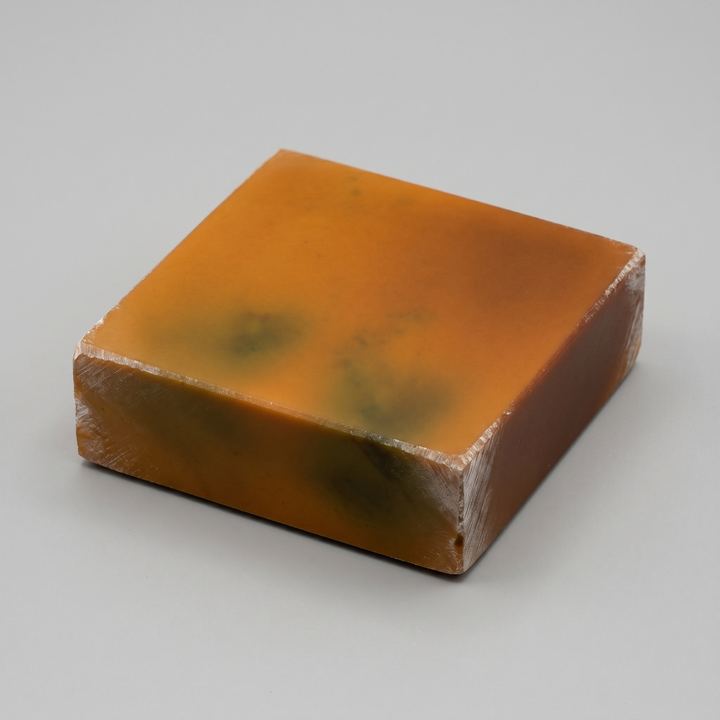
The 85×85×41 mm slab reads a subtle white-grey with a faint vanadium-blue undertone emerging in shadow — a cooler cast than standard Portland, closer to a low-iron Portland white. At 3.34 g/cm³ the piece is firm-handed and sits two-handed without strain, a weight register between cement mortar and fired clay tile. Surface fires to a partially vitrified skin, slightly glassy under raking light where the flux has run. Edges cold-cut, kerf-white. Against pure Portland concrete the body reads denser and slightly darker, and under direct sun the slab warms perceptibly faster than an ordinary cement test piece — the visible-absorber signature in hand.
Recipe
1000 g batch · peak 1100 °C| element | precursor | formula | mass | safety |
|---|---|---|---|---|
| Ca | calcium carbonate / limestone | CaCO3 | 39.86 g | safe |
| Si | quartz flour / silica | SiO2 | 23.93 g | safe |
| V | vanadium pentoxide | V2O5 | 36.22 g | moderate |
- 1Ramp
- 2Hold
- 3Ramp
- 4Hold
- 6Ramp
- 7Hold
Visible absorber — saturated color from bandgap in the visible range