AlFe₃K₄O₈
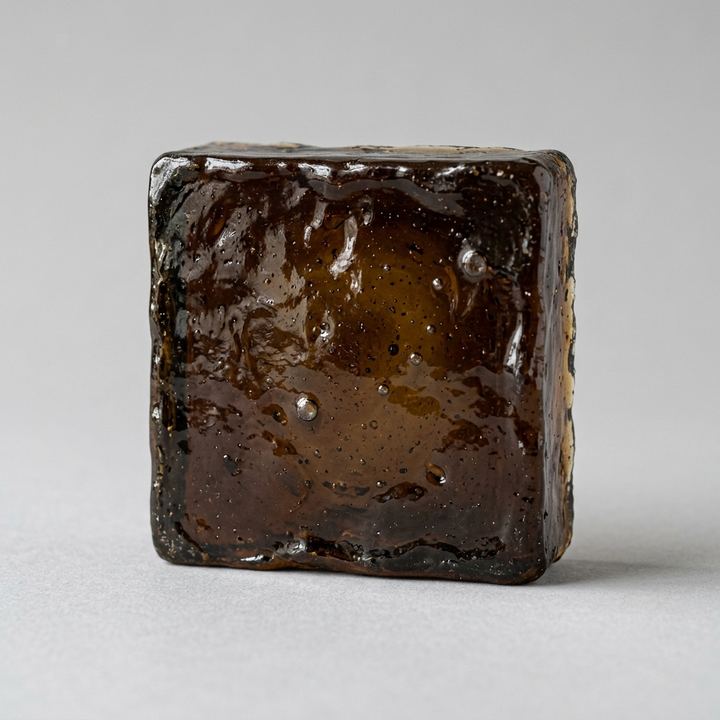
iron oxide ceramic · structural ceramicAl1Fe3K4O8 is a iron oxide ceramic suitable as structural-ceramic. Color: amber-brown. Fired at 1100°C from 3 precursors (K2CO3, Fe2O3, Al2O3). Workshop batch: 1000g at €8.91. Compressive strength ~100 MPa; estimated 0.79 kg CO₂/kg (+258% vs clay brick). Notable: visible absorber. Confidence: high.
- forms at
- 1100 °C · high-fire
- replaces
- clay brick
- CO₂
- 258% higher than clay brick (0.79 vs 0.22 kg CO₂/kg; 3.6× higher)
- energy
- 75% higher than clay brick (5.25 vs 3.00 MJ/kg; 1.8× higher)
- compressive
- 100 MPa
- density
- 3.00 g/cm³
- crystal
- triclinic
- band gap
- 2.37 eV
- cost
- €8.91/kg · €8.91 / 1000 g batch
- confidence
- high (synthesis route)
- potential
- 0.41 · env 0.00 · novel 0.46 · struct 0.30 · lineage 1.00 · supply 0.68
- flags
- visible absorber: A real-colour solar-gain control layer. Where the body takes visible light into itself rather than reflecting it, the material becomes a selective heat collector — useful on thermal-mass walls, absorber panels, and warm-toned cladding.
Architectural potential
The architectural argument for this iron-potassium oxide shifts away from structural brickwork and into warm-toned solar-collector cladding. At a hundred megapascals and two-and-a-half times the embodied CO₂ of clay brick, using it for bulk wall construction is the wrong specification — the saturated iron-amber body colour and the visible-wavelength absorption are what pay for the CO₂ premium. The natural places are trombe-wall face plates behind glazing, where a warm golden body captures daytime solar gain and releases it slowly after dark; south-facing façade-accent tiles on otherwise-neutral thermal walls; and interior thermal-mass surrounds to stoves and rocket-mass heaters where the body reads hot even when it is cold. The potassium flux brings the skin close to a partial glaze, which gives the surface enough weather resistance for exterior use without the additional embodied cost of a separate glaze fire. The caveat is volume: at 258 % of clay-brick embodied CO₂ and an energy overhead of 75 %, this is a specification for the active-absorber slivers of a façade, not for the background brick work behind them.
Material character
The face reads a warm golden amber with iron-red undertones coming through most clearly under raking light; overhead, the hue resolves toward gold. Aluminium in the host tempers the iron saturation slightly so the body is neither as vermilion as pure ferric nor as brown as manganese-doped cousins. The potassium flux pulls the 1100 °C fire into the partial-glaze zone — the skin is denser, shinier and more vitrified than the un-fluxed family baseline, without crossing fully into melt. Edges cold-cut, kerf-whitened. At 3.01 g/cm³ the slab is slightly lighter than a comparable clay-brick body of the same footprint, a surprise in hand.
Recipe
1000 g batch · peak 1100 °C| element | precursor | formula | mass | safety |
|---|---|---|---|---|
| Al | calcined alumina | Al2O3 | 8.99 g | safe |
| Fe | iron(III) oxide (red) | Fe2O3 | 42.25 g | safe |
| K | potassium carbonate / potash | K2CO3 | 48.76 g | safe |
- 1Ramp
- 2Hold
- 3Ramp
- 4Hold
- 6Ramp
- 7Hold
Visible absorber — saturated color from bandgap in the visible range