La₄Na₄O₅₆Si₂₄
alkali silicate glass · structural translucent glassLa4Na4O56Si24 is a alkali silicate glass suitable as structural translucent glass. Color: clear. Fired at 1150°C from 4 precursors (SiO2, La2O3, Na2CO3). Workshop batch: 400g at €6.80. Compressive strength ~500 MPa; estimated 0.84 kg CO₂/kg (-2% vs float glass). Notable: no special functions flagged. Confidence: high.
- forms at
- 1150 °C · high-fire
- replaces
- float glass
- CO₂
- 1.9% lower than float glass (0.84 vs 0.86 kg CO₂/kg)
- energy
- 62.5% lower than float glass (5.62 vs 15.00 MJ/kg)
- compressive
- 500 MPa
- density
- 3.00 g/cm³
- crystal
- orthorhombic
- band gap
- —
- cost
- €17.00/kg · €6.80 / 400 g batch
- confidence
- high (synthesis route)
- potential
- 0.64 · env 0.78 · novel 0.00 · struct 1.00 · lineage 0.70 · supply 1.00
Architectural potential
A lanthanum-sodium silicate glass tuned for the load-bearing-transparent register: 500 MPa of compression at 85×85×46 mm with clear optical transmission through the thickness. Natural placements are pressed-glass stair treads in public buildings, transparent floor panels in atria where daylight needs to carry between levels, light-admitting piers in gallery vestibules, and monolithic glass beams over reading tables. The lanthanum addition raises the density and refractive index without tipping the body out of the soda-lime family, so annealing, edge-grinding and adhesive-joint detailing stay within conventional pressed-glass practice. Against float glass, embodied CO₂ is effectively flat at two per cent lower, but firing energy drops by sixty-two per cent — the argument for this material sits on the furnace hour rather than on the carbon accountancy. Workshop batches reach five kilograms, so full tread-sized or small panel-sized pieces are within reach; the 1150 °C peak keeps it inside a ceramic-capable kiln but out of ambient fabrication. The caveat is lanthanum itself: rare-earth sourcing sits under continuous supply-chain pressure, the estimated batch cost of €6.80 per 400 g is already above the selenium-silicate sibling, and any large specification needs a procurement strategy rather than a single order.
Material character
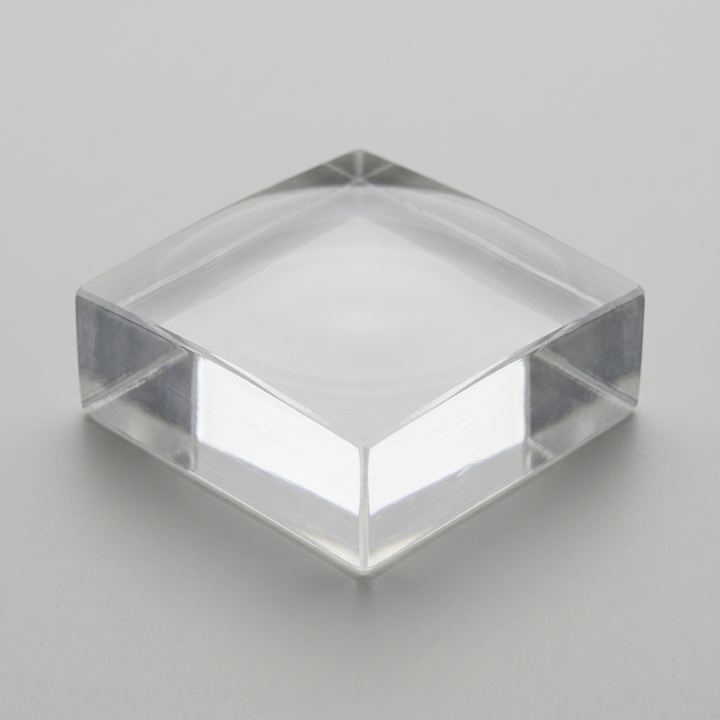
The 46 mm slab reads as a clean, slightly cool transparent — a fractionally bluer clarity than the selenium-silicate sibling, tied to lanthanum's shift in the absorption edge. Through the 85 mm face the view sits fully transparent; sighted along the long edge the body picks up a faint cold-water tint. At 3.00 g/cm³ the slab lifts with a firm two-hand grip — heavier than the average soda-lime pressed slab, a distinct step up from the Se-variant at the same footprint. Top face sits under a low convex crown with two faint anneal striae close to one edge. Cold-cut edges carry the familiar lapidary bloom and a clean conchoidal kerf.
Recipe
400 g batch · peak 1150 °C| element | precursor | formula | mass | safety |
|---|---|---|---|---|
| La | lanthanum oxide | La2O3 | 28.26 g | moderate |
| Na | sodium carbonate / soda ash | Na2CO3 | 9.19 g | safe |
| Si | quartz flour / silica | SiO2 | 62.54 g | safe |
- 1Ramp
- 2Hold
- 3Ramp
- 4Hold
- 5Ramp
- 6Hold