K₂O₆WZr
heavy oxide ceramic · thermal mass ceramicK2O6W1Zr1 is a heavy oxide ceramic suitable as thermal mass ceramic. Color: neutral. Fired at 1250°C from 3 precursors (WO3, K2CO3, ZrO2). Workshop batch: 200g at €45.25. Compressive strength ~300 MPa; estimated 0.94 kg CO₂/kg (+326% vs clay brick). Notable: electrochromic tungstate. Confidence: medium.
- forms at
- 1250 °C · high-fire
- replaces
- clay brick
- CO₂
- 326% higher than clay brick (0.94 vs 0.22 kg CO₂/kg; 4.3× higher)
- energy
- 108% higher than clay brick (6.25 vs 3.00 MJ/kg; 2.1× higher)
- compressive
- 300 MPa
- density
- 5.45 g/cm³
- crystal
- cubic
- band gap
- 2.15 eV
- cost
- €226.25/kg · €45.25 / 200 g batch
- confidence
- medium (synthesis route)
- potential
- 0.41 · env 0.00 · novel 1.00 · struct 0.60 · lineage 0.50 · supply 0.00
- flags
- electrochromic tungstate: A voltage-switchable optical chemistry. In thin-film form a small DC signal shifts transmission from clear to tinted blue, opening the door to dimmable glazing and responsive partitions that do not need mechanical shading.
Architectural potential
A tungsten-zirconium-potassium ceramic fired at 1250 °C into a dense heavy-oxide body, reaching 300 MPa of compression at 5.45 g/cm³. The tungsten content carries the material into the electrochromic register: under a small DC bias a thin tungstate film shifts from clear to deep blue, so the surface behaviour is switchable rather than passive. Architecturally this makes sense only at small-area overlay: switchable-tint window mullions in meeting-room partitions, voltage-dimmable glazing inserts for cinema foyers, reconfigurable privacy screens in medical consulting rooms. The 300 MPa body provides the thermal-mass register as well, so a south-facing thermal wall might carry electrochromic tiles at eye-level that darken through the afternoon as the ceramic mass behind them stores the solar gain. Supplements insulation and glazing rather than replacing them. The caveat is severe and has to be foregrounded: embodied CO₂ runs three hundred and twenty-six per cent above fired clay brick, the supply-chain score sits at zero, tungsten is a conflict-prone refractory, and €45.25 per 200 g batch with a 500 g ceiling keeps this firmly in the signature-patch register. The electrochromic chemistry has to earn its carbon back through daily switching, not through hiding behind other cladding.
Material character
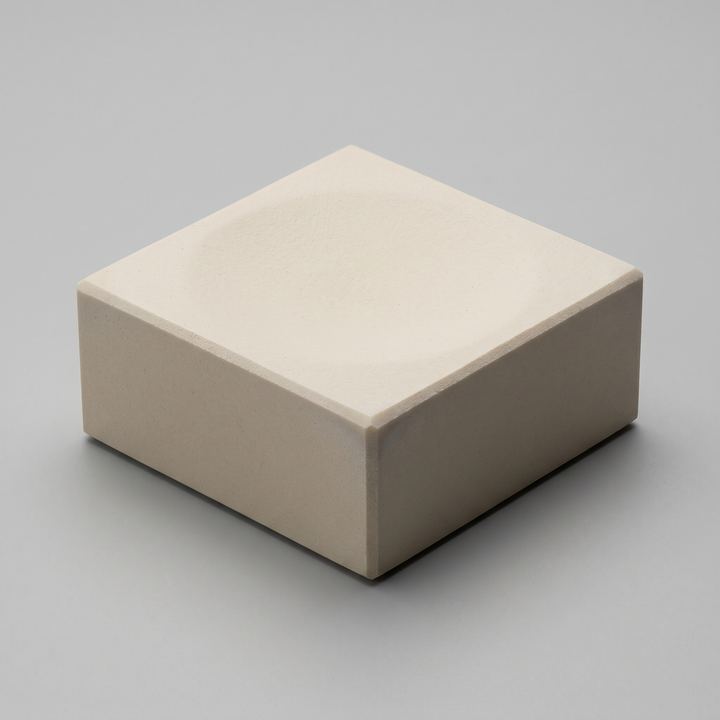
Neutral pale-grey face with a barely-warm cast from the potassium flux; the tungsten content does not colour the body in its clear state but the density gives the slab a characteristic dead-heavy hand-feel. At 5.45 g/cm³ in a 70×70×37 mm block the piece is firmly two-handed, distinctly heavier than a clay brick of the same footprint. Surface vitrified semi-gloss from the 1250 °C peak, the potassium flux pushing the skin toward a partial glaze without crossing into full melt. Edges cold-cut, the kerf carrying the fine diamond-dust bloom. The switched state — deep electrochromic blue under DC bias — is not visible at rest; the slab reads pale-neutral until wired.
Recipe
200 g batch · peak 1250 °C| element | precursor | formula | mass | safety |
|---|---|---|---|---|
| K | potassium carbonate / potash | K2CO3 | 28.02 g | safe |
| W | tungsten trioxide (yellow) | WO3 | 47.0 g | moderate |
| Zr | zirconium dioxide | ZrO2 | 24.98 g | safe |
- 1Ramp
- 2Hold
- 3Ramp
- 4Ramp
- 5Hold
- 6Ramp
- 7Ramp
Electrochromic — color switches under applied voltage (thin-film chemistry)