AlOSi₅Zr₁₀
heavy oxide ceramic · thermal mass ceramicAl1O1Si5Zr10 is a heavy oxide ceramic suitable as thermal mass ceramic. Color: neutral. Fired at 1250°C from 3 precursors (ZrO2, SiO2, Al2O3). Workshop batch: 200g at €13.80. Compressive strength ~200 MPa; estimated 0.94 kg CO₂/kg (+326% vs clay brick). Notable: no special functions flagged. Confidence: medium.
- forms at
- 1250 °C · high-fire
- replaces
- clay brick
- CO₂
- 326% higher than clay brick (0.94 vs 0.22 kg CO₂/kg; 4.3× higher)
- energy
- 108% higher than clay brick (6.25 vs 3.00 MJ/kg; 2.1× higher)
- compressive
- 200 MPa
- density
- 5.83 g/cm³
- crystal
- monoclinic
- band gap
- 0.01 eV
- cost
- €69.00/kg · €13.80 / 200 g batch
- confidence
- medium (synthesis route)
- potential
- 0.23 · env 0.00 · novel 0.00 · struct 0.40 · lineage 0.50 · supply 0.60
Architectural potential
A zirconium-silicate-alumina heavy-oxide ceramic fired at 1250 °C, 200 MPa of compression, and a specific thermal-mass register that earns its carbon debt only where the temporal-flywheel role is the point. Natural placements are south-facing trombe-wall infills in a high-desert pavilion, hypocaust slabs under a library reading floor, night-flush cooling cores in a gallery bay, and radiant-heat storage tiles behind a wood-burner in a rural dwelling. The material absorbs daytime solar gain slowly and releases it after dark — a thermal day-shifter rather than an insulator. The caveat is stark and has to frame the specification: at 326 per cent higher embodied CO₂ than clay brick and 108 per cent higher embodied energy, this ceramic cannot be used in bulk. It is a thin-tile solution, a patch across a conventional masonry assembly, a localised high-performance core inside an otherwise low-carbon wall. Specify it where the zirconium-grade thermal mass does something that clay brick cannot — a specific thermal lag, a specific re-radiation profile, a specific fire-resistance window — and let clay or earth do the bulk work elsewhere. 200 g workshop batches cap the project at signature scale.
Material character
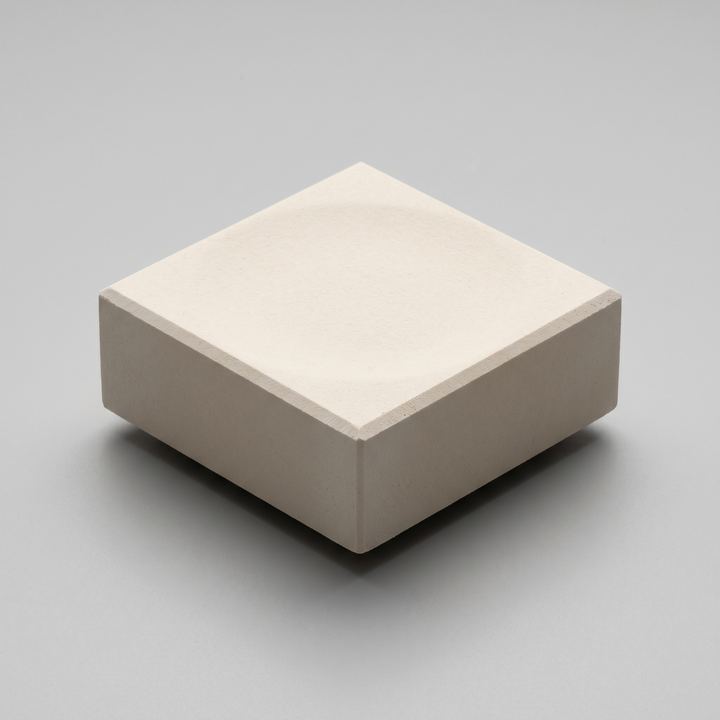
A neutral cream-grey body with the flat opacity characteristic of a zirconia-heavy ceramic — no tonal depth, no translucency, a matter-of-fact surface that refuses to play with light. At 5.83 g/cm³ and 70×70×35 mm the slab is decisively two-handed — one of the denser ceramics in the palette, close in lift register to a basalt block of the same footprint. Surface carries the vitrified skin of a high-fire ceramic, satin-matte with a just-visible sinter grain under raking light. Edges cold-cut with a fine kerf powder. Against a conventional fired clay body the ring under tap is high, sharp, and distinctly metallic-edged.
Recipe
200 g batch · peak 1250 °C| element | precursor | formula | mass | safety |
|---|---|---|---|---|
| Al | calcined alumina | Al2O3 | 3.22 g | safe |
| Si | quartz flour / silica | SiO2 | 18.97 g | safe |
| Zr | zirconium dioxide | ZrO2 | 77.81 g | safe |
- 1Ramp
- 2Hold
- 3Ramp
- 4Ramp
- 5Hold
- 6Ramp
- 7Ramp