O₁₂TeV₄W
heavy oxide ceramic · thermal mass ceramicO12Te1V4W1 is a heavy oxide ceramic suitable as thermal mass ceramic. Color: grey-blue. Fired at 1250°C from 2 precursors (V2O5, WO3). Workshop batch: 200g at €36.53. Compressive strength ~100 MPa; estimated 0.94 kg CO₂/kg (+326% vs clay brick). Notable: thermochromic VO2. Confidence: medium.
- forms at
- 1250 °C · high-fire
- replaces
- clay brick
- CO₂
- 326% higher than clay brick (0.94 vs 0.22 kg CO₂/kg; 4.3× higher)
- energy
- 108% higher than clay brick (6.25 vs 3.00 MJ/kg; 2.1× higher)
- compressive
- 100 MPa
- density
- 5.81 g/cm³
- crystal
- orthorhombic
- band gap
- 0.86 eV
- cost
- €182.65/kg · €36.53 / 200 g batch
- confidence
- medium (synthesis route)
- potential
- 0.33 · env 0.00 · novel 0.90 · struct 0.20 · lineage 0.50 · supply 0.00
- flags
- thermochromic VO2: Passive thermal-optical switching: transmission shifts near 68 °C without any driving signal. At building scale this gives a window that darkens as it heats, reducing solar gain without wiring or sensors.
Architectural potential
A vanadium-tungsten-tellurium oxide fired at 1250 °C — a heavy-oxide body carrying thermochromic vanadium-dioxide chemistry as its architectural argument. Above sixty-eight degrees celsius the vanadium flips from semiconductor to metal and the slab darkens visibly; below it, the clear grey-blue body returns. Embodied CO₂ is four times that of clay brick and compression sits at one hundred megapascals, so volume placement is ruled out and every use has to be paid for by the passive thermal switching. Natural placements are south-facing solar-gain patches in greenhouse and conservatory glazing, rooftop skylight-perimeter tiles in atrium roofs that darken under midday sun without wiring or control signals, and thermally-active ceiling inserts in double-skin offices where the ceiling plane reads one colour in the morning and another by early afternoon. Specify it as a small-area overlay on a conventional substrate, never as a structural ceramic. Untested at building scale in production architecture. The caveat is cost and supply: €36.53 per 200 g batch, a supply-chain score at zero, and sixty-eight-degree transition temperatures that have to be verified against the actual solar-gain profile of the specified façade — a partition facing north will never see the switch, and that mis-specification kills the argument entirely.
Material character
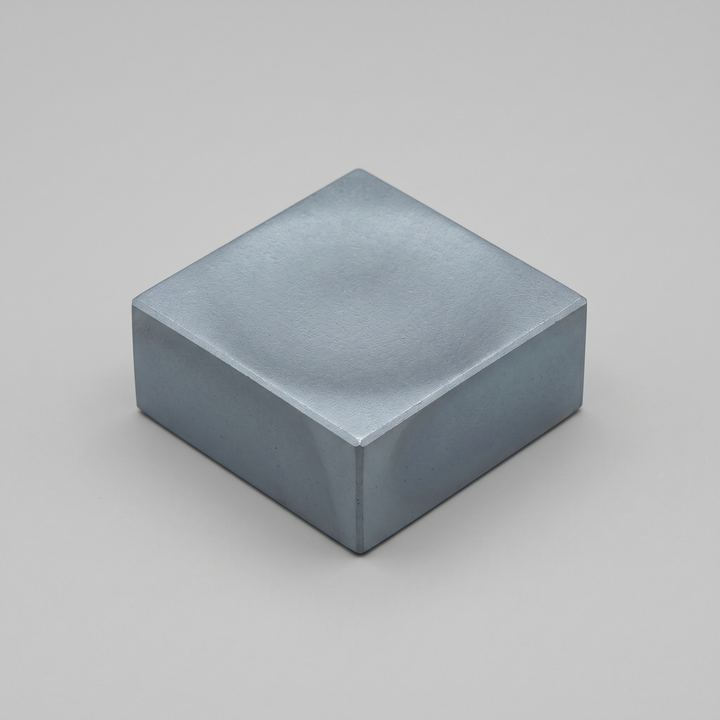
The slab reads a cool grey-blue at room temperature, close to slate but with the slightly metallic lift that vanadium oxides carry — distinct from the olive-green of the chromium-tungstate sibling. At 5.81 g/cm³ over 70×70×35 mm the piece sits heavily on the bench, closer in hand-feel to architectural stone than to a standard brick. Surface matte from the sinter, with fine grain visible in raking light; edges cold-cut, the diamond-saw powder left along the kerf. Fully opaque. The room-temperature state is what the camera records; above the transition temperature the body darkens noticeably, a shift that belongs in a heated companion shot.
Recipe
200 g batch · peak 1250 °C| element | precursor | formula | mass | safety |
|---|---|---|---|---|
| V | vanadium pentoxide | V2O5 | 61.07 g | moderate |
| W | tungsten trioxide (yellow) | WO3 | 38.93 g | moderate |
- 1Ramp
- 2Hold
- 3Ramp
- 4Ramp
- 5Hold
- 6Ramp
- 7Ramp
Thermochromic — VO₂ metal-insulator switch at ~68 °C