Al₈Ca₁₂O₄₈Si₄Ti₈
calcium silicate · cement alternativeAl8Ca12O48Si4Ti8 is a calcium silicate suitable as cement-alternative. Color: white-grey. Fired at 1100°C from 4 precursors (CaCO3, TiO2, Al2O3). Workshop batch: 1000g at €9.60. Compressive strength ~200 MPa; estimated 0.68 kg CO₂/kg (-19% vs Portland cement). Notable: no special functions flagged. Confidence: medium.
- forms at
- 1100 °C · high-fire
- replaces
- portland cement
- CO₂
- 18.7% lower than Portland cement (0.68 vs 0.83 kg CO₂/kg)
- energy
- 18.2% lower than Portland cement (4.50 vs 5.50 MJ/kg)
- compressive
- 200 MPa
- density
- 3.52 g/cm³
- crystal
- tetragonal
- band gap
- —
- cost
- €9.60/kg · €9.60 / 1000 g batch
- confidence
- medium (synthesis route)
- potential
- 0.34 · env 0.23 · novel 0.00 · struct 0.60 · lineage 0.50 · supply 0.70
Architectural potential
A serious mid-performance Portland-cement replacement with titanium-aluminate content modifying the calcium-silicate binder chemistry — 200 MPa of compression and eighteen per cent less embodied CO₂ against Portland puts it in direct conversation with low-carbon concrete for non-reinforced structural work. The 1 kg standard batch and 5 kg workshop maximum bring this into specifiable territory for pavilion-scale panel and slab work: prefabricated cladding panels, thermal-wall infills, floor toppings in retrofit carpentry, landscape walls and garden-room block, site-cast foundation plinths where the reinforcement requirement is light. The titanium content shifts the binder toward higher early strength and a whiter, more luminous finished surface than unfluxed wollastonite-family cements. Natural placements sit at pavilion wall, non-reinforced floor slab, prefab panel and plinth scale — the same pouring logic as Portland-family concrete, the same formwork, but with the kiln replaced by a lower-temperature bind-and-cure cycle. Supply-chain score is 1.0 and cost runs €9.60 per kilogram, modest by atlas standards. The caveat is the 1100 °C firing of the precursor phase: the kiln-free argument does not apply here — the energy and CO₂ savings come from reduced calcination, not from ambient curing, so the environmental case is real but partial, and the material competes with other low-carbon cement candidates on performance rather than on kiln elimination.
Material character
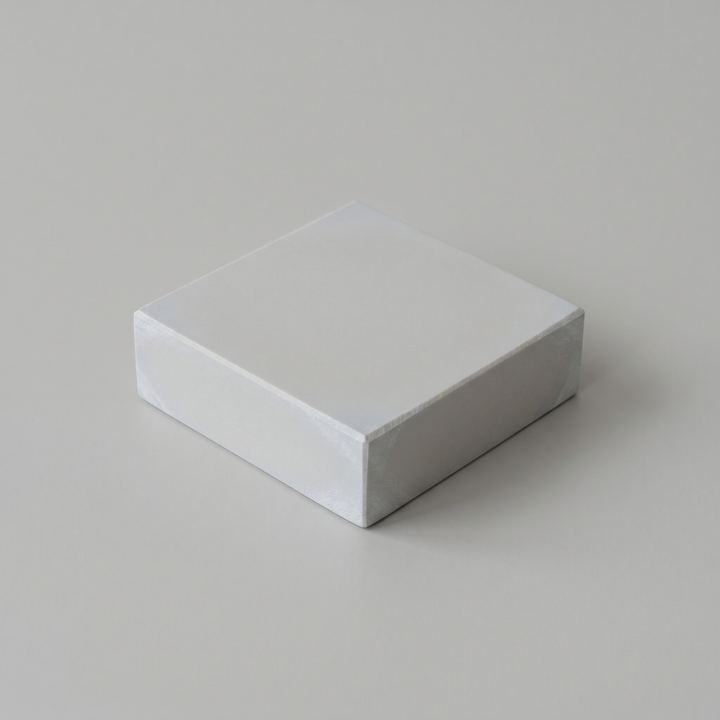
A white-grey body with a luminous edge that sets it apart from unfluxed wollastonite siblings — the titanium content shifts the fired surface toward a brighter, slightly cooler register, with the finest cast of warm undertone from residual iron in the alumina precursor. At 3.517 g/cm³ and 85×85×39 mm the slab sits firmly in the single-hand lift for short moves, a two-hand grip for sustained handling, close to a dense fired tile. Skin reads vitrified matte, finer-grained than a Portland body would finish, edging toward a partial surface glaze. Edges cold-cut with a clean, white-dusted kerf. Rings brighter than Portland concrete on the tap.
Recipe
1000 g batch · peak 1100 °C| element | precursor | formula | mass | safety |
|---|---|---|---|---|
| Al | calcined alumina | Al2O3 | 16.39 g | safe |
| Ca | calcium carbonate / limestone | CaCO3 | 48.27 g | safe |
| Si | quartz flour / silica | SiO2 | 9.66 g | safe |
| Ti | titanium dioxide (rutile) | TiO2 | 25.68 g | safe |
- 1Ramp
- 2Hold
- 3Ramp
- 4Hold
- 6Ramp
- 7Hold