Ca₁₂Fe₈O₄₈Si₄Sn₈
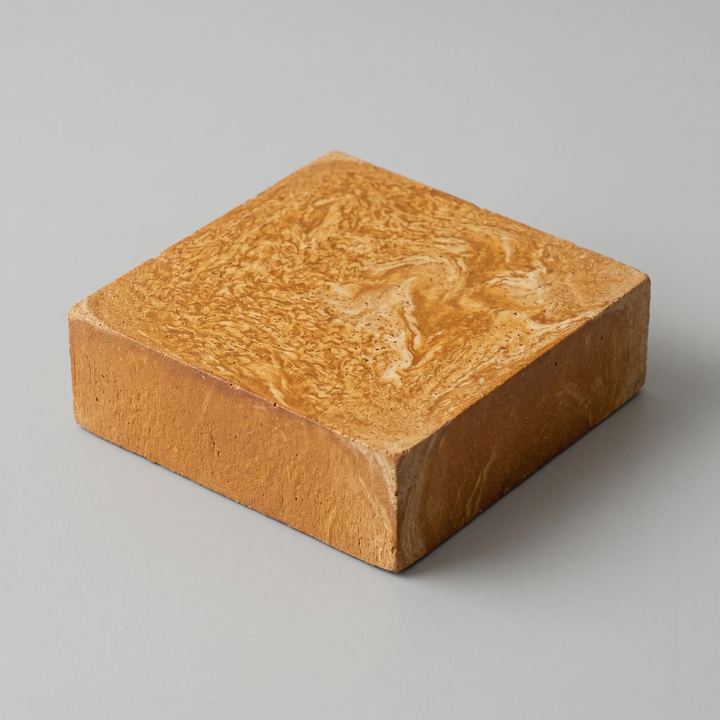
heavy oxide ceramic · thermal mass ceramicCa12Fe8O48Si4Sn8 is a heavy oxide ceramic suitable as thermal mass ceramic. Color: amber-brown. Fired at 1250°C from 4 precursors (SnO2, CaCO3, Fe2O3). Workshop batch: 200g at €3.22. Compressive strength ~50 MPa; estimated 0.94 kg CO₂/kg (+326% vs clay brick). Notable: no special functions flagged. Confidence: medium.
- forms at
- 1250 °C · high-fire
- replaces
- clay brick
- CO₂
- 326% higher than clay brick (0.94 vs 0.22 kg CO₂/kg; 4.3× higher)
- energy
- 108% higher than clay brick (6.25 vs 3.00 MJ/kg; 2.1× higher)
- compressive
- 50 MPa
- density
- 4.48 g/cm³
- crystal
- tetragonal
- band gap
- —
- cost
- €16.10/kg · €3.22 / 200 g batch
- confidence
- medium (synthesis route)
- potential
- 0.24 · env 0.00 · novel 0.00 · struct 0.10 · lineage 0.80 · supply 0.70
Architectural potential
A calcium-iron-tin silicate in the thermal-mass register — the amber-brown iron-oxide content gives the body the warm register of terracotta while the tin content lifts its fired density into serious heat-storage territory. At 50 MPa of compression the material is not structural, so specification belongs to surface and infill work rather than load-bearing wall. Natural placements are thermal-wall infill tiles on south-facing elevations, amber-toned hypocaust floor patches in greenhouse and conservatory architecture, trombe-wall inlays where the warm iron-oxide face is a deliberate chromatic argument, and radiant-panel cladding in passive-solar pavilions. The amber-brown surface does architectural work that the neutral thermal-mass siblings cannot: it reads visually warm at all times, not only under solar gain, which matters in seasonal architecture where the visual cue of thermal presence supplements the physical performance. Against clay brick the embodied CO₂ runs four times higher, so specification has to be small-area and deliberate — a patch, a sill, a thermal band within a larger infill — not a whole wall. Workshop batch reaches 500 g, cost is €3.22 per 200 g, supply-chain score is 1.0 with commercially available precursors. The caveat is compression: 50 MPa forbids load-bearing placement, so the tile field must ride on a structural substrate rather than stand as its own wall.
Material character
An amber-brown body that reads unmistakably as an iron-oxide-rich fired ceramic — the tin content modifies the surface toward a slightly cooler, glassier finish than pure terracotta would carry, but the warm earth register dominates. At 4.481 g/cm³ and 85×85×31 mm the slab sits comfortably in the single-hand lift, close to a dense architectural floor tile in weight register. Surface reads vitrified matte with faint warm sheen, a tighter grain than unfluxed iron-oxide bodies and a fractionally higher surface sheen from the tin flux. Edges come cold-cut with a warm-dusted kerf. Rings slightly higher than an ordinary terracotta on the tap.
Recipe
200 g batch · peak 1250 °C| element | precursor | formula | mass | safety |
|---|---|---|---|---|
| Ca | calcium carbonate / limestone | CaCO3 | 36.55 g | safe |
| Fe | iron(III) oxide (red) | Fe2O3 | 19.44 g | safe |
| Si | quartz flour / silica | SiO2 | 7.31 g | safe |
| Sn | tin(IV) oxide | SnO2 | 36.69 g | safe |
- 1Ramp
- 2Hold
- 3Ramp
- 4Ramp
- 5Hold
- 6Ramp
- 7Ramp