Al₂Ca₁₂O₄₈Si₁₂V₆
calcium silicate · cement alternativeAl2Ca12O48Si12V6 is a calcium silicate suitable as cement-alternative. Color: white-grey. Fired at 1100°C from 4 precursors (CaCO3, SiO2, V2O5). Workshop batch: 1000g at €31.18. Compressive strength ~200 MPa; estimated 0.68 kg CO₂/kg (-19% vs Portland cement). Notable: no special functions flagged. Confidence: medium.
- forms at
- 1100 °C · high-fire
- replaces
- portland cement
- CO₂
- 18.7% lower than Portland cement (0.68 vs 0.83 kg CO₂/kg)
- energy
- 18.2% lower than Portland cement (4.50 vs 5.50 MJ/kg)
- compressive
- 200 MPa
- density
- 3.59 g/cm³
- crystal
- monoclinic
- band gap
- —
- cost
- €31.18/kg · €31.18 / 1000 g batch
- confidence
- medium (synthesis route)
- potential
- 0.34 · env 0.23 · novel 0.00 · struct 0.60 · lineage 0.50 · supply 0.70
Architectural potential
An aluminium-vanadium-modified calcium silicate fired at 1100 °C — a serious dense calcium-silicate binder at 200 MPa of compression and a nineteen-per-cent cut in embodied CO₂ against Portland cement. The full supply-chain score (1.0) and the 5 kg workshop ceiling make this one of the more specifiable low-CO₂ cement substitutes in this batch: non-reinforced slab work for landscape walls and garden-room floors, prefabricated cladding panels for low-carbon housing, site-cast foundation plinths for pavilion architecture, and thin-panel screeds in retrofit carpentry where conventional concrete would over-burden a timber floor system. Against Portland cement the pouring logic and formwork detail stay familiar, so the contractor-culture translates directly — the building still looks like a concrete building, but with the kiln energy of the binder cut nearly one-fifth. The vanadium fraction does not carry an active chemistry here; it sits as a lattice stabiliser, which keeps the specification free of the niche-function tax. The caveat is cost: €31.18 per 1 kg batch is the highest in the low-CO₂ binder group, and the nineteen-per-cent CO₂ cut has to justify itself against lower-cost supplementary cementitious materials that already sit in the market at higher replacement rates.
Material character
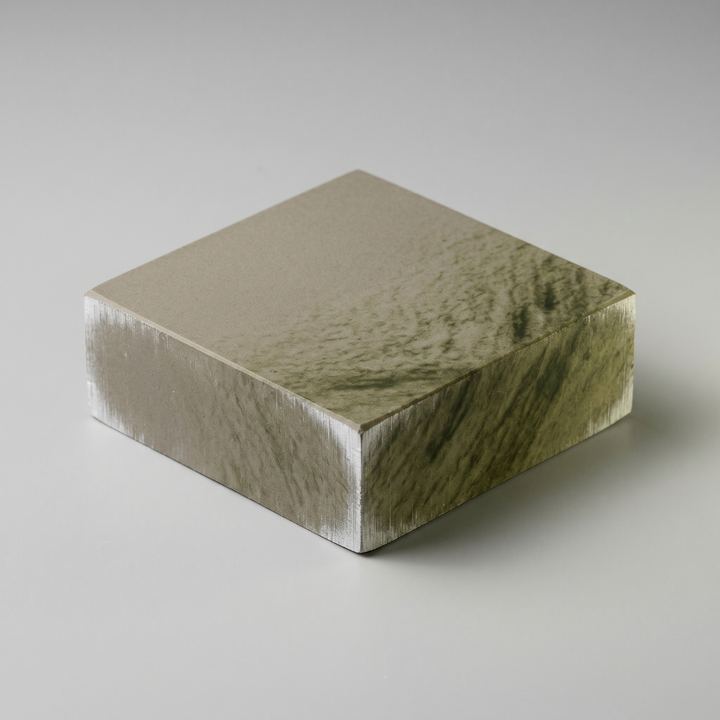
A clean white-grey body with a slight blue-cast undertone from the vanadate phase — cooler than the iron-stained calcium-silicate siblings, flatter in reflected light than the strontium-modified ones. At 3.59 g/cm³ and 85×85×39 mm the slab is firm two-handed, heavier in hand than the standard calcium-silicate blocks thanks to the vanadium loading. Surface vitrified skin, satin-matte, edging toward a partial glaze where the aluminium fraction flushed the silicate network. Edges cold-cut, the kerf bright white with a fine dust at the saw line. Against a pure calcium-silicate sibling the ring under tap is higher and cleaner, and the body reads visibly denser and cooler-toned under side-lighting.
Recipe
1000 g batch · peak 1100 °C| element | precursor | formula | mass | safety |
|---|---|---|---|---|
| Al | calcined alumina | Al2O3 | 3.97 g | safe |
| Ca | calcium carbonate / limestone | CaCO3 | 46.74 g | safe |
| Si | quartz flour / silica | SiO2 | 28.06 g | safe |
| V | vanadium pentoxide | V2O5 | 21.23 g | moderate |
- 1Ramp
- 2Hold
- 3Ramp
- 4Hold
- 6Ramp
- 7Hold