Li₂O₄SrTi
perovskite ceramic · functional ceramicLi2O4Sr1Ti1 is a perovskite ceramic suitable as functional-ceramic. Color: neutral. Fired at 1300°C from 3 precursors (SrCO3, TiO2, Li2CO3). Workshop batch: 200g at €9.57. Compressive strength ~100 MPa; estimated 0.97 kg CO₂/kg (+343% vs clay brick). Notable: ferroelectric. Confidence: medium.
- forms at
- 1300 °C · extreme-fire
- replaces
- clay brick
- CO₂
- 343% higher than clay brick (0.97 vs 0.22 kg CO₂/kg; 4.4× higher)
- energy
- 117% higher than clay brick (6.50 vs 3.00 MJ/kg; 2.2× higher)
- compressive
- 100 MPa
- density
- 3.59 g/cm³
- crystal
- tetragonal
- band gap
- 4.62 eV
- cost
- €47.85/kg · €9.57 / 200 g batch
- confidence
- medium (synthesis route)
- potential
- 0.18 · env 0.00 · novel 0.30 · struct 0.20 · lineage 0.50 · supply 0.00
- flags
- ferroelectric: Piezoelectric or similar coupled-field behaviour — the material converts mechanical load to charge (and back). Floor tiles that harvest footfall, panels that sense vibration, façade elements that log wind load are the architectural reach.
Architectural potential
The architectural claim on this lithium-doped strontium-titanate is that the floor can harvest footfall, the wall can sense its own loading, and a façade panel can log wind-pressure events without an electronics package embedded behind it. Ferroelectric-piezoelectric coupling means mechanical pressure on the slab generates a measurable charge and an applied charge induces a measurable deformation — the material itself is the sensor and the actuator. Natural placements are in atria and transit-station floor tiles where footfall data feeds either an occupancy display or a local low-power circuit; in library and museum façade patches that record wind-load history as a material signature; and in piezoelectric resonator tiles used to tune acoustic dead zones in music rooms. It is not a wall material in the cladding sense — at 100 MPa, 343 % of clay-brick embodied CO₂ and a supply-chain score of zero, the specification lives in the signature-tile register. The caveat is verification: the ferroelectric behaviour only becomes architectural once the piece has been electrically poled and its domain structure confirmed by piezo-force microscopy, adding a fabrication step that conventional tile production does not carry.
Material character
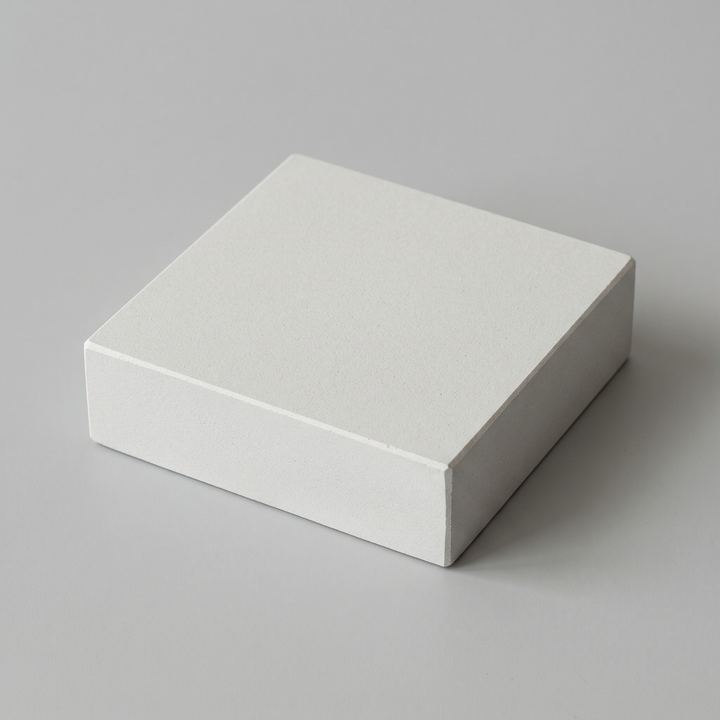
The face reads a clean neutral white-grey, a shade cooler than the grey photographic ground, with the high-purity fine-grained skin of a technical ceramic destined for an electronics cleanroom rather than a kiln yard. At 3.59 g/cm³ the 85×85×39 mm slab handles firmly single-handed; the matte sinter gives no optical clue to the ferroelectric chemistry beneath. Edges cold-cut. The slab's restraint is the point — it looks deliberately ordinary, a blank technical white, because the interesting domain structure lives below the surface and only reveals itself under piezo-response imaging.
Recipe
200 g batch · peak 1300 °C| element | precursor | formula | mass | safety |
|---|---|---|---|---|
| Li | lithium carbonate | Li2CO3 | 24.52 g | safe |
| Sr | strontium carbonate | SrCO3 | 48.98 g | safe |
| Ti | titanium dioxide (rutile) | TiO2 | 26.5 g | safe |
- 1Ramp
- 2Hold
- 3Ramp
- 4Ramp
- 5Hold
- 6Ramp
- 7Ramp
Ferroelectric — spontaneous electric polarization, switchable