O₂₄P₆WZr₃
heavy oxide ceramic · thermal mass ceramicO24P6W1Zr3 is a heavy oxide ceramic suitable as thermal mass ceramic. Color: neutral. Fired at 1250°C from 3 precursors (Ca3(PO4)2, ZrO2, WO3). Workshop batch: 200g at €27.80. Compressive strength ~300 MPa; estimated 0.94 kg CO₂/kg (+326% vs clay brick). Notable: electrochromic tungstate. Confidence: medium.
- forms at
- 1250 °C · high-fire
- replaces
- clay brick
- CO₂
- 326% higher than clay brick (0.94 vs 0.22 kg CO₂/kg; 4.3× higher)
- energy
- 108% higher than clay brick (6.25 vs 3.00 MJ/kg; 2.1× higher)
- compressive
- 300 MPa
- density
- 3.24 g/cm³
- crystal
- trigonal
- band gap
- 2.82 eV
- cost
- €139.00/kg · €27.80 / 200 g batch
- confidence
- medium (synthesis route)
- potential
- 0.41 · env 0.00 · novel 1.00 · struct 0.60 · lineage 0.50 · supply 0.00
- flags
- electrochromic tungstate: A voltage-switchable optical chemistry. In thin-film form a small DC signal shifts transmission from clear to tinted blue, opening the door to dimmable glazing and responsive partitions that do not need mechanical shading.
Architectural potential
A phosphate-tungstate-zirconate ceramic fired at 1250 °C, 300 MPa of compression, carrying the electrochromic tungstate chemistry inside a dense thermal-mass body. The combination is specific: a heavy tile that stores solar gain all day and can be switched between clear and tinted states on a DC signal — a thermal battery with an optical state channel. Natural placements are programmable trombe-wall panels that change colour register through the daily cycle, radiant-heat cladding tiles at the back of a passive-solar atrium where the tint tracks occupancy, and hypocaust floor slabs that can be shifted visually to signal which zone is currently releasing heat. At 326 per cent higher embodied CO₂ than clay brick and 108 per cent higher embodied energy, the bulk-use path is closed; specification lives at the signature-tile and demonstration-element scale. The caveat is sharper than the thermal-mass-only siblings: the supply-chain score sits at zero because phosphate-tungstate-zirconate routes draw on three separate rare feedstocks with no shared supplier, and 200 g workshop batches at €27.80 put any real project in a category where every piece has to be characterised individually before installation.
Material character
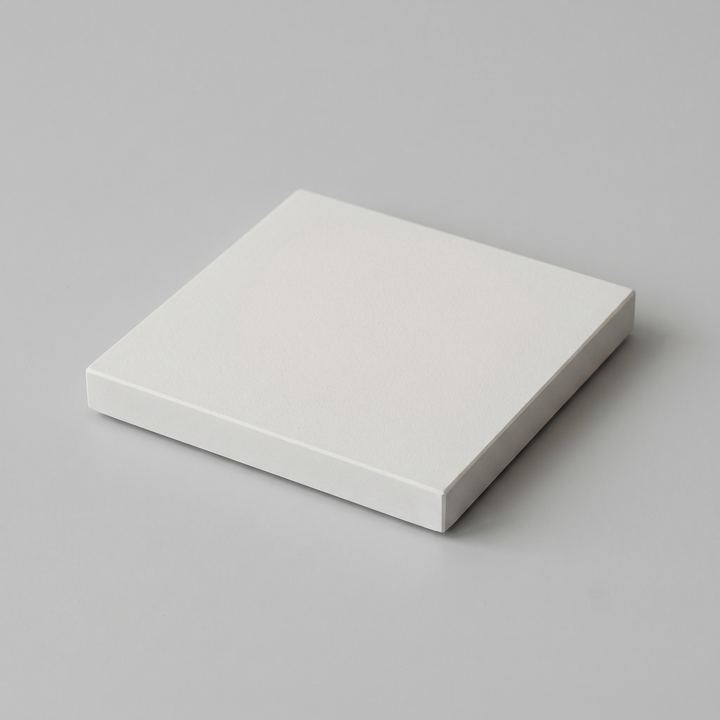
A neutral warm grey with an olive undertone from the tungstate phase — quieter than the blue-grey of a pure tungstate sibling, and darker than a plain zirconate of the same firing. At 3.24 g/cm³ and 85×85×43 mm the slab sits firm two-handed, lighter than the zirconate-only variants thanks to the phosphate fraction opening up the lattice. Surface vitrified skin, satin-matte, with a faint mottling where the phosphate and tungstate phases separated at peak fire. Edges cold-cut, kerf lightly powdered. Against the pure-zirconate siblings the body runs warmer and slightly softer in the ring under tap, and the post-switched state shifts to a visible blue-tinted face under a DC signal.
Recipe
200 g batch · peak 1250 °C| element | precursor | formula | mass | safety |
|---|---|---|---|---|
| P | tricalcium phosphate | Ca3(PO4)2 | 60.74 g | safe |
| W | tungsten trioxide (yellow) | WO3 | 15.13 g | moderate |
| Zr | zirconium dioxide | ZrO2 | 24.13 g | safe |
- 1Ramp
- 2Hold
- 3Ramp
- 4Ramp
- 5Hold
- 6Ramp
- 7Ramp
Electrochromic — color switches under applied voltage (thin-film chemistry)