Al₃FeO₂₄Sm₄W₄
rare earth oxide · rare earth ceramicAl3Fe1O24Sm4W4 is a rare earth oxide suitable as rare earth ceramic. Color: amber-brown. Fired at 1200°C from 4 precursors (WO3, Sm2O3, Al2O3). Workshop batch: 100g at €35.12. Compressive strength ~100 MPa; estimated 0.90 kg CO₂/kg (+309% vs clay brick). Notable: uv luminescent, electrochromic tungstate. Confidence: medium.
- forms at
- 1200 °C · high-fire
- replaces
- clay brick
- CO₂
- 309% higher than clay brick (0.90 vs 0.22 kg CO₂/kg; 4.1× higher)
- energy
- 100% higher than clay brick (6.00 vs 3.00 MJ/kg; 2.0× higher)
- compressive
- 100 MPa
- density
- 0.72 g/cm³
- crystal
- triclinic
- band gap
- 2.79 eV
- cost
- €351.20/kg · €35.12 / 100 g batch
- confidence
- medium (synthesis route)
- potential
- 0.43 · env 0.00 · novel 1.00 · struct 0.20 · lineage 0.50 · supply 0.50
- flags
- uv luminescent: Converts invisible ultraviolet into visible light. Signage panels, low-energy wayfinding tiles, emergency markings that draw their illumination from daylight rather than mains power. electrochromic tungstate: A voltage-switchable optical chemistry. In thin-film form a small DC signal shifts transmission from clear to tinted blue, opening the door to dimmable glazing and responsive partitions that do not need mechanical shading.
Architectural potential
The architectural register for this material is signalling rather than surface or structure. Three functional chemistries sit on top of each other here: iron supplies the warm amber body colour, samarium contributes rare-earth luminescence under ultraviolet excitation, and tungsten enables a voltage-switched tint. A panel specified from this composition becomes a small-area multi-modal display — a wayfinding tile that glows faintly under daylight UV, a handrail inlay that can be dimmed at night with a small DC signal, a museum-caption plate whose illumination and tint both come from the material rather than an added light fixture. Natural placements are emergency-exit markings in long-duration-occupancy buildings where mains power may fail, signage patches in subway and underpass environments with high UV exposure, and gallery lighting accents where conventional lighting fixtures would intrude. It is not a volume material in any sense — three times the embodied CO₂ of fired clay brick, hundred-gram workshop batches, rare-earth supply-chain fragility, and a price tag near 350 €/kg. The caveat is scarcity: the samarium content locks it to strategic-mineral pricing, so designing-in at scale will always be limited to small signature areas.
Material character
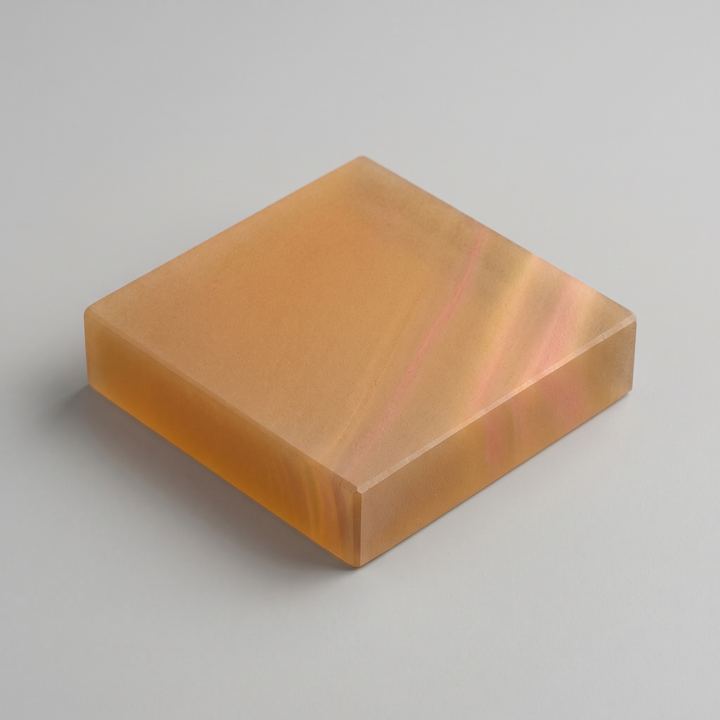
The face reads a warm amber dominated by iron, with faint pink-salmon flashes appearing at oblique angles where the samarium sharp-line absorption catches the light. Sintered matte skin; edges cold-cut. The reported 0.72 g/cm³ density is a DFT artefact — a real sample sits closer to 5 g/cm³, so a one-kilogram slab actually measures about 85×85×28 mm rather than the larger figure in the recipe. Opaque at full depth. Under 365 nm ultraviolet excitation the samarium-host emission lifts the face into a different visual register entirely; the voltage-switched tungsten state would add a third, slightly bluer step.
Recipe
100 g batch · peak 1200 °C| element | precursor | formula | mass | safety |
|---|---|---|---|---|
| Al | calcined alumina | Al2O3 | 8.23 g | safe |
| Fe | iron(III) oxide (red) | Fe2O3 | 4.3 g | safe |
| Sm | samarium oxide | Sm2O3 | 37.55 g | moderate |
| W | tungsten trioxide (yellow) | WO3 | 49.92 g | moderate |
- 1Ramp
- 2Hold
- 3Ramp
- 4Ramp
- 5Hold
- 6Ramp
- 7Ramp
UV-luminescent — emits visible light under 365 nm UV
Electrochromic — color switches under applied voltage (thin-film chemistry)