B₆O₁₆Si₂Sr₃
borosilicate glass · structural translucent advancedB6O16Si2Sr3 is a borosilicate glass suitable as structural translucent advanced. Color: neutral. Fired at 1300°C from 3 precursors (SrCO3, B2O3, SiO2). Workshop batch: 200g at €3.63. Compressive strength ~500 MPa; estimated 1.01 kg CO₂/kg (+18% vs float glass). Notable: no special functions flagged. Confidence: medium.
- forms at
- 1300 °C · extreme-fire
- replaces
- float glass
- CO₂
- 18% higher than float glass (1.01 vs 0.86 kg CO₂/kg; 1.2× higher)
- energy
- 55.0% lower than float glass (6.75 vs 15.00 MJ/kg)
- compressive
- 500 MPa
- density
- 3.58 g/cm³
- crystal
- triclinic
- band gap
- —
- cost
- €18.15/kg · €3.63 / 200 g batch
- confidence
- medium (synthesis route)
- potential
- 0.48 · env 0.69 · novel 0.00 · struct 1.00 · lineage 0.80 · supply 0.00
Architectural potential
A translucent-mass borosilicate pitched to the light-admitting structural register rather than to sheet-glazing. Five hundred megapascals of compression and 3.58 g/cm³ density lift the body out of the float-glass family and into the inhabitable translucent solid zone. The strontium content densifies the matrix and pushes the thermal stability well above window-glass, making the material a candidate for monolithic light-admitting columns in public interiors, pressed-glass stair treads with genuine load-bearing capacity, structural skylights in gallery roofs where the roof plane itself carries, and ritual thresholds in chapels and crematoria where a translucent pier replaces a conventional steel-and-glass assembly. The eighteen-per-cent CO₂ increase against float glass is a real cost; it is paid for not by carbon saving but by a fifty-five-per-cent cut in process energy and by the fact that a single poured element replaces a multi-part assembly. The caveat is hard: supply-chain score is zero, meaning strontium borosilicate is not in any standard architectural supply chain today, and the 1300 °C peak firing limits specification to facilities with industrial-glass kilns. Architectural use remains untested in production at column scale and belongs currently in prototype, gallery-pier, and signature-stair-tread work rather than in any repeated structural application.
Material character
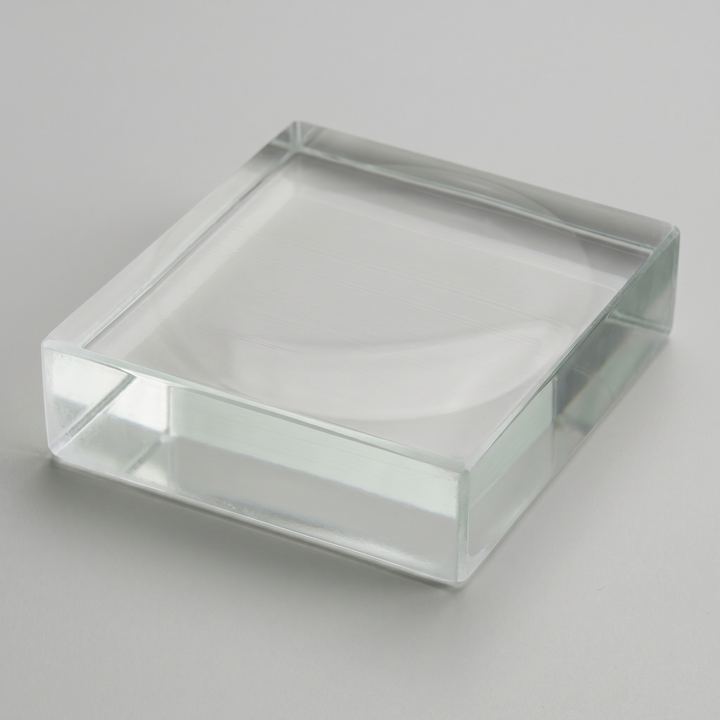
Fired to 1300 °C and annealed slowly, the slab reads clean neutral — close to a water-clear window glass but with a faint warm cast from the strontium and a slightly denser internal light than float. At 3.58 g/cm³ and 85×85×39 mm the slab refuses the one-handed lift and sits solidly on the bench, a full step heavier than ordinary soda-lime glass of the same footprint. Surface is pressed-glass smooth with a shallow convex crown on the top face; edges cold-cut, carrying the lapidary bloom of diamond-saw work. Two thin anneal striae run parallel near one long edge, faint but legible when sighted along the length.
Recipe
200 g batch · peak 1300 °C| element | precursor | formula | mass | safety |
|---|---|---|---|---|
| B | boron oxide (or borax Na2B4O7) | B2O3 | 27.06 g | safe |
| Si | quartz flour / silica | SiO2 | 15.57 g | safe |
| Sr | strontium carbonate | SrCO3 | 57.38 g | safe |
- 1Ramp
- 2Hold
- 3Ramp
- 4Hold
- 5Ramp
- 6Hold