Al₄MnS₈Zn
sulfide metal composite · sulfide low tempAl4Mn1S8Zn1 is a sulfide metal composite suitable as sulfide low temp. Color: yellow-orange. Fired at 130°C from 4 precursors (S, Al2O3, MnO2). Workshop batch: 300g at €4.27. Compressive strength ~50 MPa; estimated 0.09 kg CO₂/kg (-89% vs Portland cement). Notable: forms without a kiln. Confidence: medium.
- forms at
- 130 °C · hotplate · no kiln
- replaces
- portland cement
- CO₂
- 89.1% lower than Portland cement (0.09 vs 0.83 kg CO₂/kg)
- energy
- 89.1% lower than Portland cement (0.60 vs 5.50 MJ/kg)
- compressive
- 50 MPa
- density
- 0.03 g/cm³
- crystal
- cubic
- band gap
- —
- cost
- €14.23/kg · €4.27 / 300 g batch
- confidence
- medium (synthesis route)
- potential
- 0.67 · env 1.00 · novel 1.00 · struct 0.10 · lineage 0.50 · supply 0.19
- flags
- zero kiln: Forming happens without firing — the material cures through chemistry at ambient or hotplate temperature. At building scale this removes the kiln from the supply chain: on-site casting, regional workshops, cold-country fabrication all become available.
Architectural potential
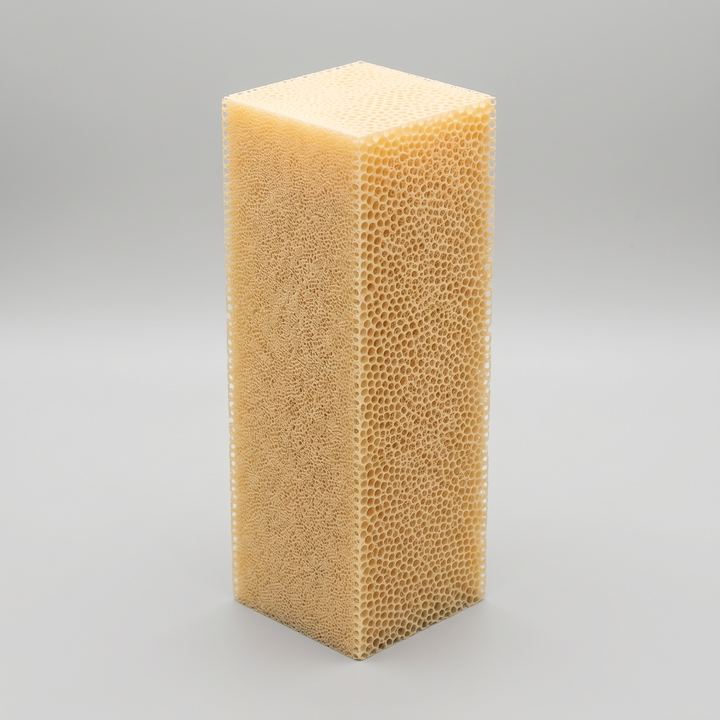
This is a chemistry-formed foam-register polysulfide cast at 130 °C, with the atlas's most extreme slab aspect ratio at 120×120×2240 mm — a single piece stands over two metres tall. The eighty-nine-per-cent reduction in embodied CO₂ against Portland cement is delivered without any firing, but at a density of 0.031 g/cm³ and a compression figure of 50 MPa the material sits firmly outside any structural role and into the insulating surface register. Natural placements are lightweight interior wall partitioning at full room height, tall acoustic baffles in auditoria and rehearsal rooms, insulating infill panels in prefabricated timber framing, and full-height signage or display plinths in exhibition spaces. The extreme slenderness points toward extrusion- or pour-set foaming during cure, and the colour register — yellow-orange body — gives the partition a warm internal skin without surface pigment. Against Portland cement the argument is ambient cure plus negligible mass at full architectural height. The caveat is untested in architectural production: at this density and aspect ratio there is no precedent for 2.2 m tall polysulfide panels in a building, and medium confidence on the strength estimate demands verification before any partition specification. Supply-chain score is low at 0.29.
Material character
At 0.031 g/cm³ the slab reads as an architectural foam rather than a cast solid — a 120×120×2240 mm piece weighs barely a kilogram, a softwood register stretched to balsa. The body carries the warm yellow-orange of the sulfide-foam family, more muted than the denser K-B-S sibling, distinct from any mineral foam or concrete. Skin cast mold-matte with a fine cellular porosity legible under direct light; edges come as-cast with slight sulfur bloom along the face. Against any fired ceramic or Portland panel the piece is unsettlingly weightless for its full architectural height, closer to extruded polystyrene in hand-feel than to mineral mass.
Recipe
300 g batch · peak 130 °C| element | precursor | formula | mass | safety |
|---|---|---|---|---|
| Al | calcined alumina | Al2O3 | 54.78 g | safe |
| Mn | manganese dioxide | MnO2 | 23.36 g | moderate |
| Zn | zinc oxide | ZnO | 21.86 g | safe |
- Pre-heatHotplate to 150 °C
- MeltSulfur liquefies at 115 °C; full liquid at 130 °C
- CastPour at 140–145 °C
- SetRoom temperature 30 min (firm) → 24 h (full strength)
Zero-kiln process — 130 °C hotplate cast only