Co₃CuSiSnY₁₂
metal pm only · sintered metalCo3Cu1Si1Sn1Y12 is a metal pm only suitable as sintered-metal. Color: green-red-copper. Fired at 1100°C from 5 precursors (Y, Co, Sn). Workshop batch: 200g at €9.38. Compressive strength ~350 MPa; estimated 0.84 kg CO₂/kg (-53% vs structural steel). Notable: no special functions flagged. Confidence: medium.
- forms at
- 1100 °C · high-fire
- replaces
- structural steel
- CO₂
- 53.1% lower than structural steel (0.84 vs 1.80 kg CO₂/kg)
- energy
- 74.4% lower than structural steel (5.62 vs 26.00 MJ/kg)
- compressive
- 350 MPa
- density
- 0.53 g/cm³
- crystal
- orthorhombic
- band gap
- 0.00 eV
- cost
- €46.90/kg · €9.38 / 200 g batch
- confidence
- medium (synthesis route)
- potential
- 0.45 · env 0.74 · novel 0.00 · struct 0.84 · lineage 0.20 · supply 0.50
Architectural potential
A heavily yttrium-loaded sintered metal with copper, cobalt and tin as minor modifiers, fired at 1100 °C and reaching 350 MPa. At building scale its natural place is sintered hardware in the bracket-to-connector register: façade clips for rainscreen cladding, CLT-to-steel shear plates, furniture joints for gallery benches, and custom nodes for small-span trusses in pavilion and exhibition architecture. Against structural steel the embodied CO₂ is down fifty-three per cent and the energy down seventy-four per cent, so the environmental argument carries moderately-repeated runs of identical nodes — the kind of specification that suits a prefabricated timber canopy or a steel-framed addition to an existing masonry building. No shape-memory flag accompanies this entry, so the piece sits as a static connector rather than an active one; its argument is fabricated geometry at medium cost, not mechanical responsiveness. Tin and copper push machining and finishing behaviour closer to a bronze than to a plain ferrous sinter, which makes the alloy friendly to threaded inserts and drilled attachments. The caveat is the same anomaly that recurs in this batch: the recorded density of 0.53 g/cm³ is implausible for a metal of this composition and reads as a porous or foamed sinter, which needs bench verification before any piece goes into structural service.
Material character
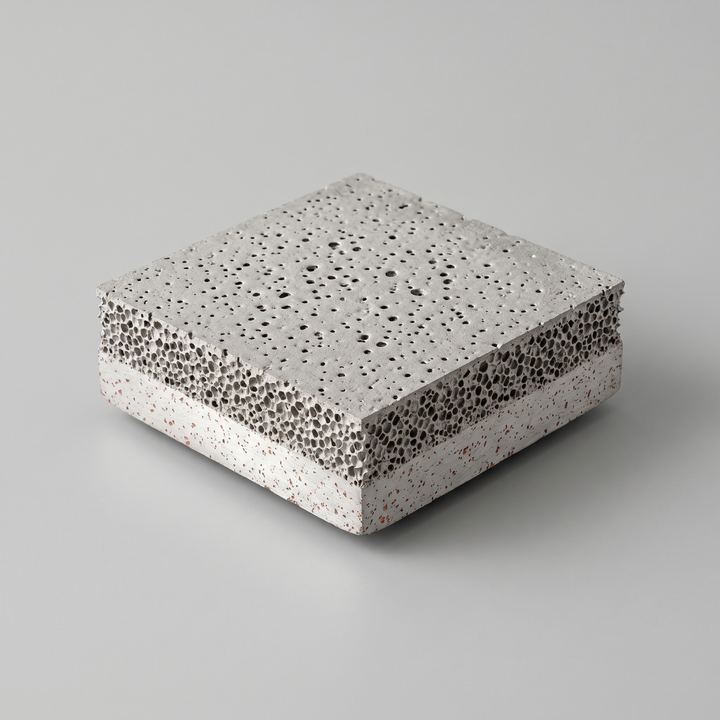
The face reads a quiet green-red copper — yttrium's silvery matrix cooled by cobalt, warmed by copper and tin, more muted than a bronze casting and paler than a clean steel sinter. At 0.53 g/cm³ over a 120×120×131 mm slab the piece firms single-handed on the bench, a distinctly lighter register than any solid metal expectation — softwood in the hand. Skin carries the sintered matte grain of a pressed-and-fired powder part, with visible micro-porosity under raking light. Edges cold-cut, kerf slightly ragged where the porous body grazes the blade. Reads dead on tap, a muffled acoustic unique to porous sinters.
Recipe
200 g batch · peak 1100 °C| element | precursor | formula | mass | safety |
|---|---|---|---|---|
| Co | cobalt powder | Co | 12.16 g | moderate |
| Cu | copper shot/powder | Cu | 4.37 g | safe |
| Si | silicon granules | Si | 1.93 g | safe |
| Sn | tin ingot | Sn | 8.16 g | safe |
| Y | yttrium metal | Y | 73.37 g | moderate |
- 1Ramp
- 2Hold
- 3Ramp
- 4Hold
- 5Ramp
- 6Ramp
- 7END