Na₆S₁₂Te₆
sulfide polysulfide · sulfide low tempNa6S12Te6 is a sulfide polysulfide suitable as sulfide low temp. Color: yellow-orange. Fired at 130°C from 2 precursors (S, Na2CO3). Workshop batch: 500g at €0.99. Compressive strength ~150 MPa; estimated 0.09 kg CO₂/kg (-89% vs Portland cement). Notable: forms without a kiln. Confidence: high.
- forms at
- 130 °C · hotplate · no kiln
- replaces
- portland cement
- CO₂
- 89.1% lower than Portland cement (0.09 vs 0.83 kg CO₂/kg)
- energy
- 89.1% lower than Portland cement (0.60 vs 5.50 MJ/kg)
- compressive
- 150 MPa
- density
- 3.48 g/cm³
- crystal
- monoclinic
- band gap
- 0.00 eV
- cost
- €1.98/kg · €0.99 / 500 g batch
- confidence
- high (synthesis route)
- potential
- 0.78 · env 1.00 · novel 1.00 · struct 0.30 · lineage 1.00 · supply 0.26
- flags
- zero kiln: Forming happens without firing — the material cures through chemistry at ambient or hotplate temperature. At building scale this removes the kiln from the supply chain: on-site casting, regional workshops, cold-country fabrication all become available.
Architectural potential
A zero-kiln sodium-sulphide-telluride cast at 130 °C that reaches 150 megapascals of compression at a remarkable 0.99 euro per 200 g batch — the cheapest compression-capable polysulfide in this palette. Against Portland cement the CO₂ drop is eighty-nine per cent and the energy drop is the same, since there is no firing at all. Architecturally this is the low-cost zero-kiln detail tile: hotplate-cast floor tile for pavilion and workshop interiors, cast threshold bars in retrofit carpentry, inlay panels in acoustic walls, and thick drop-cast hardware for timber assemblies. Because tellurium narrows the bandgap effectively to zero, the body is electrically conductive — a real opening for grounding plates, shielding liners in lab interiors, and contact-surface tile where static dissipation matters. The cement comparison makes the carbon argument legible: the same compressive weight in the hand, with the entire kiln taken out of the supply chain. The caveat is tellurium itself: supply-chain score sits below 0.3, and any saw-cutting releases sulphide odour that needs adequate ventilation. This is a detail-scale material with a specific electrical capability attached, not a bulk cladding, and should be specified where the conductive property carries its own argument for the niche.
Material character
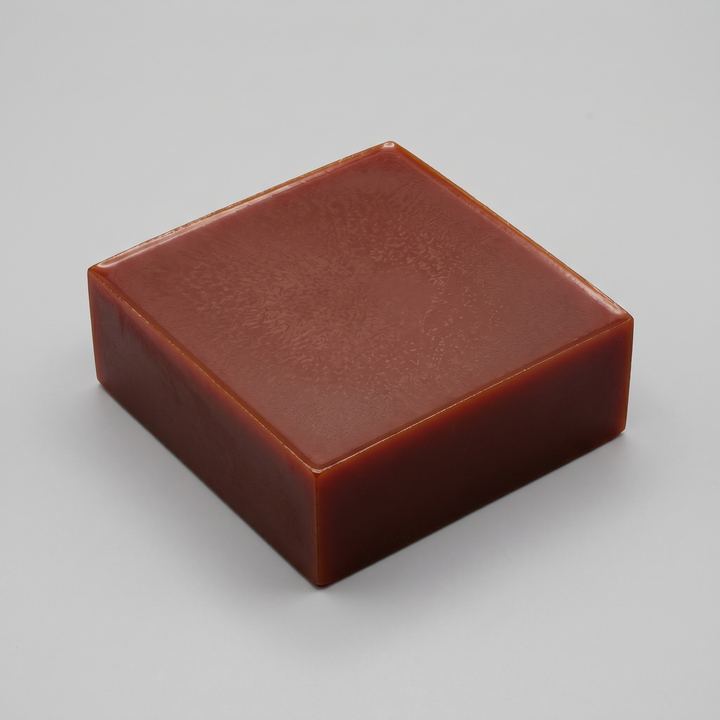
A saturated yellow-orange body at 3.48 g/cm³ — nearly double the sodium-magnesium sibling and closer to the denser polysulfides in hand-feel. The 85×85×40 mm slab firms securely in one hand, with a perceptible density step that reads immediately as heavier-than-softwood. Surface carries cast mold-matte texture with a low meniscus sheen from the hotplate pour; edges come as-cast with a slight rounding at the corners. Tellurium darkens the body marginally toward a warm amber-orange rather than the lighter lemon tone of pure sulphur-sodium casts. A faint α-sulphur bloom crystallises unevenly across the face, legible under raking light as a fine crystalline veil.
Recipe
500 g batch · peak 130 °C| element | precursor | formula | mass | safety |
|---|---|---|---|---|
| Na | sodium carbonate / soda ash | Na2CO3 | 100.0 g | safe |
- Pre-heatHotplate to 150 °C
- MeltSulfur liquefies at 115 °C; full liquid at 130 °C
- CastPour at 140–145 °C
- SetRoom temperature 30 min (firm) → 24 h (full strength)
Zero-kiln process — 130 °C hotplate cast only