Al₈C₄Co₃CuTi₁₂
metal pm only · sintered metalAl8C4Co3Cu1Ti12 is a metal pm only suitable as sintered-metal. Color: green-red-copper. Fired at 1100°C from 5 precursors (Ti, Al, Co). Workshop batch: 200g at €6.62. Compressive strength ~350 MPa; estimated 0.84 kg CO₂/kg (-53% vs structural steel). Notable: no special functions flagged. Confidence: medium.
- forms at
- 1100 °C · high-fire
- replaces
- structural steel
- CO₂
- 53.1% lower than structural steel (0.84 vs 1.80 kg CO₂/kg)
- energy
- 74.4% lower than structural steel (5.62 vs 26.00 MJ/kg)
- compressive
- 350 MPa
- density
- 4.77 g/cm³
- crystal
- trigonal
- band gap
- 0.00 eV
- cost
- €33.10/kg · €6.62 / 200 g batch
- confidence
- medium (synthesis route)
- potential
- 0.45 · env 0.74 · novel 0.00 · struct 0.84 · lineage 0.20 · supply 0.50
Architectural potential
A titanium-aluminium sintered alloy whose architectural role is premium connector-work — signature-piece façade clips, custom bracket hardware for exhibition architecture, cast connector nodes in timber-hybrid frames, and sculptural joint-pieces for gallery furniture. At 350 MPa the alloy carries serious load for a connector-register piece, and the titanium-led matrix gives a corrosion behaviour far closer to aerospace hardware than to standard structural steel. The architectural argument against welded-steel connectors is two-fold: a fifty-three-per-cent CO₂ cut and a seventy-four-per-cent energy cut, both sharpened by the small-batch sinter route avoiding the electric-arc furnace entirely. Natural placements are exterior hardware in coastal or swimming-pool architecture where the corrosion-resistance earns the cost, custom balustrade clips for stair-work in bath-houses and natatoria, and one-off node-pieces in timber-steel hybrid frames where the copper-titanium colour is wanted to read against the adjacent timber. No shape-memory or other active behaviour is flagged, so the argument stays purely structural-aesthetic. The caveat is cost versus scale: €6.62 per 200 g batch is five times the ferrous sibling's price, and the 500 g workshop ceiling keeps specification firmly in the signature-connector range rather than in quantity hardware.
Material character
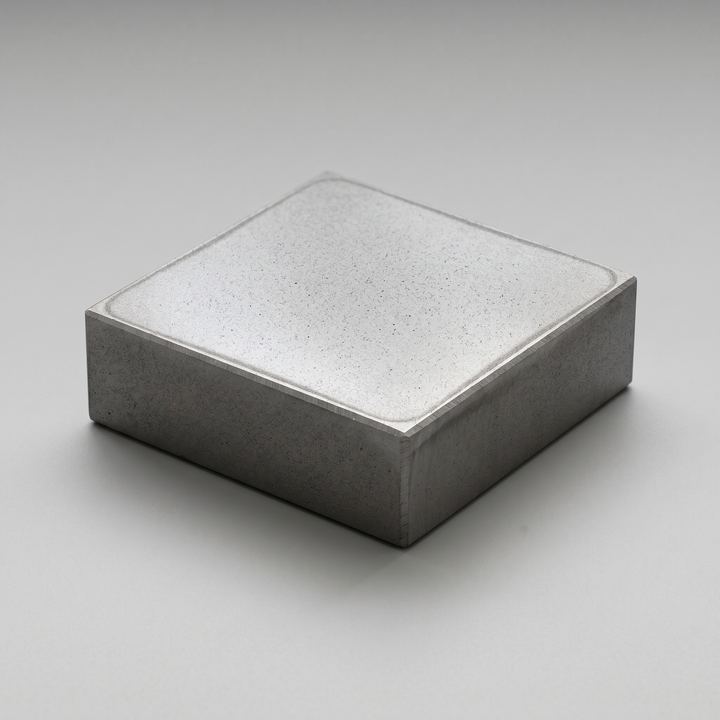
Colour reads an unusual green-red-copper for a titanium-led body — the Ti₁₂ matrix would run grey-silver on its own, but the Co₃Cu₁ additions warm the skin into a shifting oxide-copper tone that changes face with raking light. At 4.77 g/cm³ and 85×85×29 mm the slab is lighter than its ferrous cousin and sits firm one-handed despite the broad footprint. Surface carries the fine pressed-sinter grain typical of the family, slightly softer and more granular than a cast or rolled metal face. Edges cold-cut, kerf-cream. Against the Fe-Mn-Si sibling the body reads warmer, lighter, and a full kilogram closer in feel to cast bronze than to steel.
Recipe
200 g batch · peak 1100 °C| element | precursor | formula | mass | safety |
|---|---|---|---|---|
| Al | aluminum powder | Al | 20.01 g | moderate |
| C | graphite powder | C | 4.45 g | safe |
| Co | cobalt powder | Co | 16.39 g | moderate |
| Cu | copper shot/powder | Cu | 5.89 g | safe |
| Ti | titanium powder | Ti | 53.25 g | moderate |
- 1Ramp
- 2Hold
- 3Ramp
- 4Hold
- 5Ramp
- 6Ramp
- 7END