Cu₂Li₁₄Sn₈Sr₆
metal pm only · sintered metalCu2Li14Sn8Sr6 is a metal pm only suitable as sintered-metal. Color: green-red-copper. Fired at 1100°C from 4 precursors (Sn, SrCO3, Li2CO3). Workshop batch: 200g at €10.95. Compressive strength ~350 MPa; estimated 0.84 kg CO₂/kg (-53% vs structural steel). Notable: no special functions flagged. Confidence: medium.
- forms at
- 1100 °C · high-fire
- replaces
- structural steel
- CO₂
- 53.1% lower than structural steel (0.84 vs 1.80 kg CO₂/kg)
- energy
- 74.4% lower than structural steel (5.62 vs 26.00 MJ/kg)
- compressive
- 350 MPa
- density
- 4.04 g/cm³
- crystal
- hexagonal
- band gap
- 0.01 eV
- cost
- €54.75/kg · €10.95 / 200 g batch
- confidence
- medium (synthesis route)
- potential
- 0.45 · env 0.74 · novel 0.00 · struct 0.84 · lineage 0.20 · supply 0.50
Architectural potential
A lithium-heavy sintered metal body with copper and tin carrying the colour, strontium lending the unusual low density for a metallic part. Fired at 1100 °C from powder, the slab reaches 350 MPa of compressive strength at only 4.04 g/cm³ — a strength-to-weight ratio closer to aluminium castings than to structural steel, which opens a different hardware register. Where steel fittings become burdensome — suspended façade clips, stair-tread nosings, lightweight furniture joints, mullion-to-transom connector nodes in double-skin envelopes, acoustic-panel suspension brackets — this body carries the load without the dead weight. Architecturally it sits in the position once held by sand-cast aluminium hardware, but with the sinter-grain surface and colour range that aluminium cannot produce. Against structural steel the embodied CO₂ falls fifty-three per cent, so the environmental argument is real for the bracket-scale part that would otherwise be forged or cast. The caveat is lithium: at 14 atoms in 30, the lithium-carbonate precursor dominates the cost, and the 200 g batch ceiling pushes each connector into bespoke territory. Untested as a weather-exposed exterior element — lithium surface chemistry is reactive to humidity, and long-term oxidation behaviour in coastal climates is unverified.
Material character
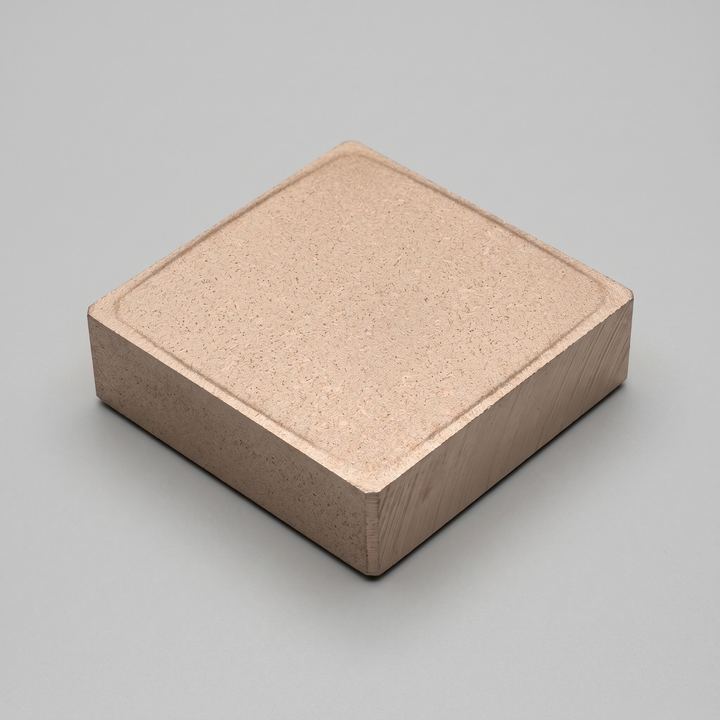
The face carries an unusual green-red-copper variegation — strontium oxide and tin lifting a pale green relief across a copper-pink matrix, the two phases legible as separate zones under oblique light. At 4.04 g/cm³ in an 85×85×34 mm block the slab reads light-for-its-size, firming single-handed where its iron-sintered siblings demand two. Surface sintered matte with a finer grain than the ruthenium variant; edges as-pressed, the shoulder kerfed clean where the press tool left its fillet. A distinctly colourful piece in a family that otherwise defaults to neutral grey, closer in visual register to patinated bronze than to sintered iron hardware. Rings bright and high when tapped, the lithium content carrying the acoustic up a register from the heavier metal-sinter siblings.
Recipe
200 g batch · peak 1100 °C| element | precursor | formula | mass | safety |
|---|---|---|---|---|
| Cu | copper shot/powder | Cu | 5.13 g | safe |
| Li | lithium carbonate (NEVER elemental Li) | Li2CO3 | 20.86 g | safe |
| Sn | tin ingot | Sn | 38.3 g | safe |
| Sr | strontium carbonate (NEVER Sr metal) | SrCO3 | 35.72 g | safe |
- 1Ramp
- 2Hold
- 3Ramp
- 4Hold
- 5Ramp
- 6Ramp
- 7END