K₄Mg₂O₂₀Si₈
alkali silicate glass · structural translucent glassK4Mg2O20Si8 is a alkali silicate glass suitable as structural translucent glass. Color: clear. Fired at 1150°C from 4 precursors (SiO2, K2CO3, MgCO3). Workshop batch: 400g at €6.96. Compressive strength ~500 MPa; estimated 0.84 kg CO₂/kg (-2% vs float glass). Notable: no special functions flagged. Confidence: high.
- forms at
- 1150 °C · high-fire
- replaces
- float glass
- CO₂
- 1.9% lower than float glass (0.84 vs 0.86 kg CO₂/kg)
- energy
- 62.5% lower than float glass (5.62 vs 15.00 MJ/kg)
- compressive
- 500 MPa
- density
- 2.47 g/cm³
- crystal
- triclinic
- band gap
- —
- cost
- €17.40/kg · €6.96 / 400 g batch
- confidence
- high (synthesis route)
- potential
- 0.64 · env 0.78 · novel 0.00 · struct 1.00 · lineage 0.70 · supply 1.00
Architectural potential
A magnesium-doped alkali-silicate glass fired at 1150 °C at workshop batch, carrying 500 MPa of compression and a clean clear body — the family's most neutral load-bearing transparent member. Natural placements are the full load-bearing transparent canon: pressed-glass floor panels walked on from above, stair treads, transparent partitions in laboratories and clean-room interiors, pressed-glass beams and ribs in entry porticos, and monolithic light-admitting columns where daylight through a structural pier is the design idea. The 100×100×40 mm slab format is the largest in this batch, which tracks with the higher workshop ceiling (5 kg) and matches the physical register of a small floor panel or a balustrade module directly. Against float glass the CO₂ is two per cent lower and the energy sixty-two per cent lower, so the carbon argument is slender but the fire argument is strong. The magnesium addition stabilises the melt and produces a cleaner anneal than the pure potassium-silicate baseline. The caveat is the tectonic: like any soda-lime relative, edge conditioning and annealing are not optional — a cracked chamfer or a rushed cool turns a 500 MPa element into a brittle one, and the detailing has to respect that from the first drawing.
Material character
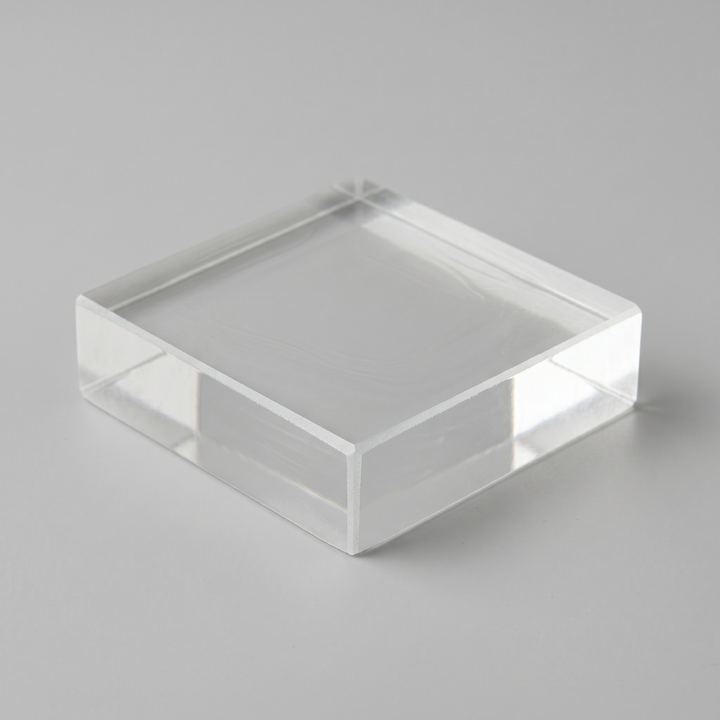
The slab reads a clean clear body without visible tint — the closest member of the atlas to ordinary window glass in colour, though not in thickness. At 2.47 g/cm³ in a 100×100×40 mm format the piece sits solidly on the bench and resists the single-handed lift, distinctly heavier than a float pane of comparable footprint because of the 40 mm depth. Cold-cut edges show the usual lapidary bloom; the pressed top face sits under a low convex crown with two faint anneal striae running the long dimension. Against the iron and cobalt siblings from the same firing the colour argument is absent — clarity, weight, and the 40 mm depth carry the reading.
Recipe
400 g batch · peak 1150 °C| element | precursor | formula | mass | safety |
|---|---|---|---|---|
| K | potassium carbonate / potash | K2CO3 | 29.86 g | safe |
| Mg | magnesium carbonate | MgCO3 | 18.22 g | safe |
| Si | quartz flour / silica | SiO2 | 51.92 g | safe |
- 1Ramp
- 2Hold
- 3Ramp
- 4Hold
- 5Ramp
- 6Hold