Bi₆O₁₄SbW
heavy oxide ceramic · thermal mass ceramicBi6O14Sb1W1 is a heavy oxide ceramic suitable as thermal mass ceramic. Color: yellow-photochromic. Fired at 1250°C from 3 precursors (Bi2O3, WO3, Sb2O3). Workshop batch: 200g at €18.73. Compressive strength ~100 MPa; estimated 0.94 kg CO₂/kg (+326% vs clay brick). Notable: photochromic, visible absorber. Confidence: medium.
- forms at
- 1250 °C · high-fire
- replaces
- clay brick
- CO₂
- 326% higher than clay brick (0.94 vs 0.22 kg CO₂/kg; 4.3× higher)
- energy
- 108% higher than clay brick (6.25 vs 3.00 MJ/kg; 2.1× higher)
- compressive
- 100 MPa
- density
- 8.74 g/cm³
- crystal
- triclinic
- band gap
- 1.94 eV
- cost
- €93.65/kg · €18.73 / 200 g batch
- confidence
- medium (synthesis route)
- potential
- 0.40 · env 0.00 · novel 1.00 · struct 0.20 · lineage 0.80 · supply 0.00
- flags
- photochromic: Darkens reversibly under UV. Glazing and surface layers that shade themselves on sunny days and clear when the sun drops — passive solar-gain control without mechanical shading. visible absorber: A real-colour solar-gain control layer. Where the body takes visible light into itself rather than reflecting it, the material becomes a selective heat collector — useful on thermal-mass walls, absorber panels, and warm-toned cladding.
Architectural potential
A heavy bismuth-tungsten-antimony oxide ceramic, fired at 1250 °C, acting as a passive thermal battery with 100 MPa of compression and a photochromic surface layer. The embodied CO₂ runs at more than four times that of a fired clay brick, so any argument for its use has to be paid for by what the chemistry carries rather than by bulk. Two capabilities justify the cost at accent scale: the bismuth body absorbs and slowly re-releases solar gain, shifting the thermal day for a south-facing room, and the UV-reactive surface darkens reversibly in sunlight, giving a patch of façade that shades itself on clear days and clears again at dusk. Natural placements are small thermal-mass patches in south-facing trombe walls where the passive darkening is wanted, photochromic sill tiles on skylight perimeters, accent courses in radiant-heat storage floors, and signature threshold bands where the yellow body and its UV response are designed to be read. Dense (8.74 g/cm³) and expensive (€18.73 per 200 g), this is a signature-element material, not a volume element. The caveat is supply: the score sits at zero, bismuth and antimony are both subject to sharp price swings, and the CO₂ balance forbids any use beyond the patch scale.
Material character
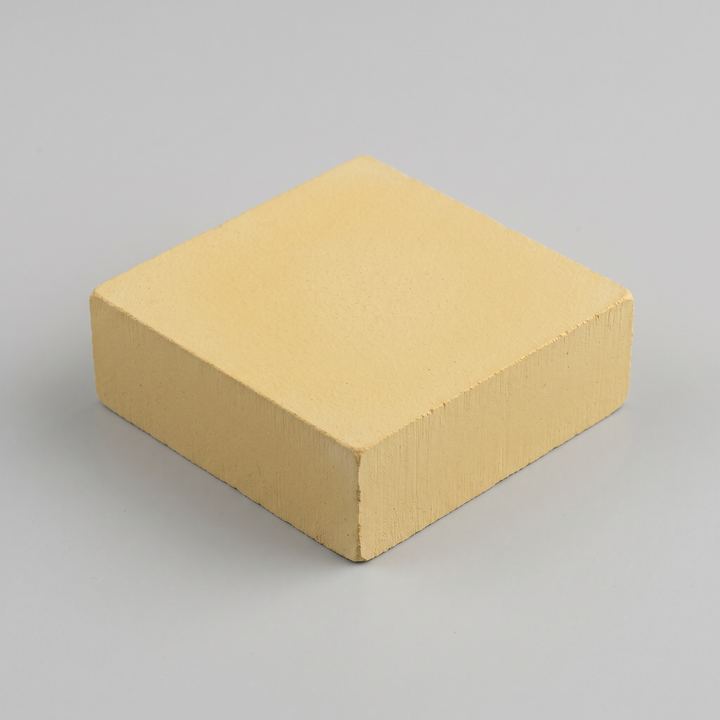
The slab reads a saturated yellow with the cool milky haze of a photochromic body — a mineral yellow rather than the organic warmth of the sulfide palette. Held under UV the face darkens toward a bronze-amber within seconds; back in shadow it clears again. At 8.74 g/cm³ in a 70×70×23 mm format the slab is startlingly heavy for its thinness — closer in hand-feel to a lead plate than to an ordinary fired tile, and distinctly heavier than the La-Mn-W-Y sibling from the same firing. Surface vitrified matte from the peak fire; edges cold-cut, the kerf powder pale against the yellow body.
Recipe
200 g batch · peak 1250 °C| element | precursor | formula | mass | safety |
|---|---|---|---|---|
| Bi | bismuth(III) oxide (yellow) | Bi2O3 | 78.73 g | moderate |
| Sb | antimony trioxide | Sb2O3 | 8.21 g | moderate |
| W | tungsten trioxide (yellow) | WO3 | 13.06 g | moderate |
- 1Ramp
- 2Hold
- 3Ramp
- 4Ramp
- 5Hold
- 6Ramp
- 7Ramp
Photochromic — reversibly darkens under UV exposure
Visible absorber — saturated color from bandgap in the visible range