BiCuPPr₁₀Sn₅
metal pm only · sintered metalBi1Cu1P1Pr10Sn5 is a metal pm only suitable as sintered-metal. Color: green-red-copper. Fired at 1100°C from 5 precursors (Pr, Sn, Bi). Workshop batch: 200g at €8.54. Compressive strength ~350 MPa; estimated 0.84 kg CO₂/kg (-53% vs structural steel). Notable: no special functions flagged. Confidence: medium.
- forms at
- 1100 °C · high-fire
- replaces
- structural steel
- CO₂
- 53.1% lower than structural steel (0.84 vs 1.80 kg CO₂/kg)
- energy
- 74.4% lower than structural steel (5.62 vs 26.00 MJ/kg)
- compressive
- 350 MPa
- density
- 7.04 g/cm³
- crystal
- monoclinic
- band gap
- 0.00 eV
- cost
- €42.70/kg · €8.54 / 200 g batch
- confidence
- medium (synthesis route)
- potential
- 0.45 · env 0.74 · novel 0.00 · struct 0.84 · lineage 0.20 · supply 0.50
Architectural potential
A heavier, rare-earth-bearing furnace-sintered sibling to the niobium-selenide, this reaches the same 350 MPa compression and fifty-three-per-cent CO₂ cut against rolled steel, but in a matrix whose bismuth-tin skin gives a more sculpted surface register. Natural placements are signature hardware: cast-feel column bases for exhibition pavilions, machined handrail brackets in gallery stairs, decorative-structural hinges in cabinetry and door-sets, and bespoke connectors for timber-hybrid frames where the joint is meant to be seen rather than hidden. The tin-bismuth phase lowers the effective sintering window and lets the part leave the furnace closer to its final surface, so finish-work stays light. Against a cast-steel bracket the argument is emissions plus register: a different colour, a different ring, a different detailing vocabulary. The caveat is cost: praseodymium at ten mol-parts pushes the piece to €8.54 per 200 g batch, nearly fifty times the cost of the niobium-selenide variant, and the supply-chain score sits in the same medium range rather than the reliable one. Specification belongs to single pieces where the material reads — balustrade shoulders, threshold fittings, one-per-room connector nodes — not to repeated small hardware where a cheaper sintered alloy would do the job.
Material character
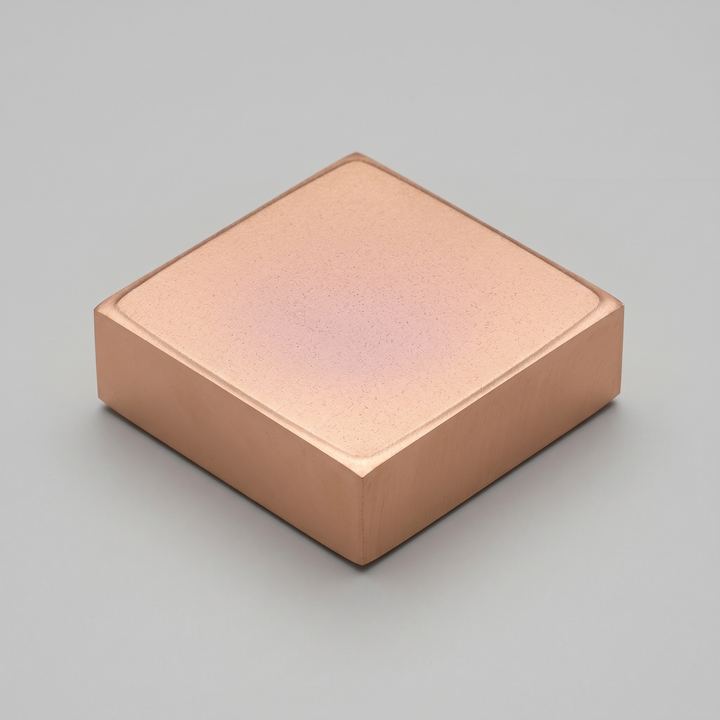
The slab reads a mottled green-red-copper like its niobium-selenide cousin, but the bismuth-tin skin migrates further during the 1100 °C hold and leaves a warmer, more buttery surface sheen — closer to a patinated bronze than to a dull copper. At 7.04 g/cm³ and 70×70×29 mm the slab lifts with a distinct two-finger weight, heavier for its size than the niobium variant and closer to the hand-feel of a small cast-iron part. Surface is sintered matte but with visible bismuth bloom in places; edges arrive crisp from the die. Tapped, the piece rings slightly lower and longer than the niobium-selenide — a softer metallic voice, still damped.
Recipe
200 g batch · peak 1100 °C| element | precursor | formula | mass | safety |
|---|---|---|---|---|
| Bi | bismuth metal | Bi | 8.45 g | safe |
| Cu | copper shot/powder | Cu | 2.57 g | safe |
| P | ferrophosphorus (liquid-phase sintering aid) | Fe3P | 8.02 g | safe |
| Pr | praseodymium metal | Pr | 56.96 g | moderate |
| Sn | tin ingot | Sn | 23.99 g | safe |
- 1Ramp
- 2Hold
- 3Ramp
- 4Hold
- 5Ramp
- 6Ramp
- 7END