Ca₆S₈Zr
sulfide polysulfide · sulfide low tempCa6S8Zr1 is a sulfide polysulfide suitable as sulfide low temp. Color: yellow-orange. Fired at 130°C from 3 precursors (CaCO3, S, ZrO2). Workshop batch: 500g at €8.39. Compressive strength ~50 MPa; estimated 0.09 kg CO₂/kg (-89% vs Portland cement). Notable: forms without a kiln. Confidence: high.
- forms at
- 130 °C · hotplate · no kiln
- replaces
- portland cement
- CO₂
- 89.1% lower than Portland cement (0.09 vs 0.83 kg CO₂/kg)
- energy
- 89.1% lower than Portland cement (0.60 vs 5.50 MJ/kg)
- compressive
- 50 MPa
- density
- 2.68 g/cm³
- crystal
- cubic
- band gap
- —
- cost
- €16.78/kg · €8.39 / 500 g batch
- confidence
- high (synthesis route)
- potential
- 0.71 · env 1.00 · novel 1.00 · struct 0.10 · lineage 0.70 · supply 0.27
- flags
- zero kiln: Forming happens without firing — the material cures through chemistry at ambient or hotplate temperature. At building scale this removes the kiln from the supply chain: on-site casting, regional workshops, cold-country fabrication all become available.
Architectural potential
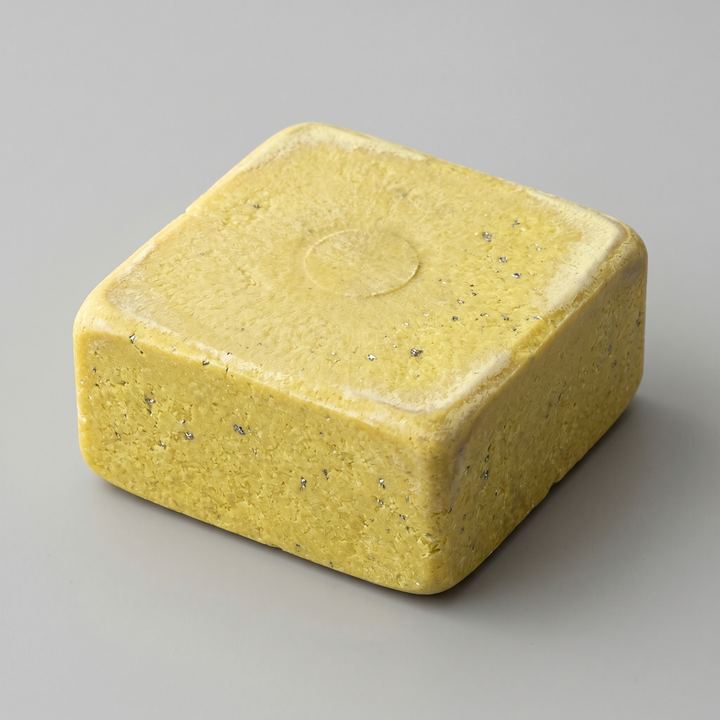
A calcium-rich zirconium-sulfide cast at 130 °C with 50 MPa of compression and the family's eighty-nine-per-cent CO₂ cut against Portland cement. The low density (2.68 g/cm³) and modest compression place this in the interior-tile and inlay register, where the kiln-free chemistry and the warm yellow-orange body carry the architectural argument rather than the load. Natural placements are acoustic-wall inlay panels in rehearsal spaces, cast skirting and dado runs in timber-lined interiors, decorative threshold bands in exhibition architecture, and 52 mm-thick sound-absorbing tiles in foyers where mass-per-area is light enough for partition substructure to carry. Because zirconia-bearing sulfides pour on a hotplate rather than in a kiln, small on-site batches in cold-country studios become viable. Against Portland cement the environmental argument is strong and legible. The caveat is geometry-plus-logistics: the 500 g batch and the 52 mm thickness mean each tile consumes most of a batch, so a patterned floor run needs a sequential pour schedule with grinding and finishing interleaved. Sulfide odour release during saw-cutting remains the workshop constraint shared with the wider polysulfide family — adequate ventilation rather than kiln infrastructure is what the studio must budget for.
Material character
At 2.68 g/cm³ this is the lightest slab in the polysulfide palette; an 85×85×52 mm piece feels firm in a single hand despite the generous 52 mm depth — close to a softwood plank in heft. The yellow-orange body is paler and sandier than the copper or ruthenium siblings, with the calcium fraction draining the saturation toward a cream register. Surface mold-matte with an even meniscus along the top face; edges as-cast, the 52 mm depth pronouncing the slab's slab-ness rather than its tile-ness. Against the denser calcium-silicate ambient binders the hand-feel is immediately lighter and the colour warmer.
Recipe
500 g batch · peak 130 °C| element | precursor | formula | mass | safety |
|---|---|---|---|---|
| Ca | calcium carbonate / limestone | CaCO3 | 82.98 g | safe |
| Zr | zirconium dioxide | ZrO2 | 17.02 g | safe |
- Pre-heatHotplate to 150 °C
- MeltSulfur liquefies at 115 °C; full liquid at 130 °C
- CastPour at 140–145 °C
- SetRoom temperature 30 min (firm) → 24 h (full strength)
Zero-kiln process — 130 °C hotplate cast only