BiLaO₁₂Sr₅W
heavy oxide ceramic · thermal mass ceramicBi1La1O12Sr5W1 is a heavy oxide ceramic suitable as thermal mass ceramic. Color: yellow-photochromic. Fired at 1250°C from 4 precursors (SrCO3, Bi2O3, WO3). Workshop batch: 200g at €21.40. Compressive strength ~100 MPa; estimated 0.94 kg CO₂/kg (+326% vs clay brick). Notable: photochromic. Confidence: medium.
- forms at
- 1250 °C · high-fire
- replaces
- clay brick
- CO₂
- 326% higher than clay brick (0.94 vs 0.22 kg CO₂/kg; 4.3× higher)
- energy
- 108% higher than clay brick (6.25 vs 3.00 MJ/kg; 2.1× higher)
- compressive
- 100 MPa
- density
- 5.61 g/cm³
- crystal
- triclinic
- band gap
- —
- cost
- €107.00/kg · €21.40 / 200 g batch
- confidence
- medium (synthesis route)
- potential
- 0.33 · env 0.00 · novel 0.90 · struct 0.20 · lineage 0.50 · supply 0.00
- flags
- photochromic: Darkens reversibly under UV. Glazing and surface layers that shade themselves on sunny days and clear when the sun drops — passive solar-gain control without mechanical shading.
Architectural potential
A bismuth-lanthanum strontium-tungstate fired at 1250 °C, 100 MPa at 5.61 g/cm³, carrying a photochromic chemistry that darkens reversibly under daylight UV. The assigned role is a passive thermal battery — mass that absorbs solar gain and releases it slowly after dark — which belongs in south-facing trombe-wall infills, hypocaust-style floor slabs in conservatories, night-flush cooling cores in atria, and radiant-heat storage panels behind south-facing glazing. The photochromic flag compounds the argument: the wall's own colour register shifts darker through the hottest hours of the day, collecting more of the incident solar gain precisely when the thermal mass is doing its work, and clears toward evening as the re-release begins. Supplement to insulation, not a replacement — the trombe-wall logic holds. Against clay brick the embodied CO₂ is more than three-times higher and energy double, so the specification is paid for by the combined thermal-storage and photochromic argument together, not by either alone. The caveat is hard: a supply-chain score of zero on bismuth-tungstate pairings, 1250 °C peak, and 200 g workshop batches to a 500 g ceiling. Untested in architectural production at trombe-wall scale — pilot-panel work only, with documented night-release curves before any full-wall commitment.
Material character
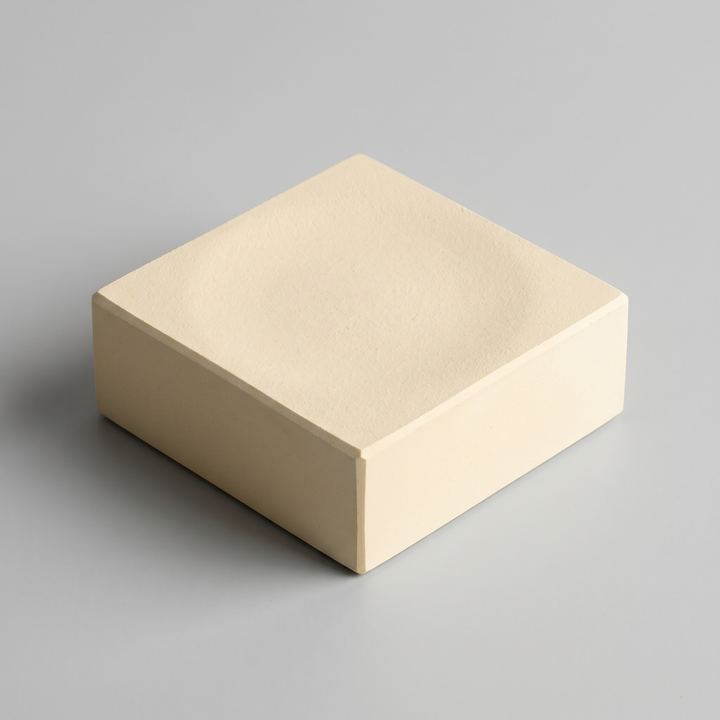
A warm photochromic yellow through the 36 mm depth, carrying a faint green undercast from the tungstate fraction — distinct from the bismuth-neodymium sibling, which pulls more amber under exposure and lacks the cool green note entirely. At 5.61 g/cm³ and 70×70×36 mm the slab sits two-handed on the bench, dense underfoot in the way a trombe-wall tile should be and close in weight to a basalt paver of the same face. Skin vitrified matte from the 1250 °C fire, close to a partial glaze along the upper rim where the lanthanum-bismuth fraction concentrates during cooling. Edges cold-cut, kerf pale-ochre. Fully opaque. Under sustained UV the face shifts toward a mustard-bronze and relaxes back over hours — the photographic record wants exposed and rested frames side by side.
Recipe
200 g batch · peak 1250 °C| element | precursor | formula | mass | safety |
|---|---|---|---|---|
| Bi | bismuth(III) oxide (yellow) | Bi2O3 | 17.06 g | moderate |
| La | lanthanum oxide | La2O3 | 11.93 g | moderate |
| Sr | strontium carbonate | SrCO3 | 54.04 g | safe |
| W | tungsten trioxide (yellow) | WO3 | 16.97 g | moderate |
- 1Ramp
- 2Hold
- 3Ramp
- 4Ramp
- 5Hold
- 6Ramp
- 7Ramp
Photochromic — reversibly darkens under UV exposure