Er₂Gd₂Li₄O₁₆Si₄
rare earth oxide · rare earth ceramicEr2Gd2Li4O16Si4 is a rare earth oxide suitable as rare earth ceramic. Color: neutral. Fired at 1200°C from 4 precursors (Er2O3, Gd2O3, SiO2). Workshop batch: 100g at €84.57. Compressive strength ~500 MPa; estimated 0.90 kg CO₂/kg (+309% vs clay brick). Notable: uv luminescent. Confidence: medium.
- forms at
- 1200 °C · high-fire
- replaces
- clay brick
- CO₂
- 309% higher than clay brick (0.90 vs 0.22 kg CO₂/kg; 4.1× higher)
- energy
- 100% higher than clay brick (6.00 vs 3.00 MJ/kg; 2.0× higher)
- compressive
- 500 MPa
- density
- 5.06 g/cm³
- crystal
- triclinic
- band gap
- 3.59 eV
- cost
- €845.70/kg · €84.57 / 100 g batch
- confidence
- medium (synthesis route)
- potential
- 0.36 · env 0.00 · novel 0.50 · struct 1.00 · lineage 0.50 · supply 0.05
- flags
- uv luminescent: Converts invisible ultraviolet into visible light. Signage panels, low-energy wayfinding tiles, emergency markings that draw their illumination from daylight rather than mains power.
Architectural potential
An erbium-gadolinium-lithium silicate fired at 1200 °C — a rare-earth ceramic carrying ultraviolet luminescence and, unusually for the rare-earth family, a full five hundred megapascals of compressive capability. The structural register opens up slightly compared to the one-hundred-megapascal siblings: small-footprint piers, a column-base plinth that also emits under UV, a threshold stone that carries load and draws emergency illumination from daylight. The embodied CO₂ still runs more than four times that of clay brick, so bulk use remains closed; the structural headroom simply means the detail can be a pier or plinth rather than only a signage tile. Natural placements are luminescent plinths and low columns in crematoria, museum threshold stones in dark-floor galleries, and wayfinding blocks in tunnel and subway architecture where the UV-to-visible conversion reduces mains-powered emergency lighting. The cost is sobering: €84.57 per 100 g batch with a 300 g workshop ceiling, driven by gadolinium and erbium together. Untested at building scale in production architecture. The caveat is specification discipline: the UV excitation source has to be designed into the architecture from the outset, because without the UV the material carries only cost — its chromatic daylight presence is neutral and gives no argument for the price.
Material character
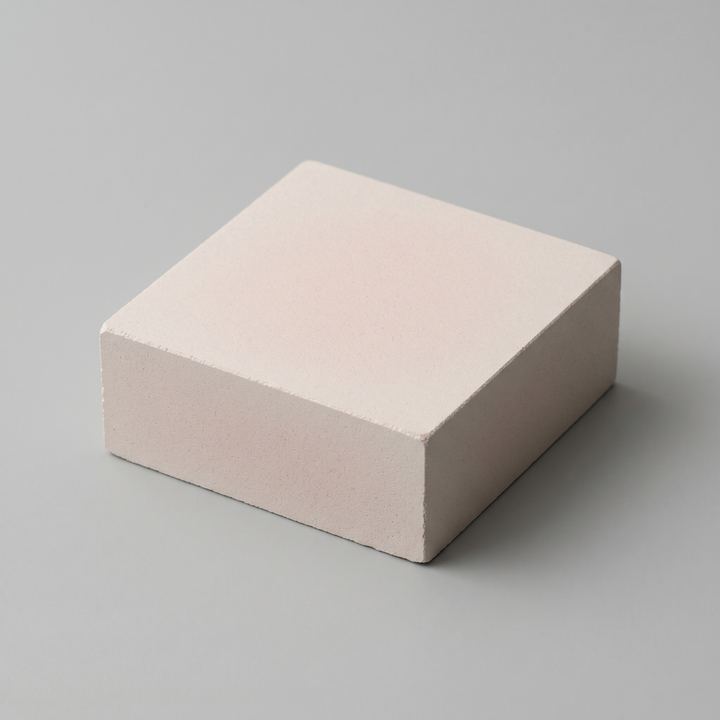
The slab reads a quiet neutral at daylight — the rare-earth combination of erbium and gadolinium does not carry a strong visible-light tint, and the silicate matrix reads close to bone. At 5.06 g/cm³ over 70×70×40 mm the piece is solid and heavy for its section, resisting a one-handed lift and closer in hand-feel to a dense architectural stone than to a typical rare-earth ceramic. Surface matte from the sinter, finely grained; edges cold-cut, kerf-whitened. Under a 365 nm excitation source the slab emits a sharp pink-red from the erbium transitions, a visible glow distinct from the greens and chartreuses of the praseodymium siblings.
Recipe
100 g batch · peak 1200 °C| element | precursor | formula | mass | safety |
|---|---|---|---|---|
| Er | erbium oxide | Er2O3 | 33.76 g | moderate |
| Gd | gadolinium oxide | Gd2O3 | 31.99 g | moderate |
| Li | lithium carbonate | Li2CO3 | 13.04 g | safe |
| Si | quartz flour / silica | SiO2 | 21.21 g | safe |
- 1Ramp
- 2Hold
- 3Ramp
- 4Ramp
- 5Hold
- 6Ramp
- 7Ramp
UV-luminescent — emits visible light under 365 nm UV