BiNdO₁₂Sr₅W
rare earth oxide · rare earth ceramicBi1Nd1O12Sr5W1 is a rare earth oxide suitable as rare earth ceramic. Color: yellow-photochromic. Fired at 1200°C from 4 precursors (SrCO3, Bi2O3, WO3). Workshop batch: 100g at €12.85. Compressive strength ~100 MPa; estimated 0.90 kg CO₂/kg (+309% vs clay brick). Notable: photochromic, visible absorber. Confidence: medium.
- forms at
- 1200 °C · high-fire
- replaces
- clay brick
- CO₂
- 309% higher than clay brick (0.90 vs 0.22 kg CO₂/kg; 4.1× higher)
- energy
- 100% higher than clay brick (6.00 vs 3.00 MJ/kg; 2.0× higher)
- compressive
- 100 MPa
- density
- 5.69 g/cm³
- crystal
- triclinic
- band gap
- 1.84 eV
- cost
- €128.50/kg · €12.85 / 100 g batch
- confidence
- medium (synthesis route)
- potential
- 0.41 · env 0.00 · novel 1.00 · struct 0.20 · lineage 0.80 · supply 0.10
- flags
- photochromic: Darkens reversibly under UV. Glazing and surface layers that shade themselves on sunny days and clear when the sun drops — passive solar-gain control without mechanical shading. visible absorber: A real-colour solar-gain control layer. Where the body takes visible light into itself rather than reflecting it, the material becomes a selective heat collector — useful on thermal-mass walls, absorber panels, and warm-toned cladding.
Architectural potential
A bismuth-neodymium strontium-tungstate fired at 1200 °C whose architectural argument sits on the photochromic and visible-absorber bands it carries — the body darkens reversibly under ultraviolet exposure and holds a warm-toned heat-collection band across the visible spectrum. At three-times the embodied CO₂ of a fired clay brick and 100 MPa of compression, this is not a volume ceramic; it belongs as a small-area surface tile on south-facing work. Natural placements are self-shading glazing-perimeter patches around atrium skylights and greenhouse eaves, photochromic insert tiles in conservatory floor patterns that darken under solar UV through midday and clear as afternoon shadow returns, and accent cladding on warm-toned brickwork where the visible-absorber band does slow radiant-heat collection for a trombe wall behind. The clay-brick analogy gives the client the scale of the carbon trade — severe — and the specification argument has to be paid for by the two functional behaviours together, not separately. The caveat is supply: a supply-chain score of zero on bismuth-tungstate pairings, 1200 °C peak, 100 g workshop batches, and €12.85 per batch. Untested in architectural production at any scale beyond the laboratory tile — use the flag as a brief, not a datasheet.
Material character
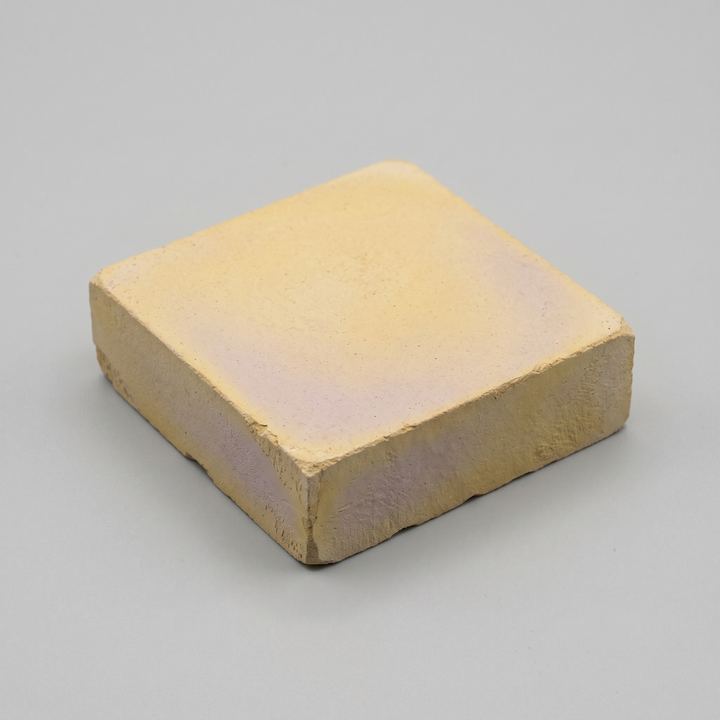
The body reads a deep photochromic yellow — a lemon-ochre through the 36 mm depth in its unexposed state, shifting to an amber-bronze under sustained daylight and relaxing back overnight as the UV signal drops. At 5.69 g/cm³ and 70×70×36 mm the slab sits two-handed on the bench, weight close to a dense architectural stone of the same footprint and distinctly heavier than the Gd7O12V1 luminescent sibling from this same batch. Skin vitrified matte from the 1200 °C fire, edging toward a partial glaze along the upper rim where the bismuth fraction pools during cooling. Edges cold-cut, kerf powder-pale. Opaque through its depth. The photographic record wants both states — unexposed and sun-darkened — shot side by side.
Recipe
100 g batch · peak 1200 °C| element | precursor | formula | mass | safety |
|---|---|---|---|---|
| Bi | bismuth(III) oxide (yellow) | Bi2O3 | 16.99 g | moderate |
| Nd | neodymium oxide | Nd2O3 | 12.27 g | moderate |
| Sr | strontium carbonate | SrCO3 | 53.83 g | safe |
| W | tungsten trioxide (yellow) | WO3 | 16.91 g | moderate |
- 1Ramp
- 2Hold
- 3Ramp
- 4Ramp
- 5Hold
- 6Ramp
- 7Ramp
Photochromic — reversibly darkens under UV exposure
Visible absorber — saturated color from bandgap in the visible range