O₁₂Pr₅WZr
heavy oxide ceramic · thermal mass ceramicO12Pr5W1Zr1 is a heavy oxide ceramic suitable as thermal mass ceramic. Color: neutral. Fired at 1250°C from 3 precursors (Pr6O11, WO3, ZrO2). Workshop batch: 200g at €75.22. Compressive strength ~300 MPa; estimated 0.94 kg CO₂/kg (+326% vs clay brick). Notable: uv luminescent, electrochromic tungstate. Confidence: medium.
- forms at
- 1250 °C · high-fire
- replaces
- clay brick
- CO₂
- 326% higher than clay brick (0.94 vs 0.22 kg CO₂/kg; 4.3× higher)
- energy
- 108% higher than clay brick (6.25 vs 3.00 MJ/kg; 2.1× higher)
- compressive
- 300 MPa
- density
- 6.52 g/cm³
- crystal
- monoclinic
- band gap
- 2.54 eV
- cost
- €376.10/kg · €75.22 / 200 g batch
- confidence
- medium (synthesis route)
- potential
- 0.42 · env 0.00 · novel 1.00 · struct 0.60 · lineage 0.50 · supply 0.05
- flags
- uv luminescent: Converts invisible ultraviolet into visible light. Signage panels, low-energy wayfinding tiles, emergency markings that draw their illumination from daylight rather than mains power. electrochromic tungstate: A voltage-switchable optical chemistry. In thin-film form a small DC signal shifts transmission from clear to tinted blue, opening the door to dimmable glazing and responsive partitions that do not need mechanical shading.
Architectural potential
Two architectures overlap in this single composition: a dense thermal-mass block for diurnal heat storage, and a dynamic signalling surface that emits under ultraviolet and tints under voltage. At 6.52 g/cm³ and 300 MPa it has the mass and the compression to serve as a small-volume thermal battery in south-facing wall patches, radiant-ceiling inserts or night-flush cooling cores. Layered on top, the praseodymium luminescence turns the same block into a dusk emitter — a passive-hybrid element whose heat-storage function runs through the day and whose visual function turns on as the ambient light shifts toward the near-UV. Natural placements are in hybrid thermal-visual tiles at entrance thresholds, in exhibition-space accent walls where the building's own heat signature is part of the display, and in atrium floor panels that store morning sun and glow at dusk. Against clay brick the embodied CO₂ sits at 326 % higher, at €75 for a 200 g workshop batch, and supply-chain score at 0.14 — so this is not a volume specification. The caveat is economics: the combined functional premium restricts use to small signature elements, one tile in a wall rather than the wall itself.
Material character
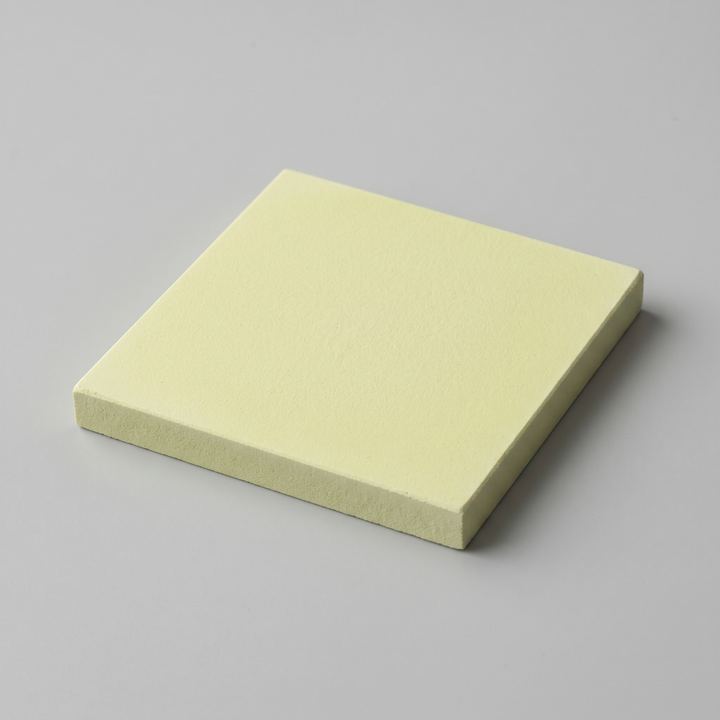
The body reads a pale sulfur-yellow with a green undertone — the praseodymium absorption signature — resolving slightly cooler under diffuse daylight than under tungsten. At 6.52 g/cm³ and 70×70×31 mm the slab is distinctly heavy for its footprint, a weight-step up from the thermal-mass ceramics based on iron or titanium. Skin matte from the sinter, fine-grained without visible porosity. Edges cold-cut clean. Opaque. The ambient colour captures only one of three states the composition can enter: the other two — UV-excited orange-green emission and voltage-induced blue shift — each belong in dedicated companion shots.
Recipe
200 g batch · peak 1250 °C| element | precursor | formula | mass | safety |
|---|---|---|---|---|
| Pr | praseodymium oxide | Pr6O11 | 70.57 g | moderate |
| W | tungsten trioxide (yellow) | WO3 | 19.22 g | moderate |
| Zr | zirconium dioxide | ZrO2 | 10.22 g | safe |
- 1Ramp
- 2Hold
- 3Ramp
- 4Ramp
- 5Hold
- 6Ramp
- 7Ramp
UV-luminescent — emits visible light under 365 nm UV
Electrochromic — color switches under applied voltage (thin-film chemistry)