Fe₂K₄O₁₂Si₄
alkali silicate glass · structural translucent glassFe2K4O12Si4 is a alkali silicate glass suitable as structural translucent glass. Color: amber-brown. Fired at 1150°C from 4 precursors (K2CO3, SiO2, Fe2O3). Workshop batch: 400g at €3.59. Compressive strength ~500 MPa; estimated 0.84 kg CO₂/kg (-2% vs float glass). Notable: no special functions flagged. Confidence: high.
- forms at
- 1150 °C · high-fire
- replaces
- float glass
- CO₂
- 1.9% lower than float glass (0.84 vs 0.86 kg CO₂/kg)
- energy
- 62.5% lower than float glass (5.62 vs 15.00 MJ/kg)
- compressive
- 500 MPa
- density
- 2.71 g/cm³
- crystal
- monoclinic
- band gap
- 2.83 eV
- cost
- €8.97/kg · €3.59 / 400 g batch
- confidence
- high (synthesis route)
- potential
- 0.64 · env 0.78 · novel 0.00 · struct 1.00 · lineage 0.70 · supply 1.00
Architectural potential
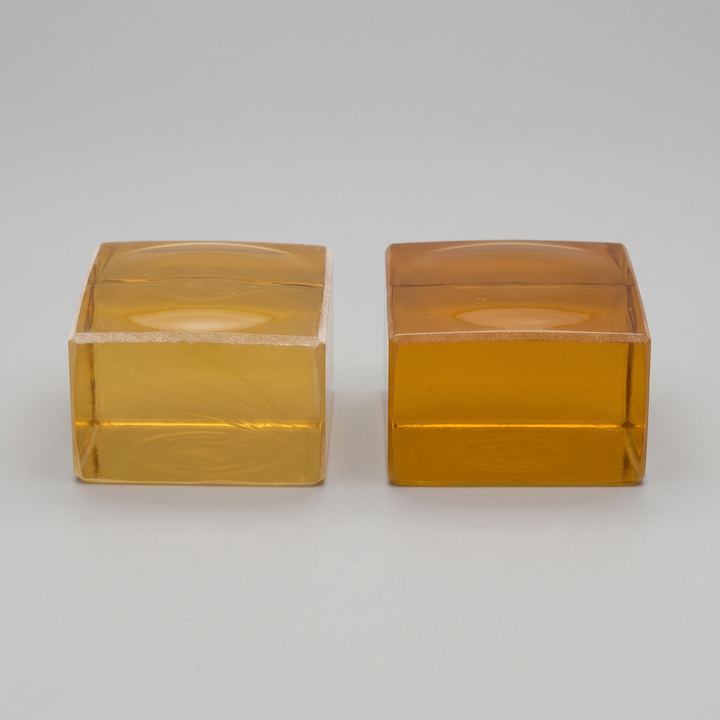
This is a load-bearing transparent glass with an amber-brown iron-driven body, 500 MPa compressive strength at 85×85×51 mm slab thickness — a warm, legible structural transparency. Natural placements are pressed-glass beams in timber-framed pavilions where the amber body sits in dialogue with oak and larch, structural stair treads in domestic and hospitality architecture where warmth is the register, transparent partitions in reading rooms and libraries where the colour warms the daylight rather than cooling it, and light-admitting piers in entrance lobbies where the body patinates visually as the sun moves. The iron-tinted body carries a gentle infrared absorption alongside the visible warmth, reducing solar-gain penetration in a manner familiar from heritage bottle glass. Against float glass the embodied CO₂ is level at minus two per cent; the argument is tectonic and chromatic rather than environmental. The sixty-three-per-cent reduction in forming energy is a quiet operational gain. High confidence and perfect supply-chain and safety scores; at €3.59 per 400 g batch this is one of the most affordable tinted structural glasses in the atlas. The caveat is iron-content verification across batches: amber register drifts toward greenish-brown as Fe³⁺ content rises, so colour-controlled specification needs per-batch sampling.
Material character
The slab carries a warm amber-brown body, the iron register that reads as aged bottle glass or darkened honey rather than the purple or cool-green alternatives. At 2.71 g/cm³ and 85×85×51 mm the piece sits comfortably for a two-hand lift, slightly lighter than the denser V- and Co-tinted siblings. Light through the 51 mm depth reads warm amber from above, deepening to a smoked tobacco tone along the long edge. Surface finishes pressed-glass with fine anneal striae along the mould seam; cold-cut edges carry the usual kerf bloom. The body warms under incandescent light, cools slightly under daylight, a visual drift the denser Mn- and Co-variants do not show.
Recipe
400 g batch · peak 1150 °C| element | precursor | formula | mass | safety |
|---|---|---|---|---|
| Fe | iron(III) oxide (red) | Fe2O3 | 23.61 g | safe |
| K | potassium carbonate / potash | K2CO3 | 40.86 g | safe |
| Si | quartz flour / silica | SiO2 | 35.53 g | safe |
- 1Ramp
- 2Hold
- 3Ramp
- 4Hold
- 5Ramp
- 6Hold