Bi₂Nd₂O₁₆Te₄
rare earth oxide · rare earth ceramicBi2Nd2O16Te4 is a rare earth oxide suitable as rare earth ceramic. Color: neutral. Fired at 1200°C from 2 precursors (Bi2O3, Nd2O3). Workshop batch: 100g at €6.14. Compressive strength ~100 MPa; estimated 0.90 kg CO₂/kg (+309% vs clay brick). Notable: uv luminescent, visible absorber. Confidence: medium.
- forms at
- 1200 °C · high-fire
- replaces
- clay brick
- CO₂
- 309% higher than clay brick (0.90 vs 0.22 kg CO₂/kg; 4.1× higher)
- energy
- 100% higher than clay brick (6.00 vs 3.00 MJ/kg; 2.0× higher)
- compressive
- 100 MPa
- density
- 7.03 g/cm³
- crystal
- monoclinic
- band gap
- 2.18 eV
- cost
- €61.40/kg · €6.14 / 100 g batch
- confidence
- medium (synthesis route)
- potential
- 0.37 · env 0.00 · novel 1.00 · struct 0.20 · lineage 0.50 · supply 0.09
- flags
- uv luminescent: Converts invisible ultraviolet into visible light. Signage panels, low-energy wayfinding tiles, emergency markings that draw their illumination from daylight rather than mains power. visible absorber: A real-colour solar-gain control layer. Where the body takes visible light into itself rather than reflecting it, the material becomes a selective heat collector — useful on thermal-mass walls, absorber panels, and warm-toned cladding.
Architectural potential
A bismuth-neodymium-tellurate ceramic fired at 1200 °C, carrying dual functional chemistry: neodymium drives the ultraviolet-luminescent response, and the bismuth-tellurate matrix provides a real-colour visible-light absorber. At 100 MPa of compression this is non-structural overlay; at 7.03 g/cm³ it is dense enough to read as architectural stone in the hand. The two functional flags combine architecturally: a tile that both absorbs visible daylight as a warm selective heat-collector and emits converted UV-to-visible light in dusk conditions. Natural placements are wayfinding panels in civic interiors that glow as daylight fades, south-facing thermal-wall inserts whose warm-toned surface quietly collects solar gain during the day and reads self-illuminated at dusk, emergency-marking inlays in escape-route thresholds that draw their illumination from accumulated daylight rather than mains power. Untested at envelope scale — the neodymium emission spectrum weakens over years of UV cycling, and no architectural precedent verifies the luminescent lifetime past a decade. The caveat is supply-chain: neodymium sits below 0.15 on the supply-chain score, embodied CO₂ runs three hundred and nine per cent above clay brick, and €6.14 per 100 g batch with a 300 g ceiling keeps specification in the accent-patch register.
Material character
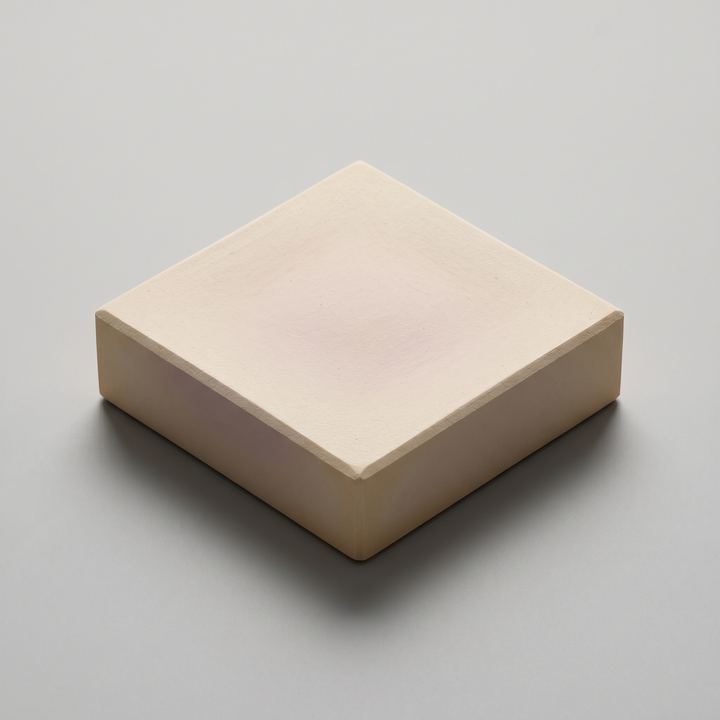
The face carries the characteristic neodymium pale-lavender tint shifting to a warmer dusty-grey under tungsten light — a colour that changes register with the illuminant, unusual in the ceramic palette. At 7.03 g/cm³ in a 70×70×29 mm block the slab reads heavier-than-it-looks, close in hand-feel to a granite tile of the same footprint. Surface vitrified matte from the 1200 °C fire, the bismuth content lending a faint reflective cast under raking light. Edges cold-cut with the usual diamond-dust kerf bloom, the tellurate matrix exposing a slightly warmer tone in the fresh cut. Under 365 nm excitation the face shifts to a pale salmon emission, a distinctly different register from the green of the erbium sibling.
Recipe
100 g batch · peak 1200 °C| element | precursor | formula | mass | safety |
|---|---|---|---|---|
| Bi | bismuth(III) oxide (yellow) | Bi2O3 | 58.07 g | moderate |
| Nd | neodymium oxide | Nd2O3 | 41.93 g | moderate |
- 1Ramp
- 2Hold
- 3Ramp
- 4Ramp
- 5Hold
- 6Ramp
- 7Ramp
UV-luminescent — emits visible light under 365 nm UV
Visible absorber — saturated color from bandgap in the visible range