Mn₂O₂Pr₈S₁₂
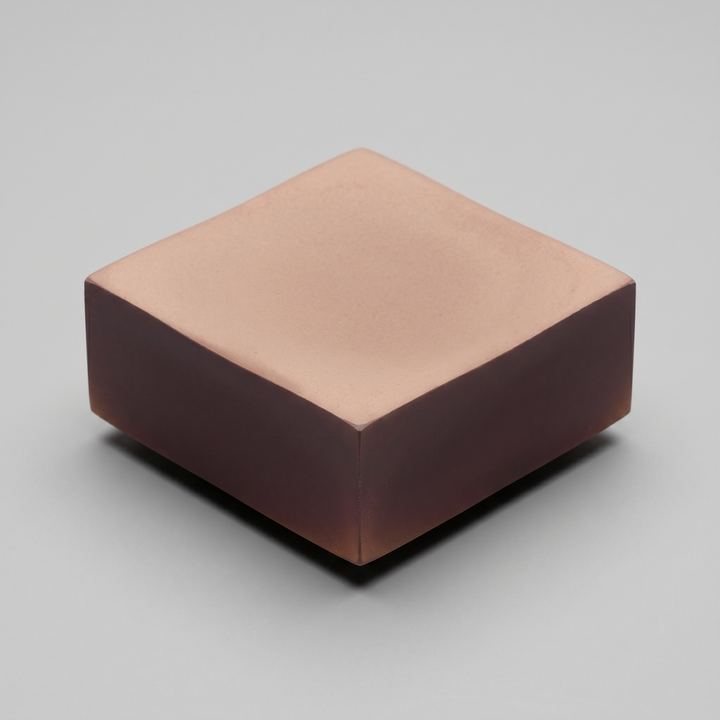
rare earth oxide · rare earth ceramicMn2O2Pr8S12 is a rare earth oxide suitable as rare earth ceramic. Color: purple-brown. Fired at 1200°C from 2 precursors (Pr6O11, MnO2). Workshop batch: 100g at €33.13. Compressive strength ~100 MPa; estimated 0.90 kg CO₂/kg (+309% vs clay brick). Notable: uv luminescent. Confidence: medium.
- forms at
- 1200 °C · high-fire
- replaces
- clay brick
- CO₂
- 309% higher than clay brick (0.90 vs 0.22 kg CO₂/kg; 4.1× higher)
- energy
- 100% higher than clay brick (6.00 vs 3.00 MJ/kg; 2.0× higher)
- compressive
- 100 MPa
- density
- 5.21 g/cm³
- crystal
- hexagonal
- band gap
- 2.35 eV
- cost
- €331.30/kg · €33.13 / 100 g batch
- confidence
- medium (synthesis route)
- potential
- 0.26 · env 0.00 · novel 0.57 · struct 0.20 · lineage 0.50 · supply 0.09
- flags
- uv luminescent: Converts invisible ultraviolet into visible light. Signage panels, low-energy wayfinding tiles, emergency markings that draw their illumination from daylight rather than mains power.
Architectural potential
A praseodymium-manganese oxysulfide in the functional ceramic register for signal-bearing surfaces, carrying UV-luminescent conversion chemistry on a deeply coloured oxide body. At 100 MPa and with embodied CO₂ four times that of a fired clay brick, this is explicitly not a bulk material — the argument for its use has to sit entirely in the emission and the colour. Natural placements are accent cladding plaques in gallery vestibules, emergency wayfinding tiles in corridors that draw illumination from ambient daylight UV, sensor-tile patches in bath-house thresholds where the body can be read across wet and dry states, and signage inserts at named architectural moments. The 300 g workshop ceiling and the supply-chain score of 0.14 confine specification to the signature-element scale — a single tile, a named threshold, a plaque. Praseodymium gives a richer and more complex emission colour under UV than the yttrium-samarium sibling, which makes it the candidate where colour-temperature control of the luminescent signal matters. The real caveat is cost paired with rarity: €33.13 per 100 g is twice the yttrium-samarium batch price, and the praseodymium market is thin enough that any project at more than a handful of tiles needs a verified procurement line before design specification.
Material character
The 70×70×39 mm slab reads a deep purple-brown, manganese driving a warm cocoa undertone while praseodymium shifts the hue toward a mulberry purple at the shadow angles. Under 365 nm excitation the body lifts into an orange-red glow, distinctly warmer and more saturated than the yttrium-samarium sibling, with the characteristic Pr³⁺ line emission legible as a faint red spike. Vitrified matte skin from the 1200 °C fire; edges cold-cut with a clean diamond kerf. At 5.21 g/cm³ the slab is noticeably heavy in hand for its size, close to the vanadium-perovskite register but with the warmer, oxysulfide colour rather than the cool perovskite blue.
Recipe
100 g batch · peak 1200 °C| element | precursor | formula | mass | safety |
|---|---|---|---|---|
| Mn | manganese dioxide | MnO2 | 11.32 g | moderate |
| Pr | praseodymium oxide | Pr6O11 | 88.68 g | moderate |
- 1Ramp
- 2Hold
- 3Ramp
- 4Ramp
- 5Hold
- 6Ramp
- 7Ramp
UV-luminescent — emits visible light under 365 nm UV