Bi₃O₁₄Tm₃W₂
rare earth oxide · rare earth ceramicBi3O14Tm3W2 is a rare earth oxide suitable as rare earth ceramic. Color: yellow-photochromic. Fired at 1200°C from 3 precursors (Bi2O3, Tm2O3, WO3). Workshop batch: 100g at €79.79. Compressive strength ~100 MPa; estimated 0.90 kg CO₂/kg (+309% vs clay brick). Notable: photochromic. Confidence: medium.
- forms at
- 1200 °C · high-fire
- replaces
- clay brick
- CO₂
- 309% higher than clay brick (0.90 vs 0.22 kg CO₂/kg; 4.1× higher)
- energy
- 100% higher than clay brick (6.00 vs 3.00 MJ/kg; 2.0× higher)
- compressive
- 100 MPa
- density
- 9.32 g/cm³
- crystal
- triclinic
- band gap
- —
- cost
- €797.90/kg · €79.79 / 100 g batch
- confidence
- medium (synthesis route)
- potential
- 0.33 · env 0.00 · novel 0.90 · struct 0.20 · lineage 0.50 · supply 0.00
- flags
- photochromic: Darkens reversibly under UV. Glazing and surface layers that shade themselves on sunny days and clear when the sun drops — passive solar-gain control without mechanical shading.
Architectural potential
A bismuth-thulium-tungstate ceramic whose architectural argument rests entirely on the photochromic chemistry — the body darkens reversibly under UV exposure and clears when the sun drops. At 9.32 g/cm³ it is the densest body in this batch, heavier than lead crystal, with an embodied CO₂ more than three times a clay brick; no volume use is defensible. Natural placements are strictly small-area signage-and-switching pieces: UV-responsive wayfinding tiles along south-facing corridors, shading inserts in skylight perimeters, entry-threshold panels that darken as the day warms, and accent cladding patches on south-facing façades where the colour shift reads as a time-indicator. At 100 MPa the compression is decent for the tile register but pointless at volume. The device-scale argument is that daylight itself drives the switch with no wiring, no sensor, and no external power. Against clay brick the embodied CO₂ runs plus three hundred and nine per cent and embodied energy doubles — any architectural specification must justify itself on the switching capability alone. The caveat is acute: €79.79 per 100 g batch, a supply-chain score of zero, and thulium availability that puts specification firmly in the signature-patch register. Use sparingly, and only where the photochromic switch is the point.
Material character
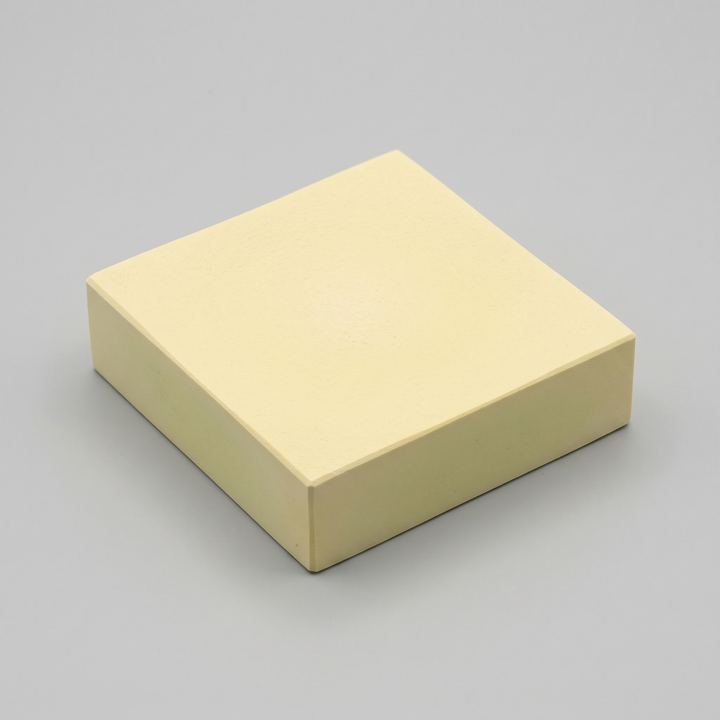
A rich yellow body reading darker under raking light as the UV-responsive tungstate begins its slow afternoon shift. At 9.32 g/cm³ the 70×70×22 mm slab sits disproportionately heavy for its modest footprint — a firm two-handed lift despite the tile-scale dimensions, the weight closer to a lead crystal paperweight than to a ceramic tile. Surface fires to a smooth high-sinter matte, with the fine thulium-bismuth grain visible as a faint speckle. Edges cold-cut, kerf-yellow. Against an ordinary yellow-fired clay tile the body reads noticeably deeper and heavier, and the colour carries a latent shift under UV that no ordinary pigment can match.
Recipe
100 g batch · peak 1200 °C| element | precursor | formula | mass | safety |
|---|---|---|---|---|
| Bi | bismuth(III) oxide (yellow) | Bi2O3 | 40.14 g | moderate |
| Tm | thulium oxide | Tm2O3 | 33.24 g | moderate |
| W | tungsten trioxide (yellow) | WO3 | 26.63 g | moderate |
- 1Ramp
- 2Hold
- 3Ramp
- 4Ramp
- 5Hold
- 6Ramp
- 7Ramp
Photochromic — reversibly darkens under UV exposure