Ca₂O₁₀Si₂TiV
calcium silicate · cement alternativeCa2O10Si2Ti1V1 is a calcium silicate suitable as cement-alternative. Color: white-grey. Fired at 1100°C from 4 precursors (CaCO3, SiO2, V2O5). Workshop batch: 1000g at €27.98. Compressive strength ~50 MPa; estimated 0.68 kg CO₂/kg (-19% vs Portland cement). Notable: visible absorber. Confidence: medium.
- forms at
- 1100 °C · high-fire
- replaces
- portland cement
- CO₂
- 18.7% lower than Portland cement (0.68 vs 0.83 kg CO₂/kg)
- energy
- 18.2% lower than Portland cement (4.50 vs 5.50 MJ/kg)
- compressive
- 50 MPa
- density
- 0.35 g/cm³
- crystal
- triclinic
- band gap
- 1.72 eV
- cost
- €27.98/kg · €27.98 / 1000 g batch
- confidence
- medium (synthesis route)
- potential
- 0.39 · env 0.23 · novel 0.46 · struct 0.15 · lineage 0.50 · supply 0.70
- flags
- visible absorber: A real-colour solar-gain control layer. Where the body takes visible light into itself rather than reflecting it, the material becomes a selective heat collector — useful on thermal-mass walls, absorber panels, and warm-toned cladding.
Architectural potential
A titanium-vanadium-doped calcium silicate, fired at 1100 °C, carrying the solar-absorber chemistry of a V-doped titanate on a cement-register binder. At 50 MPa the compressive performance sits at the non-structural end of the binder range, which forbids load-bearing walls but opens up a specific placement: thermal-absorber surface panels for south-facing trombe walls, warm-toned cladding inserts on solar-gain façades, and screed-layer toppings for hypocaust-style floor slabs where the body is meant to absorb visible light into itself rather than reflect it. Against Portland cement the embodied CO₂ is nineteen per cent lower, and the visible-absorber chemistry shifts the role from binder to collector — a layer that pays for itself by taking solar gain into the thermal mass behind it rather than bouncing it into the room. The very low bulk density (0.348 g/cm³) is the tell: this is a foamed or aerated cast, not a dense pour, so its natural scale is the insulating-absorber panel, not the structural screed. The caveat is cost — €27.98 per 1 kg batch is high for a low-CO₂ cement substitute, and the absorber chemistry earns its specification only where the thermal argument is actually being made.
Material character
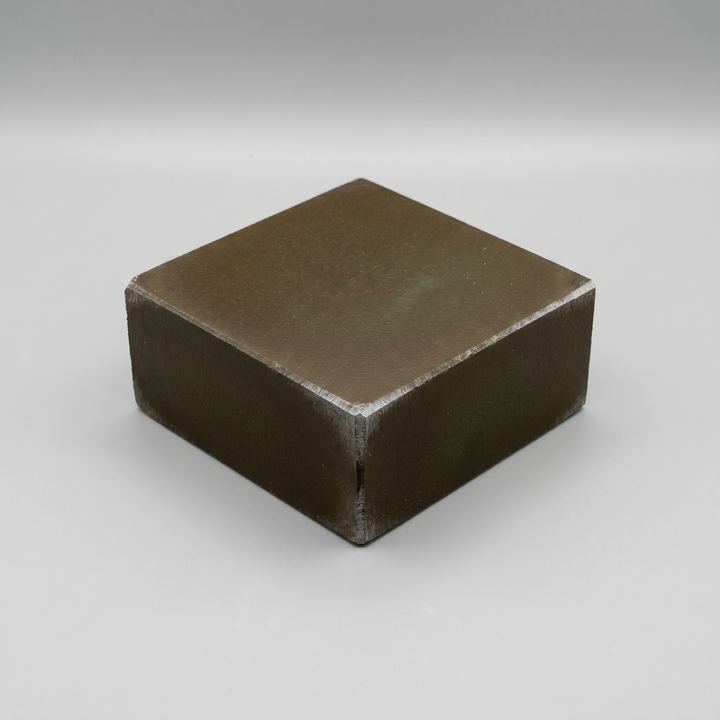
A warm white-grey body with a faintly greenish cast from the vanadium-titanate phase — distinct from the purely neutral calcium-silicate whites in the atlas. At 0.348 g/cm³ the 120×120×200 mm block is unexpectedly single-handed in the lift, close in hand-feel to a softwood offcut rather than a dense masonry unit — the aerated cast reads in the weight before it reads in the eye. Surface cold-pressed and chalky, with a gentle open porosity that catches raking light as a soft dusting. Edges slightly crumbling, powdery at the kerf. Against an ordinary calcium-silicate block the body is visibly lighter and the absorber tint shifts it warmer under full sun.
Recipe
1000 g batch · peak 1100 °C| element | precursor | formula | mass | safety |
|---|---|---|---|---|
| Ca | calcium carbonate / limestone | CaCO3 | 40.76 g | safe |
| Si | quartz flour / silica | SiO2 | 24.47 g | safe |
| Ti | titanium dioxide (rutile) | TiO2 | 16.26 g | safe |
| V | vanadium pentoxide | V2O5 | 18.52 g | moderate |
- 1Ramp
- 2Hold
- 3Ramp
- 4Hold
- 6Ramp
- 7Hold
Visible absorber — saturated color from bandgap in the visible range