Bi₄O₂₆W₈
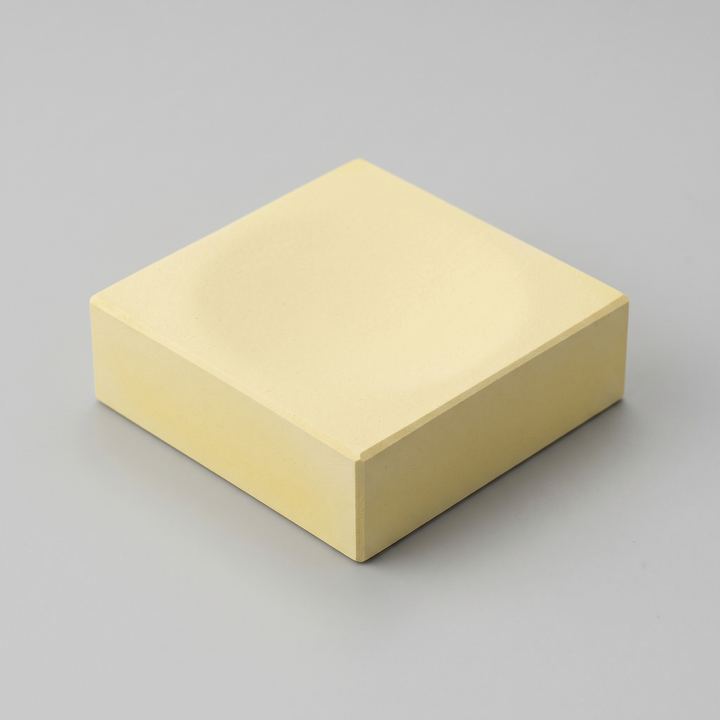
heavy oxide ceramic · thermal mass ceramicBi4O26W8 is a heavy oxide ceramic suitable as thermal mass ceramic. Color: yellow-photochromic. Fired at 1250°C from 2 precursors (WO3, Bi2O3). Workshop batch: 200g at €57.90. Compressive strength ~100 MPa; estimated 0.94 kg CO₂/kg (+326% vs clay brick). Notable: photochromic. Confidence: medium.
- forms at
- 1250 °C · high-fire
- replaces
- clay brick
- CO₂
- 326% higher than clay brick (0.94 vs 0.22 kg CO₂/kg; 4.3× higher)
- energy
- 108% higher than clay brick (6.25 vs 3.00 MJ/kg; 2.1× higher)
- compressive
- 100 MPa
- density
- 7.70 g/cm³
- crystal
- monoclinic
- band gap
- —
- cost
- €289.50/kg · €57.90 / 200 g batch
- confidence
- medium (synthesis route)
- potential
- 0.33 · env 0.00 · novel 0.90 · struct 0.20 · lineage 0.50 · supply 0.00
- flags
- photochromic: Darkens reversibly under UV. Glazing and surface layers that shade themselves on sunny days and clear when the sun drops — passive solar-gain control without mechanical shading.
Architectural potential
A bismuth-tungstate heavy-oxide ceramic with a photochromic face: reversible darkening under UV, so the body shades itself on sunny days and clears as the sun drops — passive solar-gain control without wiring or sensors. Paired with its thermal-mass function, the slab stores daytime gain and also meters the amount it takes in, a rare double capability in one ceramic. Natural placements are south-facing trombe-wall infills in passive-house architecture, rooftop solar-gain-control tile fields around skylights in atrium buildings, conservatory-wall inserts where direct solar gain needs passive regulation, and museum-gallery partitions where UV-driven self-shading protects artwork during bright hours. Compression at 100 megapascals keeps this body in the surface-layer and infill register. The caveats are severe and compounded. Embodied CO₂ runs three and a quarter times higher than fired clay brick; cost sits at nearly 58 euros per 200 g workshop batch — the most expensive material in this batch; the bismuth-tungstate supply-chain score is zero, so feedstock is assembled from specialist sources without a mature trade. Specification belongs strictly in the signature register: one or two photochromic tiles in a thermal field, a single self-shading window panel, never a continuous facade surface.
Material character
A warm yellow body at 7.70 g/cm³ in a 70×70×27 mm slab — dense for its footprint, two-handed weight, the heaviest heavy-oxide in this batch. The bismuth content drives the resting colour toward a saturated butter-yellow that darkens visibly under UV raking to amber-bronze. Surface sits vitrified matte from the 1250 °C fire, with a faint surface sheen where tungstate-rich grains crystallise slightly coarser than the bismuth-rich matrix. Edges come cold-cut with diamond-kerf whitening. Fully opaque. Against a pure bismuth-tungstate sibling without the photochromic flag the colour is similar but the surface response to UV is the specific legible difference — a detail visible only under blacklight comparison.
Recipe
200 g batch · peak 1250 °C| element | precursor | formula | mass | safety |
|---|---|---|---|---|
| Bi | bismuth(III) oxide (yellow) | Bi2O3 | 33.44 g | moderate |
| W | tungsten trioxide (yellow) | WO3 | 66.56 g | moderate |
- 1Ramp
- 2Hold
- 3Ramp
- 4Ramp
- 5Hold
- 6Ramp
- 7Ramp
Photochromic — reversibly darkens under UV exposure