K₄Mn₂O₁₂Si₄
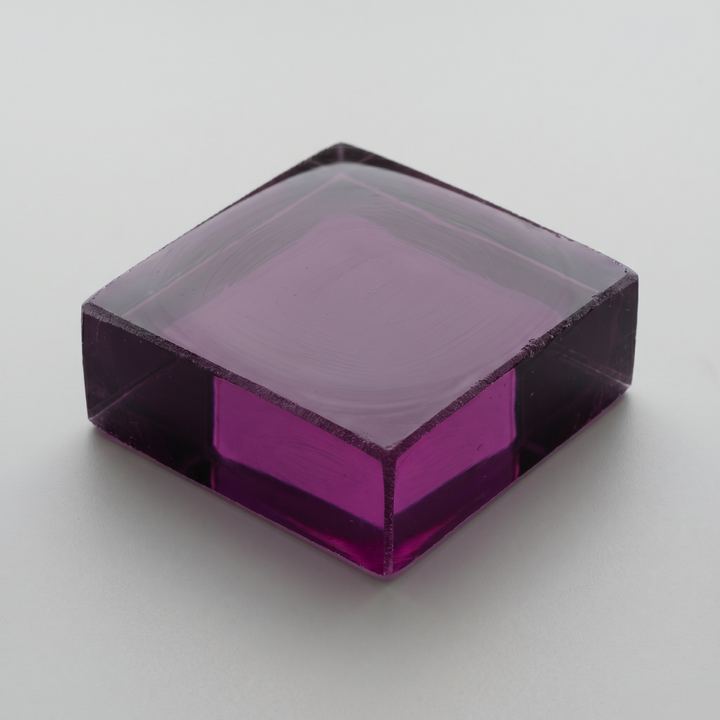
alkali silicate glass · structural translucent glassK4Mn2O12Si4 is a alkali silicate glass suitable as structural translucent glass. Color: purple-brown. Fired at 1150°C from 4 precursors (K2CO3, SiO2, MnO2). Workshop batch: 400g at €5.14. Compressive strength ~500 MPa; estimated 0.84 kg CO₂/kg (-2% vs float glass). Notable: no special functions flagged. Confidence: high.
- forms at
- 1150 °C · high-fire
- replaces
- float glass
- CO₂
- 1.9% lower than float glass (0.84 vs 0.86 kg CO₂/kg)
- energy
- 62.5% lower than float glass (5.62 vs 15.00 MJ/kg)
- compressive
- 500 MPa
- density
- 2.77 g/cm³
- crystal
- orthorhombic
- band gap
- 2.95 eV
- cost
- €12.85/kg · €5.14 / 400 g batch
- confidence
- high (synthesis route)
- potential
- 0.64 · env 0.78 · novel 0.00 · struct 1.00 · lineage 0.70 · supply 1.00
Architectural potential
This is a load-bearing transparent glass with a purple-brown manganese body, 500 MPa of compression and an 85×85×50 mm slab thickness that sits squarely in the pressed-structural register. Natural placements are structural stair treads in gallery architecture where a smoked-amethyst tread reads as a signature element, pressed-glass floor panels in hospitality fit-outs above daylit lower floors where the body filters the downward light into a warm purple, transparent partitions in wellness and bath architecture where the Mn register softens bright interiors, and light-admitting piers in museum thresholds where the plum-dark colour carries institutional weight. The manganese content here is doubled against the K4Mn2O18Si6 sibling's ratio, pushing the colour slightly further into brown-plum territory. Against float glass the embodied CO₂ is level at minus two per cent; the argument is chromatic. The sixty-three-per-cent reduction in forming energy against conventional float adds operational savings. High confidence and perfect supply-chain and safety scores make specification straightforward. At €5.14 per 400 g batch the material sits mid-range on cost. The caveat is precursor balance: the Mn:Si ratio drives colour saturation directly, so batch-to-batch matching for panels specified side-by-side wants careful precursor weighing and controlled melt chemistry.
Material character
The slab reads a dense purple-brown body, slightly further into plum territory than the K4Mn2O18Si6 sibling — the silica-lean formulation shifts the register warmer and more saturated. At 2.77 g/cm³ and 85×85×50 mm the piece sits stable for a two-hand lift, slightly heavier than its Mn-rich cousin for the same face. Light through the 50 mm depth reads a smoky plum from above, darkening to near-black at the long edge. Surface finishes pressed-glass with anneal striae close to the mould seam; cold-cut edges carry the usual lapidary bloom. The body reads denser in colour than any single-dose-Mn glass — closer to pigment than to tint.
Recipe
400 g batch · peak 1150 °C| element | precursor | formula | mass | safety |
|---|---|---|---|---|
| K | potassium carbonate / potash | K2CO3 | 40.02 g | safe |
| Mn | manganese dioxide | MnO2 | 25.18 g | moderate |
| Si | quartz flour / silica | SiO2 | 34.8 g | safe |
- 1Ramp
- 2Hold
- 3Ramp
- 4Hold
- 5Ramp
- 6Hold