Gd₆O₁₄W₂
rare earth oxide · rare earth ceramicGd6O14W2 is a rare earth oxide suitable as rare earth ceramic. Color: neutral. Fired at 1200°C from 2 precursors (Gd2O3, WO3). Workshop batch: 100g at €47.48. Compressive strength ~100 MPa; estimated 0.90 kg CO₂/kg (+309% vs clay brick). Notable: uv luminescent, electrochromic tungstate. Confidence: medium.
- forms at
- 1200 °C · high-fire
- replaces
- clay brick
- CO₂
- 309% higher than clay brick (0.90 vs 0.22 kg CO₂/kg; 4.1× higher)
- energy
- 100% higher than clay brick (6.00 vs 3.00 MJ/kg; 2.0× higher)
- compressive
- 100 MPa
- density
- 0.83 g/cm³
- crystal
- orthorhombic
- band gap
- 2.28 eV
- cost
- €474.80/kg · €47.48 / 100 g batch
- confidence
- medium (synthesis route)
- potential
- 0.37 · env 0.00 · novel 1.00 · struct 0.20 · lineage 0.50 · supply 0.10
- flags
- uv luminescent: Converts invisible ultraviolet into visible light. Signage panels, low-energy wayfinding tiles, emergency markings that draw their illumination from daylight rather than mains power. electrochromic tungstate: A voltage-switchable optical chemistry. In thin-film form a small DC signal shifts transmission from clear to tinted blue, opening the door to dimmable glazing and responsive partitions that do not need mechanical shading.
Architectural potential
A gadolinium-tungstate rare-earth ceramic fired at 1200 °C, carrying two distinct functional layers — ultraviolet-luminescence from the gadolinium host, and electrochromic tungstate switching from the W-O framework. At 100 MPa the compression supports signage-tile and accent-cladding use rather than structural placement. Natural placements are wayfinding panels in emergency-route lighting where a daytime UV charge delivers evening glow without mains supply, low-energy signage tiles in transit concourses, switchable accent panels in a permanent collection gallery where the tint state tracks exhibition lighting, and a responsive lighting tile in an intensive-care corridor that reads ambient light and returns it at night. At 309 per cent higher embodied CO₂ than clay brick, bulk use is excluded; this is a niche element justified entirely by the coupled luminescent-and-switchable behaviour. The caveat is severe: gadolinium supply is concentrated in a handful of refineries, the supply-chain score sits at 0.14, workshop batches cap at 100 g, and €47.48 per batch places specification at the level of a signature element or a small inset. The low bulk density (0.827 g/cm³) indicates an aerated cast — hand-feel is unexpectedly light for a rare-earth tile.
Material character
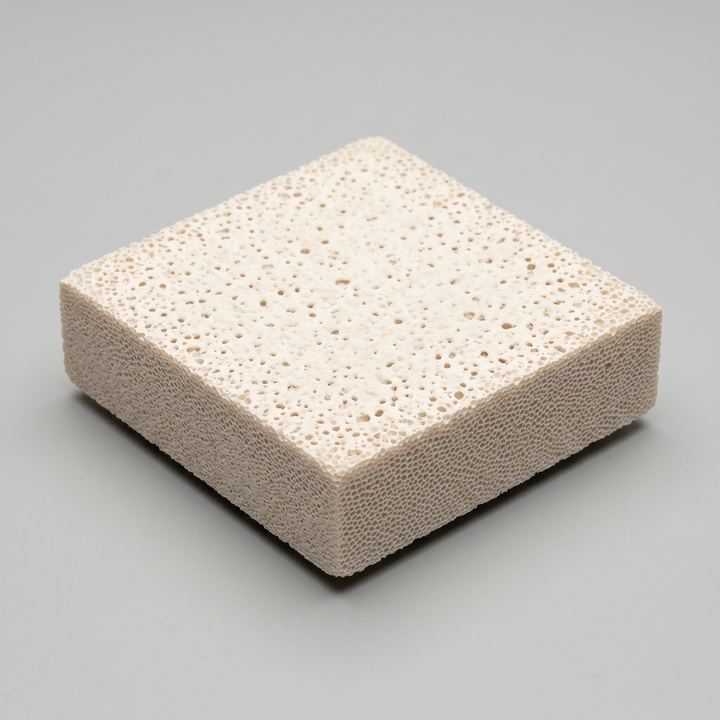
A neutral cool white body with a faint violet undertone from the gadolinium host — unsaturated at daylight, but with a legible glow signature when the UV channel is driven from below. At 0.827 g/cm³ the 120×120×84 mm block lifts almost one-handed, close in hand-feel to a dense softwood offcut rather than a conventional ceramic tile. Surface vitrified skin, satin-matte with a fine mottling from the tungstate phase at the outer micron. Edges cold-cut, kerf-powdered and chalky. Against an ordinary tungstate ceramic the body reads lighter in lift but denser in ring, and the low-voltage switched state shifts the face to a tinted blue-grey under sustained drive.
Recipe
100 g batch · peak 1200 °C| element | precursor | formula | mass | safety |
|---|---|---|---|---|
| Gd | gadolinium oxide | Gd2O3 | 70.11 g | moderate |
| W | tungsten trioxide (yellow) | WO3 | 29.89 g | moderate |
- 1Ramp
- 2Hold
- 3Ramp
- 4Ramp
- 5Hold
- 6Ramp
- 7Ramp
UV-luminescent — emits visible light under 365 nm UV
Electrochromic — color switches under applied voltage (thin-film chemistry)