Bi₅CuNd₁₀PSn
metal pm only · sintered metalBi5Cu1Nd10P1Sn1 is a metal pm only suitable as sintered-metal. Color: green-red-copper. Fired at 1100°C from 5 precursors (Nd, Bi, Fe3P). Workshop batch: 200g at €8.21. Compressive strength ~350 MPa; estimated 0.84 kg CO₂/kg (-53% vs structural steel). Notable: no special functions flagged. Confidence: medium.
- forms at
- 1100 °C · high-fire
- replaces
- structural steel
- CO₂
- 53.1% lower than structural steel (0.84 vs 1.80 kg CO₂/kg)
- energy
- 74.4% lower than structural steel (5.62 vs 26.00 MJ/kg)
- compressive
- 350 MPa
- density
- 0.85 g/cm³
- crystal
- monoclinic
- band gap
- 0.00 eV
- cost
- €41.05/kg · €8.21 / 200 g batch
- confidence
- medium (synthesis route)
- potential
- 0.45 · env 0.74 · novel 0.00 · struct 0.84 · lineage 0.20 · supply 0.50
Architectural potential
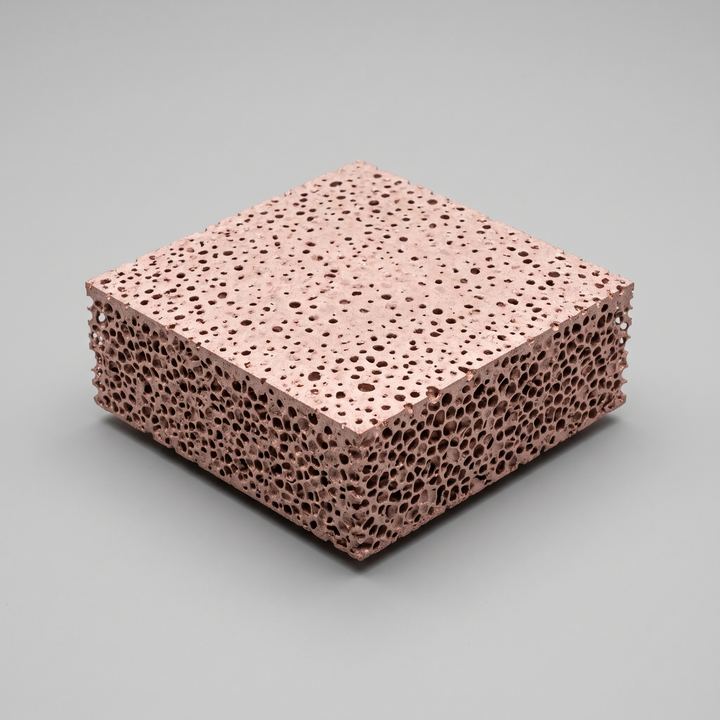
This is a powder-pressed metal body fired to 1100 °C, sitting in the register of brackets, clips, furniture joints and connector nodes rather than primary structure. At 350 MPa of compression and a fifty-three-per-cent cut in embodied CO₂ against structural steel, the material's argument is the replacement of welded mild-steel hardware with a single sintered node — façade clips, balustrade brackets, structural seat-angle fittings, timber-to-steel connector pieces, custom hardware for bespoke joinery. The neodymium content pushes the alloy toward fine-cast geometry that cast steel struggles to hold: thin-walled clip geometries, undercut brackets, compact nodes for reciprocal timber frames. The 120×120×82 mm slab form is the blank; real parts are milled and finish-worked out of that sinter. Natural places are hardware-heavy projects where the tectonic asks to be read at close range — staircases, gallery rail-fittings, exposed timber joints, rooftop pavilion frames. The caveat is density: at 0.847 g/cm³ this sinter is unusually low for its family, pointing toward significant residual porosity that needs verification before structural specification. Medium confidence on the strength figure, and batches top out at 500 g — signature-element scale, not bulk hardware production.
Material character
The slab carries a mottled green-red-copper surface: neodymium greys interleaved with copper-bismuth warmth, reading closer to a weathered bronze patina than to freshly cast brass. At only 0.847 g/cm³ the 120×120×82 mm form is disconcertingly light in the hand — softwood register rather than metal — which betrays the sinter's residual porosity and sets it apart from the dense, cold-weight signature of cast bronze or forged steel. Skin sintered matte, slightly granular under raking light; edges cold-cut with the fine powder bloom left along the kerf. Distinct from the dense neodymium-steel siblings, where the same colour would arrive at five or six times the mass.
Recipe
200 g batch · peak 1100 °C| element | precursor | formula | mass | safety |
|---|---|---|---|---|
| Bi | bismuth metal | Bi | 36.43 g | safe |
| Cu | copper shot/powder | Cu | 2.22 g | safe |
| Nd | neodymium metal | Nd | 50.29 g | moderate |
| P | ferrophosphorus (liquid-phase sintering aid) | Fe3P | 6.92 g | safe |
| Sn | tin ingot | Sn | 4.14 g | safe |
- 1Ramp
- 2Hold
- 3Ramp
- 4Hold
- 5Ramp
- 6Ramp
- 7END