Mg₂Na₁₄S₉
sulfide polysulfide · sulfide low tempMg2Na14S9 is a sulfide polysulfide suitable as sulfide low temp. Color: yellow-orange. Fired at 130°C from 3 precursors (Na2CO3, S, MgCO3). Workshop batch: 500g at €8.62. Compressive strength ~50 MPa; estimated 0.09 kg CO₂/kg (-89% vs Portland cement). Notable: forms without a kiln. Confidence: high.
- forms at
- 130 °C · hotplate · no kiln
- replaces
- portland cement
- CO₂
- 89.1% lower than Portland cement (0.09 vs 0.83 kg CO₂/kg)
- energy
- 89.1% lower than Portland cement (0.60 vs 5.50 MJ/kg)
- compressive
- 50 MPa
- density
- 1.80 g/cm³
- crystal
- trigonal
- band gap
- 2.56 eV
- cost
- €17.24/kg · €8.62 / 500 g batch
- confidence
- high (synthesis route)
- potential
- 0.71 · env 1.00 · novel 1.00 · struct 0.10 · lineage 0.70 · supply 0.27
- flags
- zero kiln: Forming happens without firing — the material cures through chemistry at ambient or hotplate temperature. At building scale this removes the kiln from the supply chain: on-site casting, regional workshops, cold-country fabrication all become available.
Architectural potential
A zero-kiln sodium-rich polysulfide cast at 130 °C on a hotplate, with an eighty-nine-per-cent cut in embodied CO₂ against Portland cement. Compression sits at fifty megapascals, so this is not a structural body but a detail-scale cast element: drop-cast floor tile for pavilion interiors, cast inlay strips in timber thresholds, non-load-bearing partition panels in exhibition architecture, thick skirtings and sill pieces in retrofit work where the kiln is two hours away and the fire regulations forbid it anyway. The architectural argument is the absence of firing: the same slow weight and geological reading as a cement-bound tile, achieved in a warm studio with a single hotplate and a plywood mould. Against Portland cement the logistics change completely — no silo, no water demand at scale, no calcination carbon — and for regional workshops in cold-country conditions this opens block-work at garden-pavilion scale without a kiln yard. The caveat is double: saw-cutting releases sulphide odour so ventilation is non-negotiable, and the supply-chain score for sodium-heavy sulphide precursors sits below 0.3, limiting this to signature tile runs rather than bulk cladding. At two kilograms maximum workshop batch the reach is real but specifically bounded.
Material character
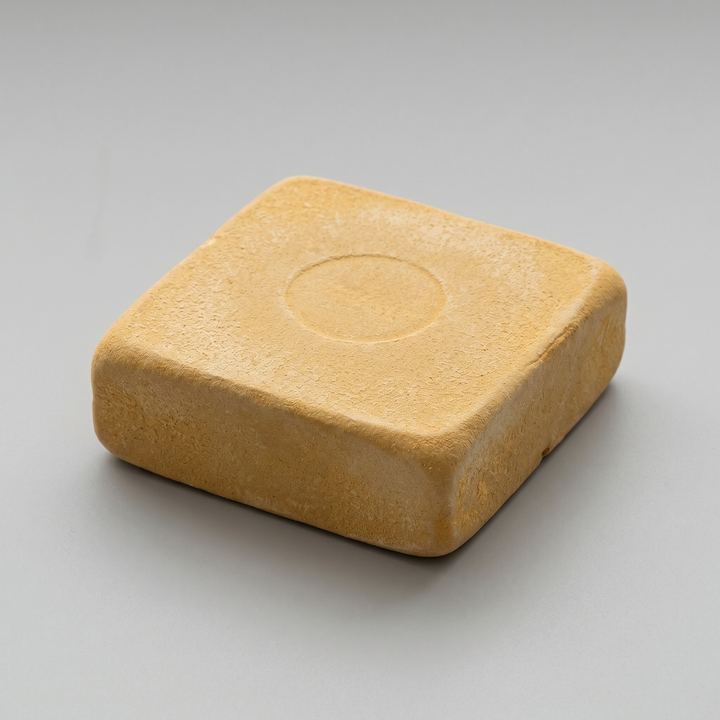
A warm yellow-orange body at 1.80 g/cm³ — unusually light for the family, closer to a dense softwood than to cement in the hand. The 100×100×56 mm slab lifts single-handed without strain, a notable step down from the 3.92 g/cm³ copper-heavy siblings. Surface reads cast mold-matte with the low meniscus sheen of a hotplate pour; edges as-cast, softly rounded where the sulphide melt pulled slightly from the mould wall. The colour is saturated and even, with a faint powdery surface bloom of α-sulphur that catches side-light. Fully opaque through the depth. Against the denser polysulfides the hand-feel is markedly softer and the acoustic register duller when tapped.
Recipe
500 g batch · peak 130 °C| element | precursor | formula | mass | safety |
|---|---|---|---|---|
| Mg | magnesium carbonate | MgCO3 | 18.52 g | safe |
| Na | sodium carbonate / soda ash | Na2CO3 | 81.48 g | safe |
- Pre-heatHotplate to 150 °C
- MeltSulfur liquefies at 115 °C; full liquid at 130 °C
- CastPour at 140–145 °C
- SetRoom temperature 30 min (firm) → 24 h (full strength)
Zero-kiln process — 130 °C hotplate cast only