Mn₂O₂Pr₈Se₁₂
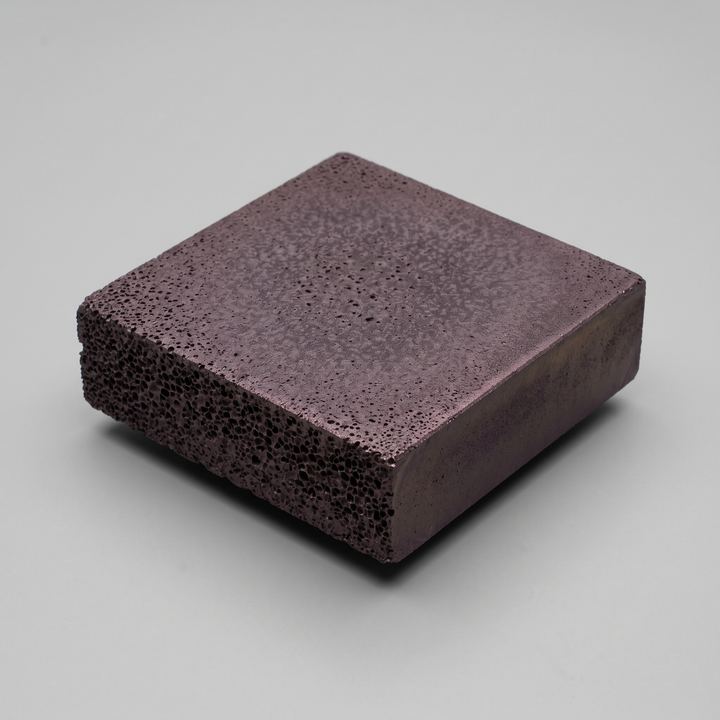
rare earth oxide · rare earth ceramicMn2O2Pr8Se12 is a rare earth oxide suitable as rare earth ceramic. Color: purple-brown. Fired at 1200°C from 3 precursors (Pr6O11, Se, MnO2). Workshop batch: 100g at €26.85. Compressive strength ~100 MPa; estimated 0.90 kg CO₂/kg (+309% vs clay brick). Notable: uv luminescent. Confidence: medium.
- forms at
- 1200 °C · high-fire
- replaces
- clay brick
- CO₂
- 309% higher than clay brick (0.90 vs 0.22 kg CO₂/kg; 4.1× higher)
- energy
- 100% higher than clay brick (6.00 vs 3.00 MJ/kg; 2.0× higher)
- compressive
- 100 MPa
- density
- 0.63 g/cm³
- crystal
- hexagonal
- band gap
- 2.02 eV
- cost
- €268.50/kg · €26.85 / 100 g batch
- confidence
- medium (synthesis route)
- potential
- 0.26 · env 0.00 · novel 0.57 · struct 0.20 · lineage 0.50 · supply 0.10
- flags
- uv luminescent: Converts invisible ultraviolet into visible light. Signage panels, low-energy wayfinding tiles, emergency markings that draw their illumination from daylight rather than mains power.
Architectural potential
This material only makes architectural sense as a luminescent signage or wayfinding element — the embodied CO₂ runs four times that of a clay brick at a hundred megapascals of compression, so the case for specification lives entirely in the UV-luminescent praseodymium chemistry it carries. Invisible ultraviolet excitation converts to visible emission in the purple-red range, which at building scale means emergency egress markings that draw illumination from ambient daylight rather than mains power, low-energy wayfinding tiles along stair nosings and corridor thresholds, signage panels in memorial and ritual interiors where the luminescence becomes part of the spatial register. Natural placements are single-tile patches and line-work details, not volume elements. The 0.626 g/cm³ density signals a porous sintered body — closer to a lightweight signage tile than to a structural ceramic — which supports the small-area wayfinding reading directly. Against clay brick the material is unusable at any volume; specified as a 85×100 mm letterform, a 20 mm threshold strip, or a single accent patch in a cladding field, the argument becomes legible. The caveat is precursor rarity: praseodymium in the raw-material list drops the supply-chain score to 0.14, batch is 100 g maximum at a 300 g workshop ceiling, and €26.85 per batch puts every letterform into signature-element costing.
Material character
A purple-brown body with a dusty, slightly dry surface — the selenide content darkens the praseodymium signature toward a smoky aubergine rather than the usual rare-earth creamy tones. At 0.626 g/cm³ and 120×120×111 mm the block is genuinely light for its size, single-hand-liftable with almost no register of effort, closer to a dense insulation block than to a fired ceramic tile. Skin reads sintered matte with visible pore texture at close range; edges come cold-cut with powdery kerf residue rather than the clean bloom of a dense body. Under 365 nm UV excitation the purple-red emission rises from inside the face rather than the surface.
Recipe
100 g batch · peak 1200 °C| element | precursor | formula | mass | safety |
|---|---|---|---|---|
| Mn | manganese dioxide | MnO2 | 7.0 g | moderate |
| Pr | praseodymium oxide | Pr6O11 | 54.84 g | moderate |
| Se | selenium (elemental) | Se | 38.16 g | moderate |
- 1Ramp
- 2Hold
- 3Ramp
- 4Ramp
- 5Hold
- 6Ramp
- 7Ramp
UV-luminescent — emits visible light under 365 nm UV