C₂Ce₂Fe₂Mn₂Si₂
metal pm only · sintered metalC2Ce2Fe2Mn2Si2 is a metal pm only suitable as sintered-metal. Color: neutral. Fired at 1100°C from 5 precursors (Ce, Fe, Mn). Workshop batch: 200g at €6.38. Compressive strength ~250 MPa; estimated 0.84 kg CO₂/kg (-53% vs structural steel). Notable: shape memory FeMnSi. Confidence: medium.
- forms at
- 1100 °C · high-fire
- replaces
- structural steel
- CO₂
- 53.1% lower than structural steel (0.84 vs 1.80 kg CO₂/kg)
- energy
- 74.4% lower than structural steel (5.62 vs 26.00 MJ/kg)
- compressive
- 250 MPa
- density
- 6.95 g/cm³
- crystal
- monoclinic
- band gap
- 0.00 eV
- cost
- €31.90/kg · €6.38 / 200 g batch
- confidence
- medium (synthesis route)
- potential
- 0.62 · env 0.74 · novel 0.80 · struct 0.60 · lineage 0.20 · supply 0.50
- flags
- shape memory FeMnSi: Deforms on cue and snaps back to a remembered shape when warmed. Deployable canopies, self-tensioning fasteners, seismic-damping brackets, and geometry-changing envelopes all become mechanically possible.
Architectural potential
A cerium-doped shape-memory sintered alloy in the FeMnSi-C family, fired at 1100 °C to 250 MPa with a fifty-three-per-cent cut in embodied CO₂ and a seventy-four-per-cent cut in energy against structural steel. Cerium in the matrix sharpens the transformation behaviour: the part's reset to its remembered shape on warming becomes more reliable across cycles, which lifts the architectural case beyond one-shot activation into repeatable service. Natural placements are therefore seismic-damping brackets in retrofit fittings for masonry façades, deployable canopy hinges that re-tension with each sun cycle, self-closing vent louvres in passive stack-ventilation shafts, and connector nodes in temporary exhibition structures that re-seat after every transport. The steel comparison sets the environmental argument — lighter on carbon and markedly lighter on energy — but the specification argument is functional rather than environmental: the piece earns its place by moving, not by standing still. The caveat is 200 g batches to a 500 g ceiling and a verification requirement on the transformation-temperature envelope of each cast node, so this is one-signature-element hardware rather than repeated fastener stock. Carbon at the two-of-twelve molar ratio hints at a cast-iron-adjacent embrittlement risk that thermal cycling has to be tested against before structural use.
Material character
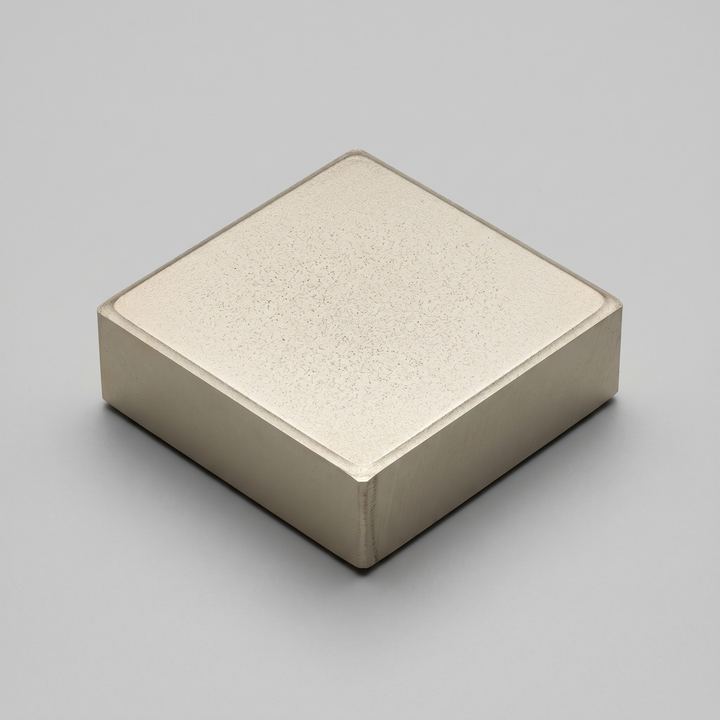
Neutral toward a cool carbon-grey — darker than the erbium-modified FeMnSi sibling, with the muted sheen that carbon content gives to a cerium-silicate-modified iron sinter. At 6.95 g/cm³ and 70×70×29 mm the slab sits stably two-handed on the bench, slightly lighter in hand than the erbium version of the same family despite the near-identical footprint. Skin carries the fine sintered matte grain of a pressed-and-fired powder body; the cerium fraction gives a slight warm tint under raking light that the pure FeMnSi matrix lacks. Edges cold-cut, kerf clean, with a faint graphite smudge from the carbon fraction where the blade has passed through the sintered body. Rings briefly on tap, a cleaner acoustic than the porous-sinter entries in this batch.
Recipe
200 g batch · peak 1100 °C| element | precursor | formula | mass | safety |
|---|---|---|---|---|
| C | graphite powder | C | 4.13 g | safe |
| Ce | cerium metal | Ce | 48.15 g | moderate |
| Fe | iron powder -325 mesh | Fe | 19.19 g | moderate |
| Mn | manganese flakes | Mn | 18.88 g | moderate |
| Si | silicon granules | Si | 9.65 g | safe |
- 1Ramp
- 2Hold
- 3Ramp
- 4Hold
- 5Ramp
- 6Ramp
- 7END
Shape-memory — deformed body recovers on heating (Fe-Mn-Si)