FeMn₃P₂Si₂Zr₄
metal pm only · sintered metalFe1Mn3P2Si2Zr4 is a metal pm only suitable as sintered-metal. Color: neutral. Fired at 1100°C from 4 precursors (Fe3P, Mn, Si). Workshop batch: 200g at €2.54. Compressive strength ~250 MPa; estimated 0.84 kg CO₂/kg (-53% vs structural steel). Notable: shape memory FeMnSi. Confidence: medium.
- forms at
- 1100 °C · high-fire
- replaces
- structural steel
- CO₂
- 53.1% lower than structural steel (0.84 vs 1.80 kg CO₂/kg)
- energy
- 74.4% lower than structural steel (5.62 vs 26.00 MJ/kg)
- compressive
- 250 MPa
- density
- 6.44 g/cm³
- crystal
- monoclinic
- band gap
- 0.00 eV
- cost
- €12.70/kg · €2.54 / 200 g batch
- confidence
- medium (synthesis route)
- potential
- 0.61 · env 0.74 · novel 0.80 · struct 0.60 · lineage 0.20 · supply 0.46
- flags
- shape memory FeMnSi: Deforms on cue and snaps back to a remembered shape when warmed. Deployable canopies, self-tensioning fasteners, seismic-damping brackets, and geometry-changing envelopes all become mechanically possible.
Architectural potential
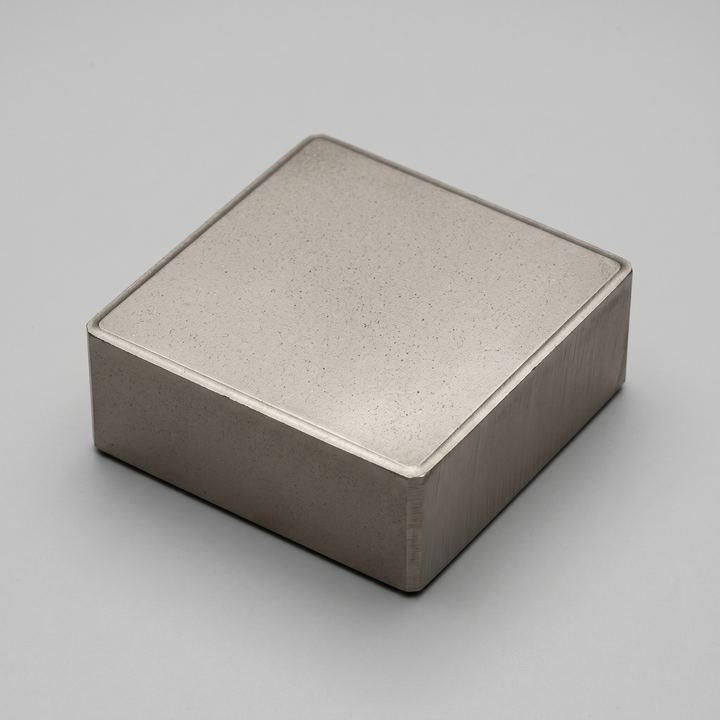
This is a sintered Fe-Mn-Si alloy with one specific architectural affordance: it deforms on cue and snaps back to its remembered shape when warmed. At 250 MPa of compression and a fifty-three-per-cent cut in embodied CO₂ against structural steel, the mechanical numbers already support use as bracketry and hardware — the shape-memory chemistry adds a second tectonic register entirely. Natural placements are seismic-damping brackets at beam-column joints that reset themselves after ground motion, self-tensioning fasteners that pre-load against timber shrinkage as the fitting warms with the room, deployable canopy hinges that open on heating, and geometry-changing envelope clips that hold two configurations — summer and winter — for the same façade. The 70×70×32 mm slab is the billet; parts are milled out of it. At a cost of €2.54 per 200 g batch, the material is unusually affordable for an alloy carrying this kind of behaviour. The caveat is workshop ceiling and confidence: batches top out at 500 g, placing specification firmly in the signature-bracket register rather than bulk hardware runs, and medium confidence on the shape-memory transition temperatures means real thermal-cycle testing is needed before any seismic or deployable use is committed to.
Material character
The slab reads a neutral iron-grey body with the faintly warm undertone that zirconium carries into an Fe-Mn alloy, distinct from the cooler blue-grey of plain sintered steel. At 6.44 g/cm³ and 70×70×32 mm the piece sits with the dense cold-weight signature expected of the family — two-hand grip, firmly mineral. Skin finishes sintered matte with a fine granular texture under raking light; edges cold-cut, the diamond-saw powder left along the kerf. Against the Bi-Cu-Nd sibling in the same family the density register is entirely different: this one drops into the hand with the dead weight of mild steel, not the softwood lightness of the porous neodymium sinter.
Recipe
200 g batch · peak 1100 °C| element | precursor | formula | mass | safety |
|---|---|---|---|---|
| Fe | iron powder -325 mesh | Fe | 8.29 g | moderate |
| Mn | manganese flakes | Mn | 24.46 g | moderate |
| P | ferrophosphorus (liquid-phase sintering aid) | Fe3P | 58.92 g | safe |
| Si | silicon granules | Si | 8.34 g | safe |
- 1Ramp
- 2Hold
- 3Ramp
- 4Hold
- 5Ramp
- 6Ramp
- 7END
Shape-memory — deformed body recovers on heating (Fe-Mn-Si)