C₂Fe₃MnSi₂Y₂
metal pm only · sintered metalC2Fe3Mn1Si2Y2 is a metal pm only suitable as sintered-metal. Color: neutral. Fired at 1100°C from 5 precursors (Y, Fe, Si). Workshop batch: 200g at €5.37. Compressive strength ~50 MPa; estimated 0.84 kg CO₂/kg (-53% vs structural steel). Notable: shape memory FeMnSi. Confidence: medium.
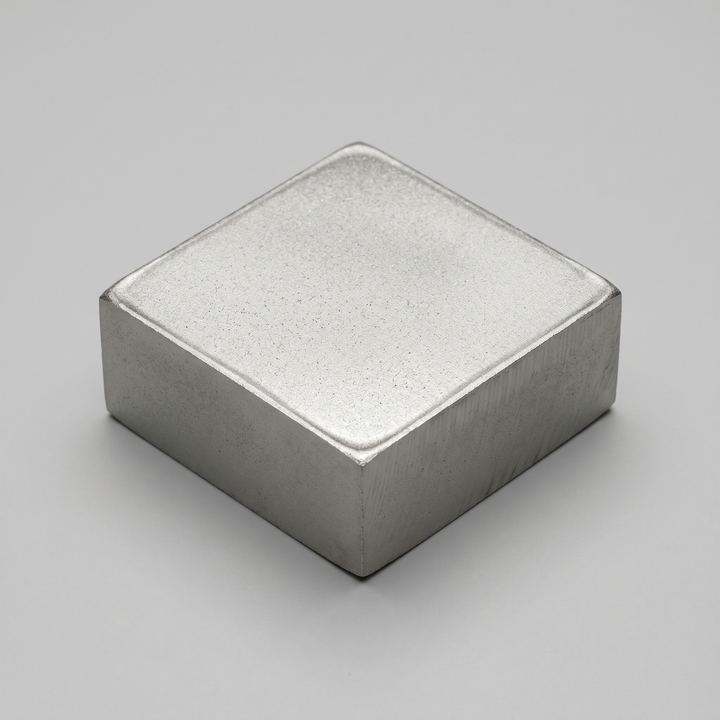
- forms at
- 1100 °C · high-fire
- replaces
- structural steel
- CO₂
- 53.1% lower than structural steel (0.84 vs 1.80 kg CO₂/kg)
- energy
- 74.4% lower than structural steel (5.62 vs 26.00 MJ/kg)
- compressive
- 50 MPa
- density
- 5.95 g/cm³
- crystal
- monoclinic
- band gap
- —
- cost
- €26.85/kg · €5.37 / 200 g batch
- confidence
- medium (synthesis route)
- potential
- 0.55 · env 0.74 · novel 0.80 · struct 0.12 · lineage 0.20 · supply 0.50
- flags
- shape memory FeMnSi: Deforms on cue and snaps back to a remembered shape when warmed. Deployable canopies, self-tensioning fasteners, seismic-damping brackets, and geometry-changing envelopes all become mechanically possible.
Architectural potential
A powder-pressed iron-manganese-silicon steel with yttrium and carbon additions, sintered at 1100 °C into brackets, clips, joints, and small structural fittings. Fifty megapascals of compression keeps it out of primary-column territory, but the role is connection rather than span: façade clips, furniture nodes, cladding substructure, hardware for timber joinery. The decisive capability is the iron-manganese-silicon shape-memory behaviour — a deformation cued by temperature that snaps the part back to a remembered geometry on warming. Architecturally this opens the door to self-tensioning fasteners, deployable canopy brackets, and seismic-damping mounts that absorb movement and recover their original set afterwards. Natural placements are earthquake-retrofit connection pieces, deployable shading hardware for south-facing façades, self-tightening timber connectors, and bracket sets for kinetic envelopes where the bracket itself carries the active geometry. Against cast or welded structural steel the embodied CO₂ runs fifty-three per cent lower and the energy seventy-four per cent lower, so the trade is favourable before the shape-memory function is even counted. The caveat is batch size and confidence: 200 g per press, 500 g workshop ceiling, MEDIUM confidence on the performance numbers, and cycle-life under real seismic loading remains untested in architectural production.
Material character
The slab reads a neutral dark grey with the warm graphitic sheen typical of an iron-rich sintered body — closer to a mild-steel plate than to the silvery powder metallurgies of nickel or aluminium. At 5.95 g/cm³ in a 70×70×34 mm format the piece feels compact and solid in the hand, noticeably lighter than a cast-steel reference of the same footprint but denser than a ceramic equivalent. Surface sintered matte with a visible grain from the pressing dies; edges machined clean and slightly burnished where the saw has caught. Fully opaque. Against a conventionally cast FeMnSi alloy the sintered skin is the distinguishing tell — no flow lines, only a powder-compacted texture.
Recipe
200 g batch · peak 1100 °C| element | precursor | formula | mass | safety |
|---|---|---|---|---|
| C | graphite powder | C | 5.0 g | safe |
| Fe | iron powder -325 mesh | Fe | 34.87 g | moderate |
| Mn | manganese flakes | Mn | 11.43 g | moderate |
| Si | silicon granules | Si | 11.69 g | safe |
| Y | yttrium metal | Y | 37.01 g | moderate |
- 1Ramp
- 2Hold
- 3Ramp
- 4Hold
- 5Ramp
- 6Ramp
- 7END
Shape-memory — deformed body recovers on heating (Fe-Mn-Si)