Cu₄La₁₁Si₆
metal pm only · sintered metalCu4La11Si6 is a metal pm only suitable as sintered-metal. Color: green-red-copper. Fired at 1100°C from 3 precursors (La, Cu, Si). Workshop batch: 200g at €8.96. Compressive strength ~350 MPa; estimated 0.84 kg CO₂/kg (-53% vs structural steel). Notable: no special functions flagged. Confidence: medium.
- forms at
- 1100 °C · high-fire
- replaces
- structural steel
- CO₂
- 53.1% lower than structural steel (0.84 vs 1.80 kg CO₂/kg)
- energy
- 74.4% lower than structural steel (5.62 vs 26.00 MJ/kg)
- compressive
- 350 MPa
- density
- 0.59 g/cm³
- crystal
- monoclinic
- band gap
- 0.00 eV
- cost
- €44.80/kg · €8.96 / 200 g batch
- confidence
- medium (synthesis route)
- potential
- 0.45 · env 0.74 · novel 0.00 · struct 0.84 · lineage 0.20 · supply 0.50
Architectural potential
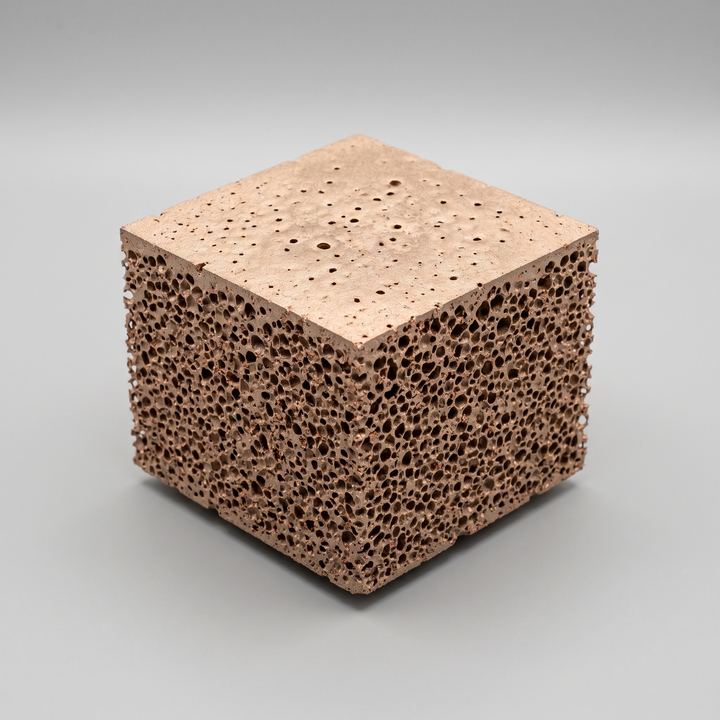
The extreme outlier of the furnace-sintered powder-metal set: at 0.59 g/cm³ and a 120×120×118 mm block this is foam-register rather than solid-metal register, and the architectural reading shifts accordingly. Three hundred and fifty megapascals of compression with the weight of dense softwood is the structural anomaly worth designing around — acoustic-damping panel cores in concert halls and recording spaces, lightweight connector nodes in long-span roof frames where dead load matters, furniture joint blocks that read as metal but lift like balsa, crash-barrier inserts in transport architecture. Against structural steel the CO₂ falls by fifty-three per cent and the energy budget by three-quarters, but this material is not steel: the compression is real, the stiffness is not — use where absorption matters more than modulus. The lanthanum-copper-silicide chemistry gives the body a coppery-green cast and opens specialty functional behaviour at thin-section scale, though no specific flag is recorded here. Natural placements are the detail and panel scale, not the frame. The caveat is cost: €8.96 per 200 g batch at a 500 g maximum workshop output, plus lanthanum in the precursor list drops the supply-chain score to 0.71 — not catastrophic, but restrictive enough that specification belongs to signature details rather than repeated hardware series.
Material character
Green-red-copper across both faces with a diffuse, slightly dusty appearance — the low density signals genuine open porosity in the sinter, and the colour reads lighter and less saturated than the dense zinc-copper siblings. At 0.59 g/cm³ the 120×120×118 mm block lifts one-handed with almost no register of effort, a balsa-wood register in metal, which is the surprise that defines hand-feel. Surface sintered matte with visible pore texture at close range, not the closed grain of a dense powder press. Edges come softer than the dense siblings, chamfered more by the powder route itself than by finishing. The tap is muted, closer to fibreboard than to metal plate.
Recipe
200 g batch · peak 1100 °C| element | precursor | formula | mass | safety |
|---|---|---|---|---|
| Cu | copper shot/powder | Cu | 13.03 g | safe |
| La | lanthanum metal | La | 78.33 g | moderate |
| Si | silicon granules | Si | 8.64 g | safe |
- 1Ramp
- 2Hold
- 3Ramp
- 4Hold
- 5Ramp
- 6Ramp
- 7END