C₂Mo₂Na₆O₁₄Si₂
heavy oxide ceramic · thermal mass ceramicC2Mo2Na6O14Si2 is a heavy oxide ceramic suitable as thermal mass ceramic. Color: neutral. Fired at 1250°C from 3 precursors (Na2CO3, MoO3, SiO2). Workshop batch: 200g at €13.93. Compressive strength ~500 MPa; estimated 0.94 kg CO₂/kg (+326% vs clay brick). Notable: no special functions flagged. Confidence: medium.
- forms at
- 1250 °C · high-fire
- replaces
- clay brick
- CO₂
- 326% higher than clay brick (0.94 vs 0.22 kg CO₂/kg; 4.3× higher)
- energy
- 108% higher than clay brick (6.25 vs 3.00 MJ/kg; 2.1× higher)
- compressive
- 500 MPa
- density
- 3.15 g/cm³
- crystal
- monoclinic
- band gap
- —
- cost
- €69.65/kg · €13.93 / 200 g batch
- confidence
- medium (synthesis route)
- potential
- 0.32 · env 0.00 · novel 0.00 · struct 1.00 · lineage 0.50 · supply 0.65
Architectural potential
A thermal-mass ceramic in the heavy-oxide register, pitched to the passive-solar and radiant-heat-storage role. Five hundred megapascals of compression with a mass density of 3.15 g/cm³ puts it well above brick for thermal-flywheel capacity, but the CO₂ cost is high — over three times that of a clay brick — so the argument cannot be an environmental one. The case has to be functional: a south-facing trombe-wall infill that shifts peak heat release by six to eight hours, a hypocaust-style radiant slab in a gallery or chapel floor, a night-flush cooling core in a double-skin façade, or a heat-storage panel set behind a solar-collector glazing. The sodium-molybdenum-silicate matrix densifies at 1250 °C and gives the slab genuine compressive capacity alongside its thermal behaviour, so the panel is self-carrying rather than frame-supported, which simplifies detailing in retrofit work. Supplement, not replacement: this is not a substitute for insulation; it lives behind or within the insulated envelope and does its work over the diurnal cycle. The caveat is triple: high firing energy, high material cost at €13.93 per 200 g, and untested at wall scale in architectural production. Specification belongs to prototype thermal-wall research and one-off signature elements rather than to repeated trombe infills.
Material character
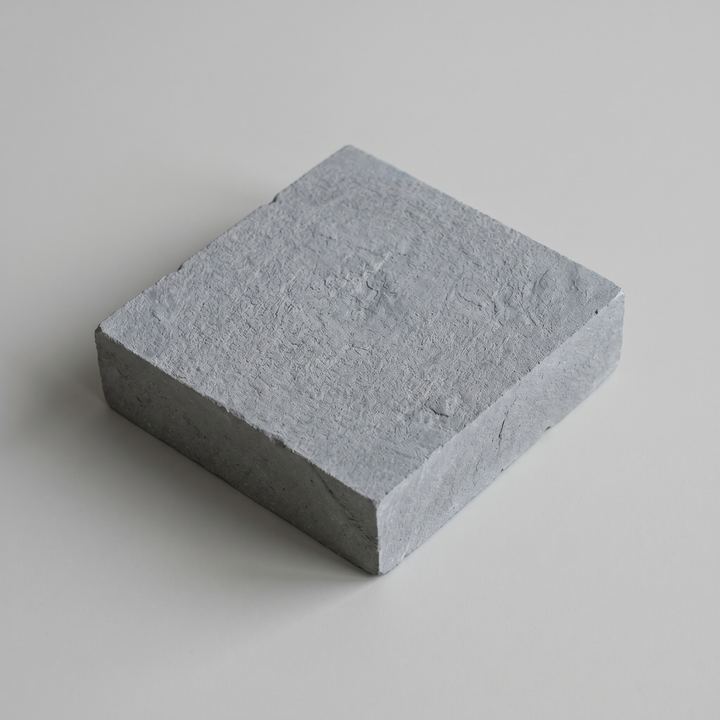
The fired body reads a neutral warm grey with a faint yellow undertone from the molybdate phase — not the orange-ochre of a clay brick, not the cool grey of concrete, something halfway between terracotta and pumice. At 3.15 g/cm³ and 85×85×44 mm the slab handles with real ceramic heft, a deliberate two-finger grip and a full-kilo weight in the lift. Surface finishes vitrified-matte from the 1250 °C hold, with a fine closed grain visible under raking light and a slight skin-darkening where the molybdate migrated to the face during the hold; edges cold-cut, kerf-whitened along the diamond-saw line. Tapped, it rings cleaner and higher than a clay brick of equal size — a denser, more mineral voice, closer to a stoneware than to a standard-fired brick.
Recipe
200 g batch · peak 1250 °C| element | precursor | formula | mass | safety |
|---|---|---|---|---|
| Mo | molybdenum trioxide | MoO3 | 39.65 g | moderate |
| Na | sodium carbonate / soda ash | Na2CO3 | 43.8 g | safe |
| Si | quartz flour / silica | SiO2 | 16.55 g | safe |
- 1Ramp
- 2Hold
- 3Ramp
- 4Ramp
- 5Hold
- 6Ramp
- 7Ramp